Ansys Assistant will be unavailable on the Learning Forum starting January 30. An upgraded version is coming soon. We apologize for any inconvenience and appreciate your patience. Stay tuned for updates.
General Mechanical

General Mechanical

Topics related to Mechanical Enterprise, Motion, Additive Print and more.

Modeling bearing between 2 disks

    • pouryatorabi
      Subscriber

      Hi everyone


      I'm a mechanical engineer but I studied the field of control, now I need to analyse a design using ansys and have a lot of problem, But the biggest one is that I don't know how to model a bearing between 2 surfaces.


      Consider I have 2 disks and they are connected with a cross roller bearing, I should I model this? should I model the bearing with a common disk and make friction contacts? And should I define the bearing as a rigid body?

    • peteroznewman
      Subscriber

      What answers do you want from the ANSYS model?


      Depending on the level of local detail around the bearing you need, you might model the races of the bearing and have contact between the race and the bearing seat face on each disk. If you don't need much local detail, but just need the two disks to rotate relative to one another, you can connect the disks with a revolute joint scoped to bearing seat faces on each disk.


      Bearings generally have low friction. Is friction important? 

    • pouryatorabi
      Subscriber

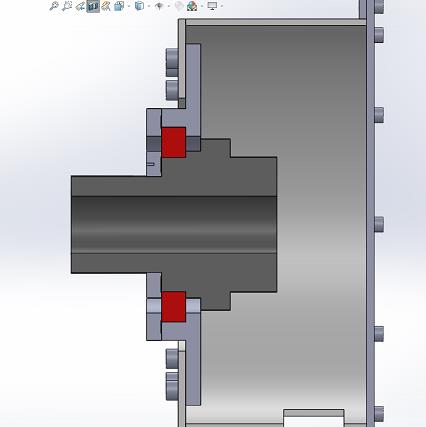
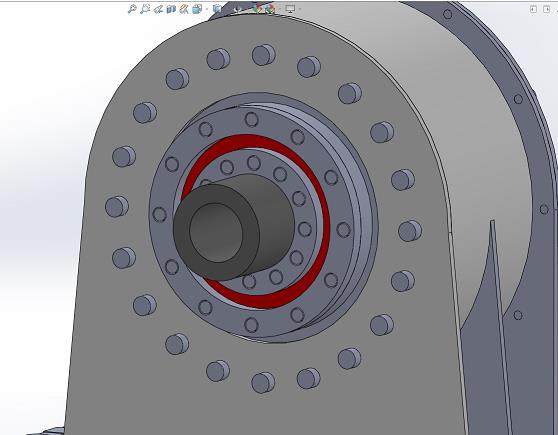
      I just want a static analysis, This is what I have:


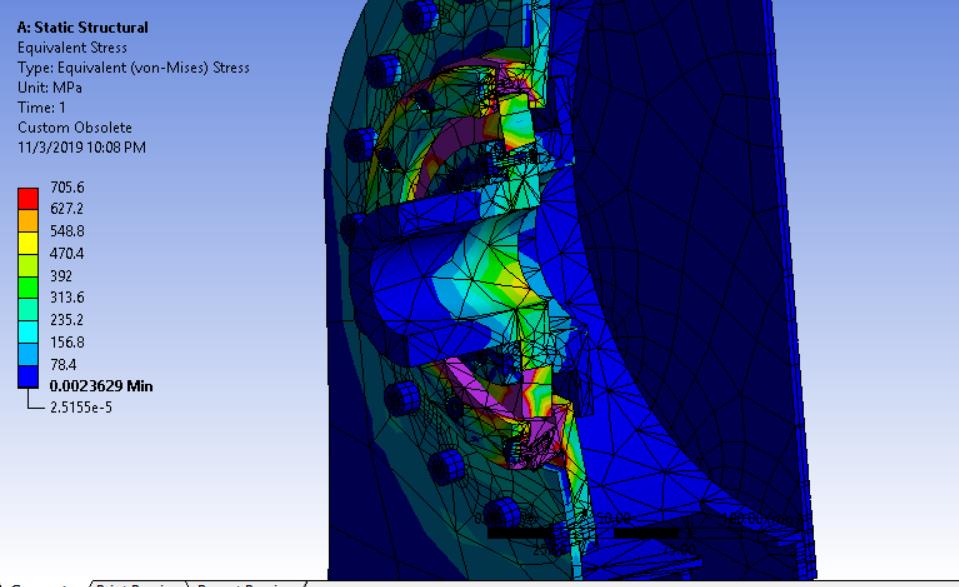
      The red one is a bearing, a cross roller bearing, I modeled it as a flexible disk and assigned steel material, but since it is flexible, it deforms and produce too much stress. I just don't know how to solve this model.

    • peteroznewman
      Subscriber

      A solid red ring of steel would have higher stiffness than a cross roller bearing.


      Are you using bonded contact to glue all the parts together?  That is a simple model that gives a quick result. The accuracy can be improved by adding more complexity to the model such as frictional contact and bolt pretension.


      When you use bonded contact, high stress can develop in a small region that is a result of over simplifying the model. As you add improvements, you can eliminate the high stress from the model.


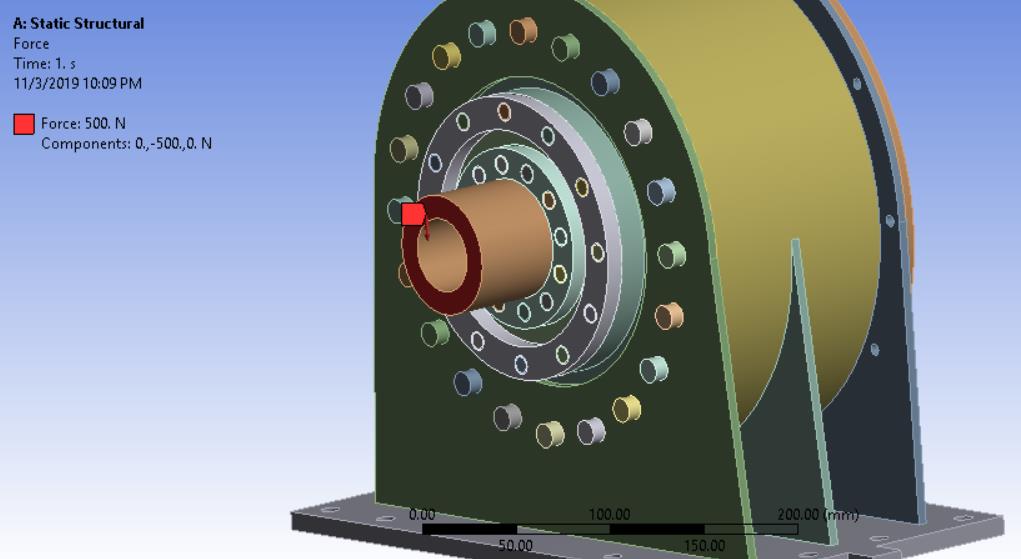
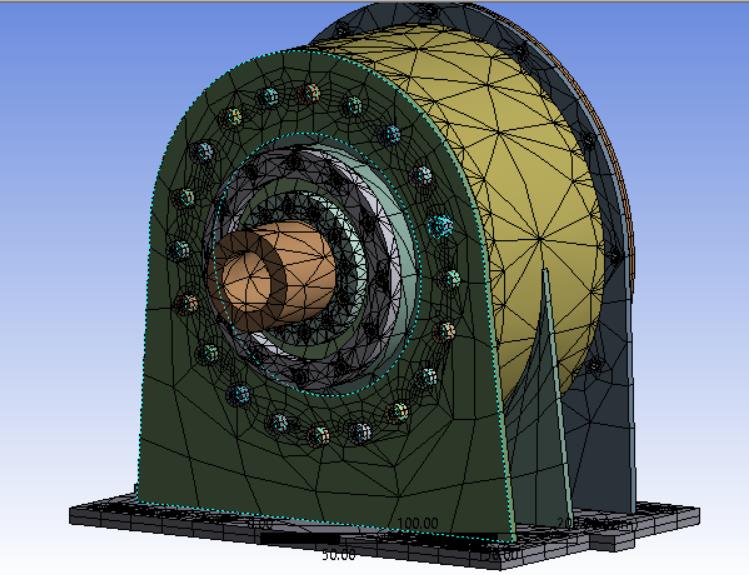
      Show an image of the stress and an image showing the mesh and an image showing the load.

    • pouryatorabi
      Subscriber

      I have applied pretension for bolts but it took too long so I omitted it, but when I use frictional contacts it shows me weird results, like 700 Mpa for equivalent stress only for 500 N force!!! Why is that? I have applied bonded only for welded parts and those that have thread for bolts (I don't remember what you call it ), I tried different friction coefficient but had no luck, here are some pics:


    • pouryatorabi
      Subscriber

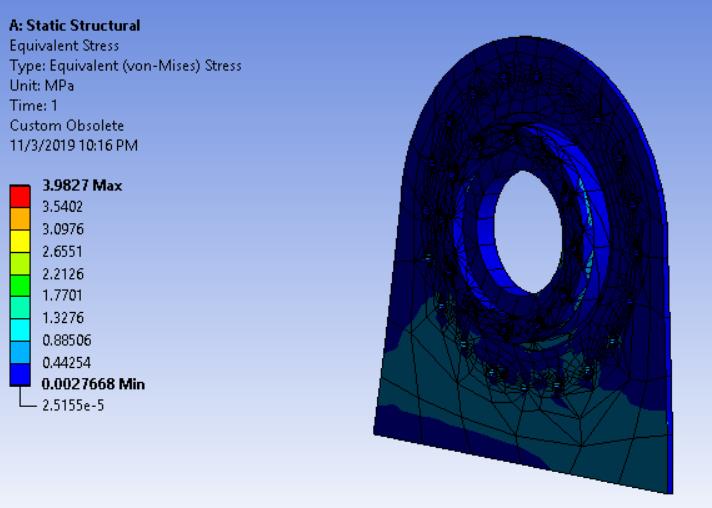
      I simplified the model, this is when all of them are bonded:


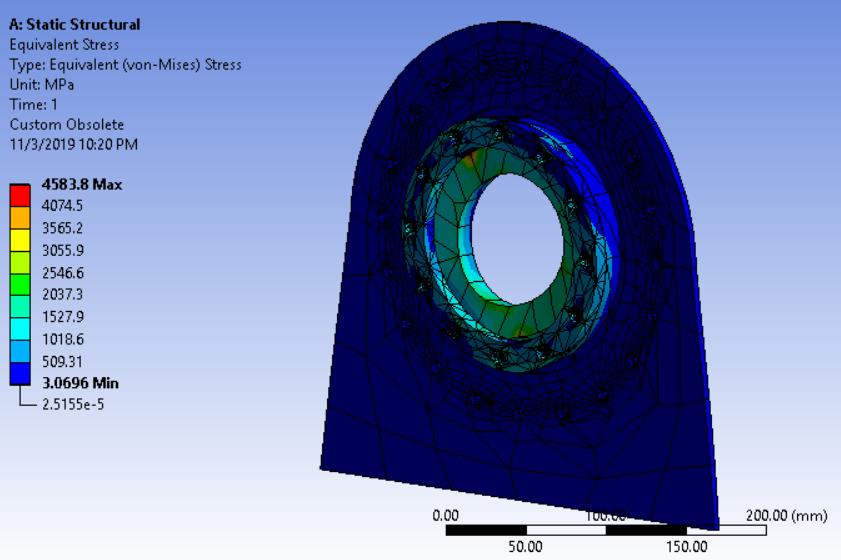
      And this is when I change bearing contacts to frictional:


    • peteroznewman
      Subscriber

      The light source in those views is on the right so surfaces of the model that face to the left are in shadow making it difficult to see detail. You could rotate the model to face to the right and they will have more light on them. Also if you change the color dark blue to light grey, that also makes it easier to see detail.


      You should use smaller elements around the locations where the high stress is observed by using sizing mesh controls on faces, edges, or Sphere of Influence to get more accuracy in the stress results after solving the model again.

    • pouryatorabi
      Subscriber

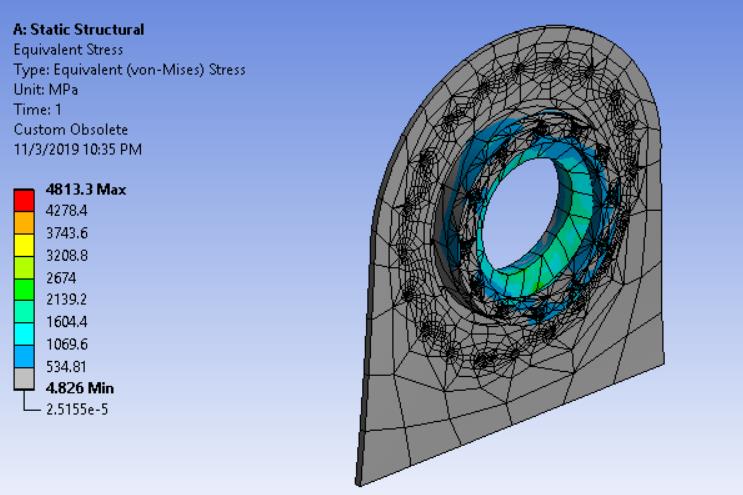
      Thanks for the tips, here is another image for the simplified model:


      But why is it 4813 Mpa when I use frictional, I tried smaller meshes but it's still too big, What am I missing?

    • peteroznewman
      Subscriber

      You still have a very coarse mesh. Look at the size of the elements around this bolt.


      You should continue to reduce the element size, but that could be a problem on the limited Student license.


      Do you have Student license or an unlimited license?


      Large elements and bonded contact can create artificial "hot spots" of stress.  This can be eliminated by using small elements and frictional contact.


      One way to limit the model size is to replace the thin-walled sheet with a midsurface model and mesh it with shell elements, while the bearing seat at the center and the bearing retaining parts with the bolts can remain solid bodies.


Viewing 8 reply threads
  • The topic ‘Modeling bearing between 2 disks’ is closed to new replies.
[bingo_chatbox]