-
-
February 27, 2024 at 1:35 pm
HS
SubscriberHi everyone,
I need some help in simulating intermixing of two miscible fluids in a microchannel. Naturally I searched a lot, here and on Google, but nowhere I find a definitive answer.
My geometry is a simple T-shaped microchannel (120 µm width, 40 µm height), with two inlets, and one outlet, similar to Figure4b and Figure4f here. One inlet is just water, the other one is a water-based ink solution (dilute, so that it basically does not change density and viscosity). Each inlet is at 0.5 m/s. As this two fluids are miscible I believe "Species - Species Transport" model (and not any multiphase model) must be used, without reaction. Flow is laminar, steady state, and solution method is SIMPLE.
Problem 1: My expected result, from literature, logic and experiments is that unless the length of microchannel is very long there must be minimal mixing of the two streams (please see the figures I linked above), and that mostly due to diffusion. Their intrface must get blurry and we go downstream, but a complete mixing across the channel width will not occur. Well, in fact in microfluidics mixing is a challenge, because viscose forces dominate convective terms. However, in my simulation I see a very fast mixing (within few micrometers from the juction whole channel is uniformly mixed), which is totally non-physical. Decreasing Mass Diffusivity in mixture-template does not help, even if I do that by several orders of magnitude.Â
Problem 2: In using species transport I should define the mixture template; ideally a mixture of two water-based liquids. But his seems to be impossible. Once I add water-liquid (h2o<1>), Fluent wouldn't let me add a second one into mixture template, saying h2o
is already there. So what I did was to use ethyl-alcohol-liquid (c2h5oh ) and change its accessible properties (density, viscosity,..) to that of water. Yet I am not sure this is the right approach. e.g., I don't know if Fluent takes the chemical formula into account and does some additional calculations based on it... Also species model seems mostly orientated to solve combustion and reactive situations... I suspect (but am not sure) that this issue is the root cause for the first problem. How should I simulate this situation? Any help/suggestion/recommendation is much appreciated.Â
-
February 27, 2024 at 1:50 pm
Rob
Forum ModeratorSpecies is the correct approach. In the materials panel open water and change the label to "water-ink" or similar and remove the chemical formula, click on the Change/Create button but do NOT overwrite. Now go back to the mixture and you can add water and water-ink. You need to review the diffusion coefficient as the default mixture is for gas and it's usually several orders of magnitude too high.Â
The chemical formula is a secondary check for species labelling. It is still used somewhere, but I generally just keep it if I need to remember what something is: eg benzene is C6H6.Â
-
February 29, 2024 at 9:13 am
HS
SubscriberThank you for the reply. Not owerwriting indeed helped me use creaste a "water-ink" based on water-liquid ineasted of waht I did previously (i.e. based on ethyl-alcohol). Also thanks for the information about chemical formula.
About the diffusion oefficient; as I mentioned in my first post, I have already decreased diffusion coefficient several orders of magnitude, so much so that if I try to decrease it any further I get an error that it cannot be zero; basically from 2.229e-9, which is actually correct for water in liquid phase to 2.229e-29. But this doesn't help and I see a unrealistically high diffusion and mixing of the two fluids.
The only imporvment I got was by making the mesh 2~3 times finer.
-
-
February 29, 2024 at 11:44 am
Rob
Forum ModeratorHaving too coarse a mesh will also incorrectly enhance diffusion as the solver accuracy is reduced. For a microchannel I'd be looking at 20+ cells across and ideally all hex mesh. Depending on the configuration 2d may be an option. There have been various papers on the subject, and University of Sheffield had several PhD projects in the late 90s - early 00s on micromixers.Â
-
February 29, 2024 at 12:04 pm
-
February 29, 2024 at 12:15 pm
Rob
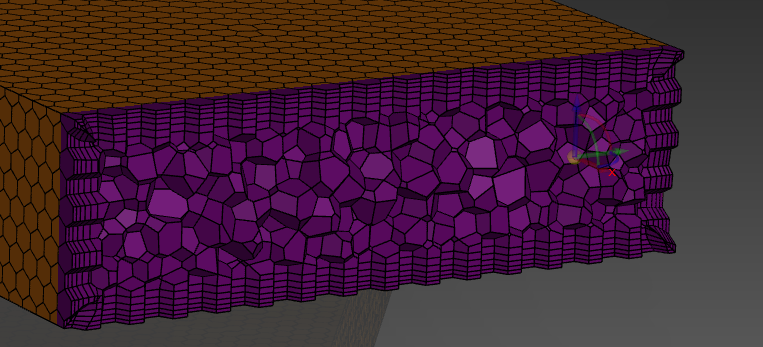
Forum ModeratorHmm, you may want to rethink using inflation. If the mixing is in the middle of the domain inflation won't help you. High aspect ratio cells (inflated mesh) aren't good either. Inflation is good for situations where nothing changes along a cell: in your case the species concentration will change along a cell.Â
-
February 29, 2024 at 12:54 pm
HS
SubscriberI'll try that. I should defenitly first optimize the mesh.
-
-
February 29, 2024 at 2:51 pm
Rob
Forum ModeratorJust remesh in Fluent Meshing after removing the inflation. Then write a mesh out & close Fluent Meshing. Open Fluent and load the old case file, then read the mesh and that should set up all of the materials, bc's etc. Run.Â
-
- The topic ‘Mixing of two miscible fluids’ is closed to new replies.
-
5879
-
1906
-
1420
-
1306
-
1021
© 2026 Copyright ANSYS, Inc. All rights reserved.