-
-
February 5, 2025 at 11:19 am
SR786
SubscriberHi,
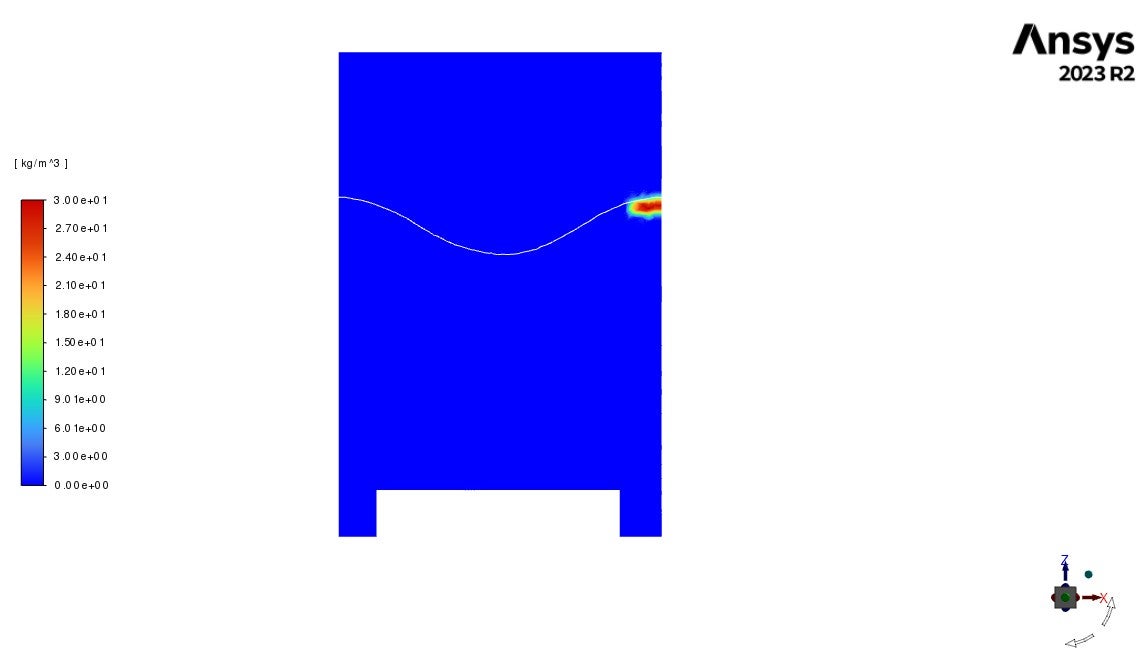
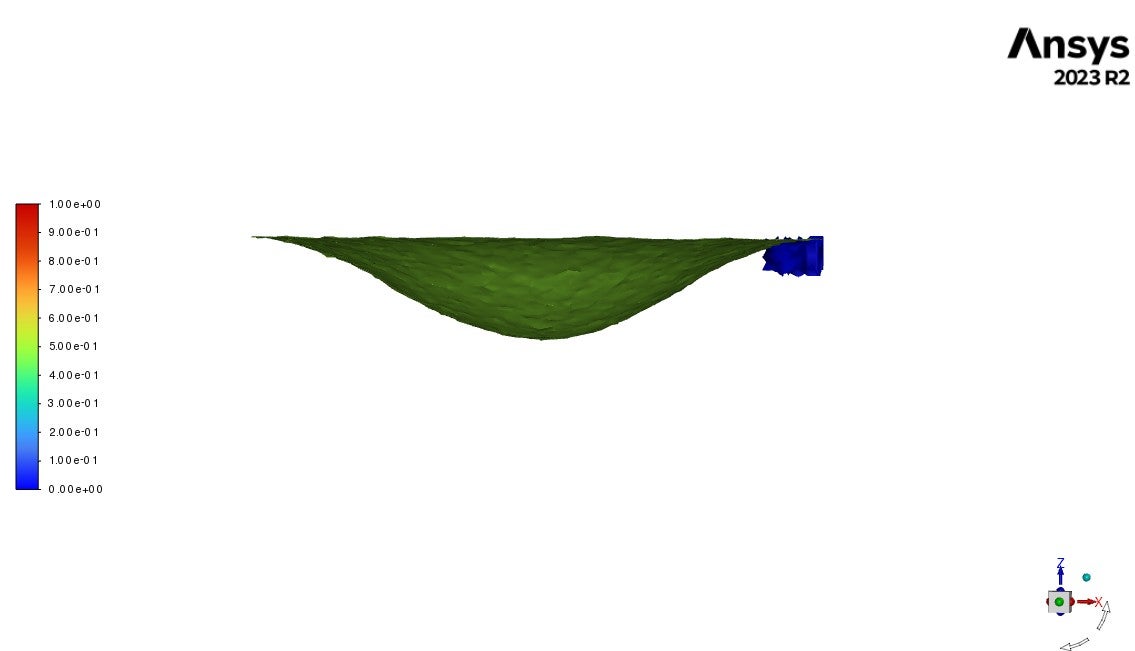
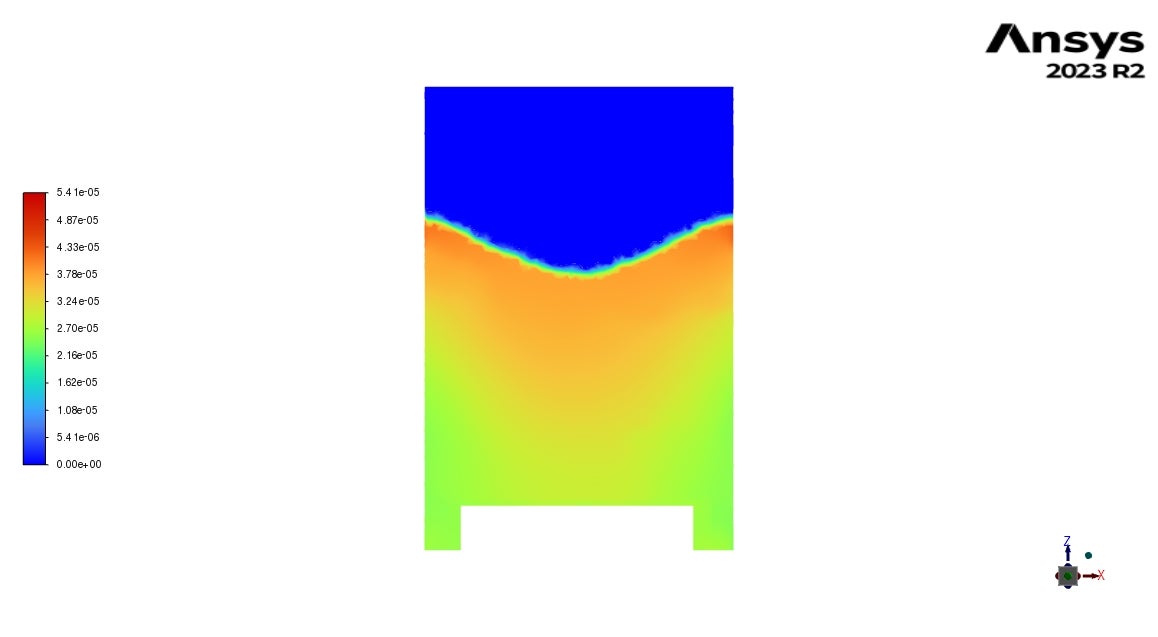
I am attempting to model mixing of tracer in a stirred tank with a free surface (air-water interface, vortex shape forms). I have first computed the free surface of the liquid using VOF solver. I then patched in 2 mL of tracer into the liquid (2.65 L), assuming that the properties of the tracer are the same as the liquid phase and tracer does not disturb the flow so I can switch off all the equations and solve only for species transport.
I have patched 30 g/L of tracer for the 2 mL volume by initialising the mass fraction.
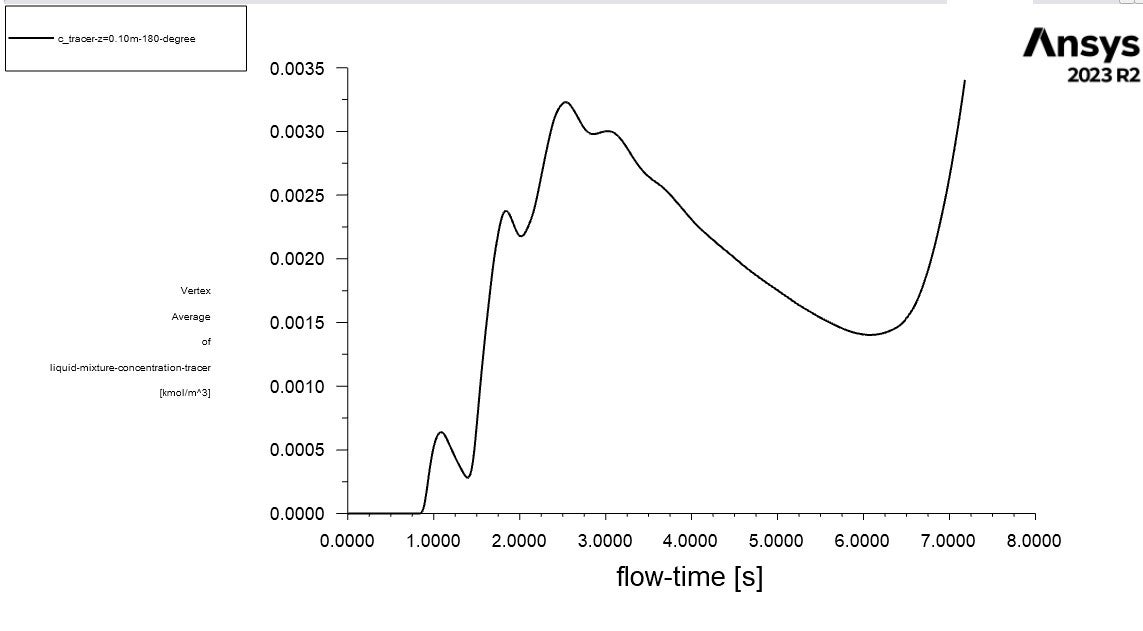
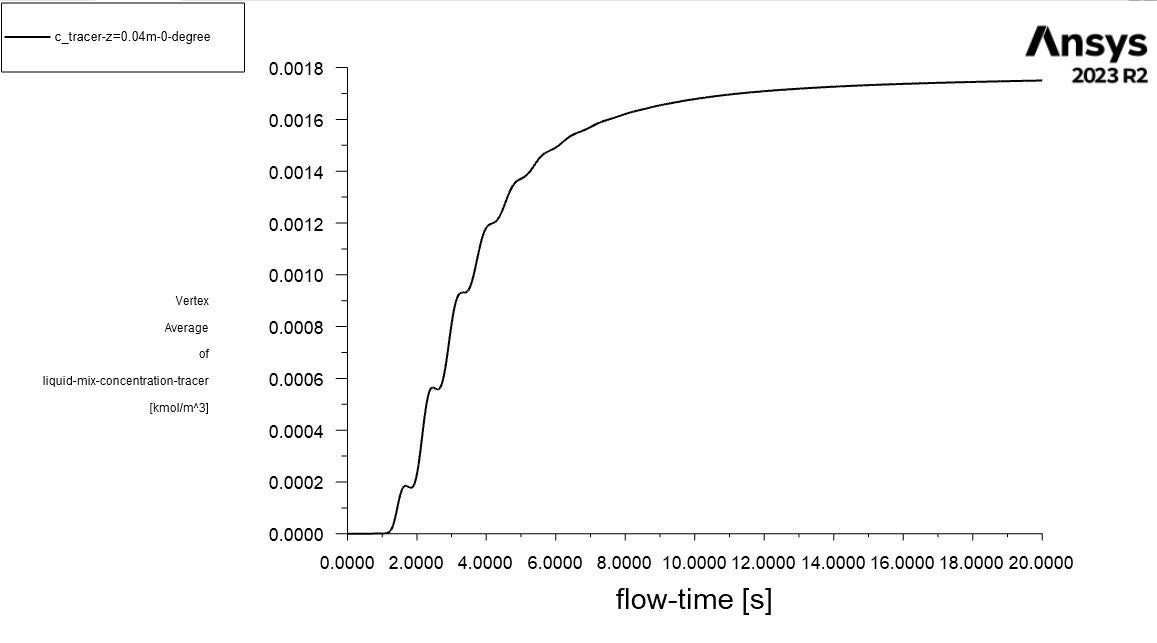
What I am noticing is that during the simulation run, the concentration of tracer initially decreases as the tracer is dispersing in the liquid (should be expected due to mixing) but then suddenly increases to a large value of 760 g/L and the concentration profile shows an inflection and begins to increase rapidly rather than reach a steady value. I am unsure as to what is causing this behaviour as I have tried the same methodology for single phase simulation (assuming flat liquid surface) and it works as expected. Unless I have set up something wrong (and I have repeatedly checked my simulation set-up), then I am struggling to understand what is causing this rapid change in tracer concentration when I have a vortex and not flat liquid surface?
-
February 5, 2025 at 3:05 pm
Rob
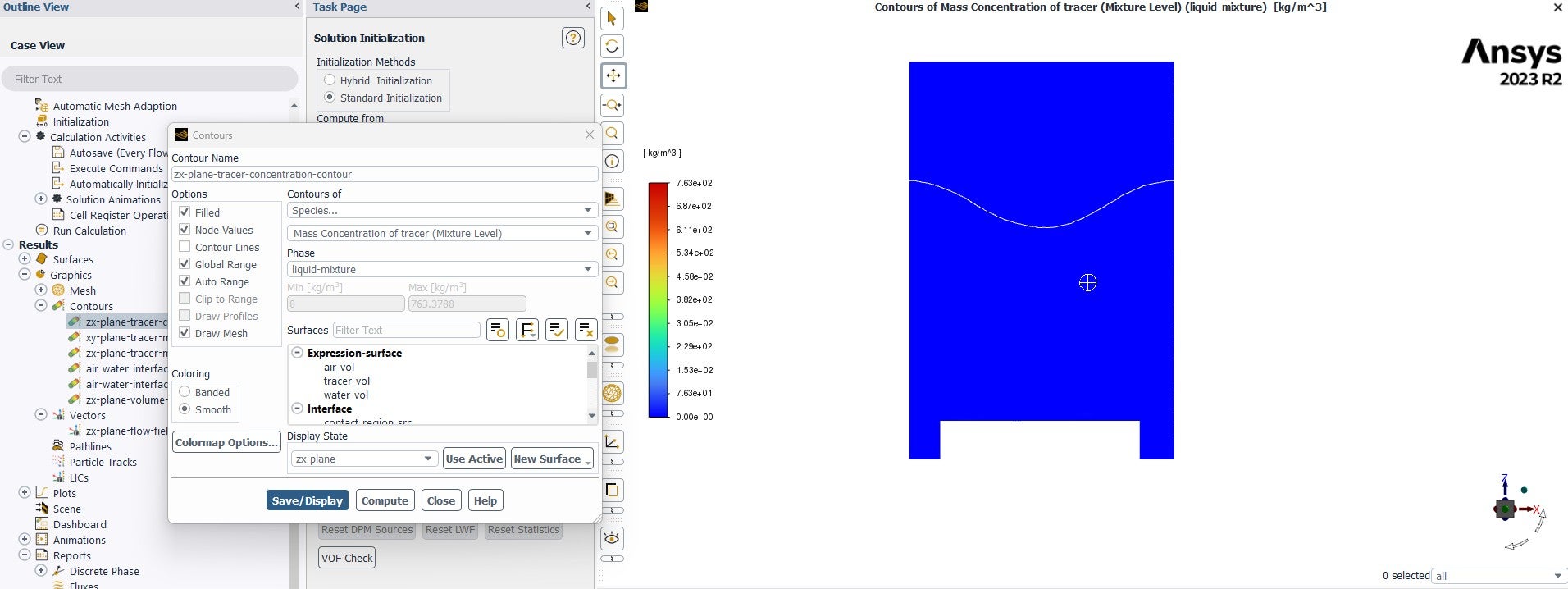
Forum ModeratorWhere is the monitor point, and if you replot the contour for species what do you see?
-
February 5, 2025 at 4:33 pm
SR786
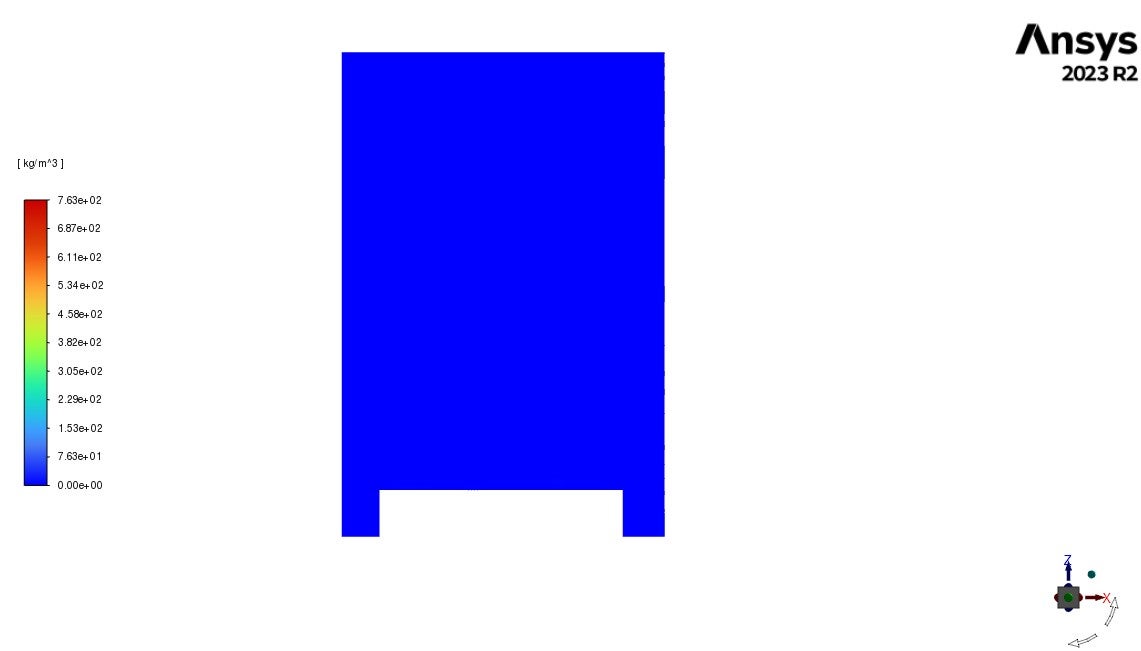
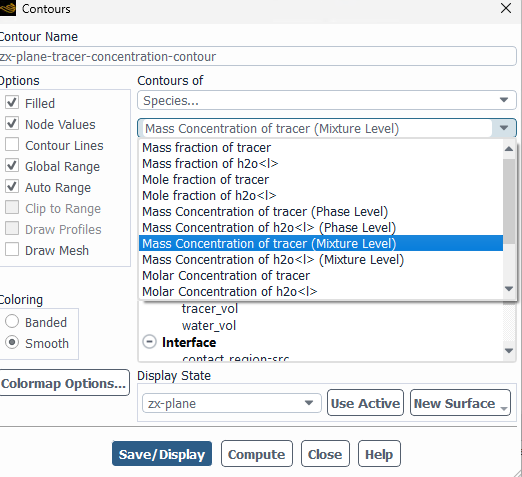
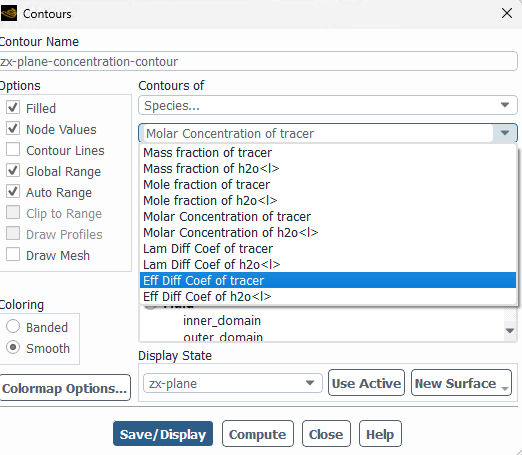
SubscriberHi the monitor point is below the free surface at height 0.1 m. The contour plot is for species, where it represents the mass concentration of tracer. I have been having issues with performing mixing with free surface as the concentration of tracer in the tank always seems to exceed the specified concentration at time = 0 (in this case concentration of tracer being 763.3788 g/L despite me defining a concentration of 30 g/L so this is physically unrealistic to have such a large value present in the computational domain) and resultingly the concentrations seem to increase exponentially rather than reach a steady-state value. I attempted the same method with a single phase, flat liquid surface (i.e., patching volume of tracer, initialising mass fraction and solving for species transport only) and there were no issues so I am perplexed as to what is causing this issue unless there is a bug when coupling species transport with multi-phase solvers such as VOF.
-
February 5, 2025 at 4:38 pm
Rob
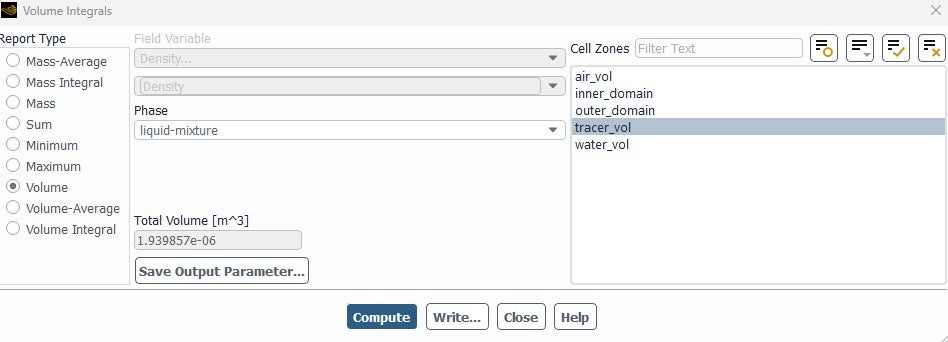
Forum ModeratorShouldn't be a bug as it'd have been seen before. How does the volume sum look for the tracer mass? One problem with tracers is determining if the reported value is because a "lump" of tracer is moving around or it's dispersing.
-
February 5, 2025 at 4:51 pm
-
February 5, 2025 at 4:53 pm
Rob
Forum ModeratorThat's the initial volume. You may need to monitor the species mass in all liquid volumes to check if mass is being conserved.
-
February 5, 2025 at 4:56 pm
SR786
SubscriberHow do I perform this check?
-
February 5, 2025 at 4:59 pm
Rob
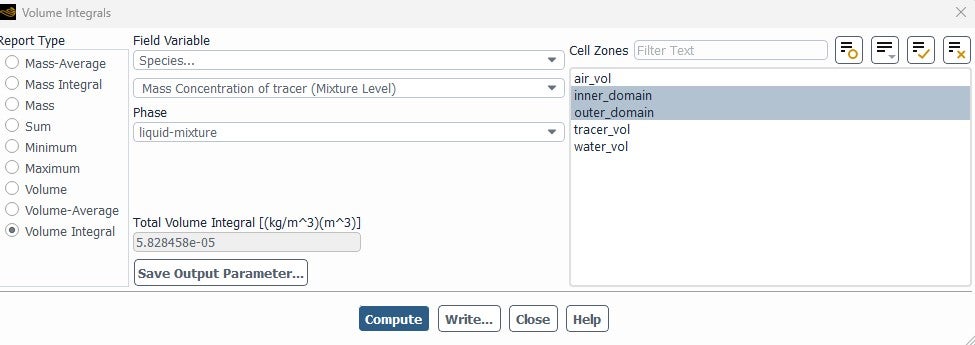
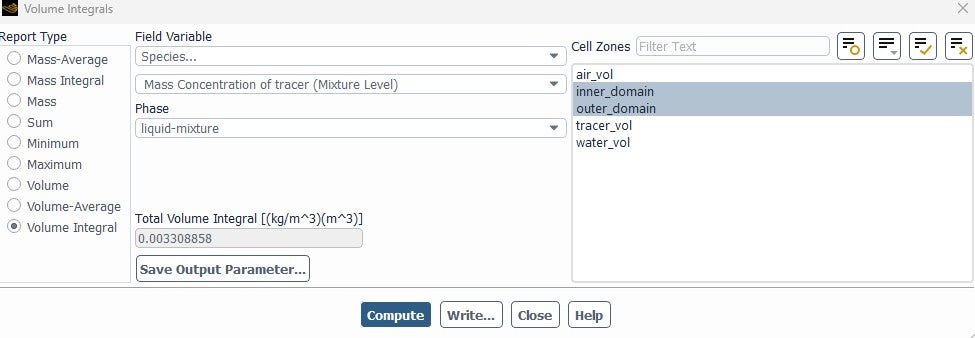
Forum ModeratorThe panel you just showed, you need to species mass. I can't remember offhand which of the options you want, so you may need to do some investigations.
-
February 5, 2025 at 5:12 pm
SR786
SubscriberHi, it appears that mass isn't conserved. The mass of tracer in the domain at time = 0 is ~0.06 g which is what I expect for patching ~2 mL with C = 30 g/L. However, the mass of tracer in the domain at time = 7.29 s is ~3.31 g. This explains why the concentration is suddenly increasing as mass is not being conserved leading to physically unrealistic results from the simulation. However, how do I fix this issue now?
-
February 6, 2025 at 11:08 am
Rob
Forum ModeratorWhat is water_vol ?
-
February 10, 2025 at 10:58 am
SR786
SubscriberHi, water_vol is the volume of water that was initially patched for the VOF simulation (starting from flat surface t = 0).
I wonder if the stability issues could be related to time step sensitivity. When I ran my VOF simulation I used a time step size of 5*10^-4 s to control CFL number, however when I began the mixing simulation I used 1*10^-3 s throughout (to reduce simulation times). I assumed as the velocity wasn't changing (frozen flow field) as I am only solving the equation for species transport that the time step would be trivial.
However, the species transport equation is still sensitive to time-step size and too large a time-step could possibly introduce numerical diffusion leading to these problems in mass accumlation of the species.
-
February 10, 2025 at 12:15 pm
Rob
Forum ModeratorTime step will play a part, but I'd expect it to be less sensitive than VOF. However, as you're only solving one equation (species) it should be pretty quick.
How many cell zones are there? I'd generally have as few as possible and then use registers to patch in the water.
-
February 10, 2025 at 1:02 pm
SR786
SubscriberThere are two cell zones, characteristing the rotating and stationary region (Multiple Reference Frame) as it is a rotating tank problem. The air & water volume were defined previously for the VOF (which I am continuing the simulation from just with all the equations switched off apart from species). The tracer volume has been patched with register function into water. Due to all of this I have these cell zones defined.
-
February 10, 2025 at 4:55 pm
Rob
Forum ModeratorOK, how does it look if you report on all cell zones.
-
February 12, 2025 at 12:17 pm
SR786
SubscriberThis is the report for all cell zones at the end of the simulation:
liquid-mixture
Total Mass-Weighted Integral
Mass fraction of tracer [(kg/m^3)(m^3)]
-------------------------------- --------------------
inner_domain 0.0033485791
outer_domain 0.017932657
air_vol 0.00048225207
tracer_vol 1.7113207e-05
water_vol 0.020798984
In contrast to the report for the beginning of the simulation
liquid-mixture
Total Mass-Weighted Integral
Mass fraction of tracer [(kg/m^3)(m^3)]
-------------------------------- --------------------
inner_domain 0
outer_domain 6.0157372e-05
air_vol 4.0166542e-05
tracer 6.0157372e-05
water_vol 1.999083e-05
I want the amount of tracer in my domain to be 6.0157372e-05 kg or ~0.06 g initially which is what I patched in the liquid phase and this value will then remain constant (conservation of mass) as the process is batch so no additional tracer is being added

-
February 12, 2025 at 5:16 pm
SR786
SubscriberHi,
I spoke with my supervisor regarding this problem. He suggested it could be a numerical issue, due to mass conservation problems. As I computed the solution based on homogeneous VOF, which assumes a shared flow field for air and water could this be yielding the issues that I am currently seeing and when considering mixing do I need to decouple the velocity for the two phases by using inhomogeneous VOF (with sharp interface defined between gas and liquid phases).
For the single phase problem, where I only assumed flat liquid surface I tried the same methodology as I was doing with homogeneous VOF flow field and there were no issues.
-
February 12, 2025 at 5:42 pm
Rob
Forum ModeratorPossibly. The volume fractions may also be a factor: you're resolving small volume fractions (species) on volume fractions (phase) too. Moving to Eulerian multiphase probably won't help. What happens if you patch in a bigger volume and track uniformity? The aim is to check mixing, and as we're taking some liberties with the solution does the actual species amount need to be quite so precise?
-
February 14, 2025 at 11:11 am
SR786
SubscriberHi,
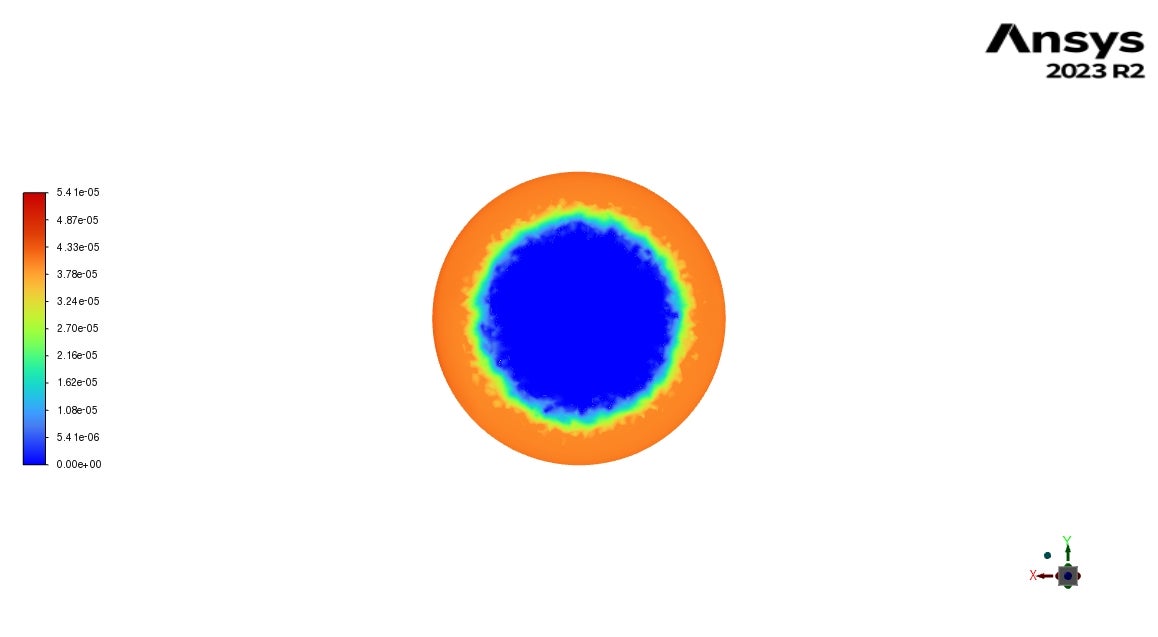
I've tried simulating mixing with passive scalar transport of tracer based on converged frozen flow field using hydrodynamic results from homogeneous VOF with Standard k-e model rather than the SST k-w Curvature Correciton model. I patched the same volume and mass of tracer as previously. I am getting expected mixing behaviour in the tank with no accumulation. The contours for mass fraction (in two planes, one near the surface from top view and one from a side view) look reasonable. The concentration profiles also look good. However, I cannot use this turbulence model for my work due to the physics of my system (unbaffled tank - high swirl and vortexing) despite it being more robust. Does this mean that the initial solution I computed for SST k-w Curvature Correction may not have been robust enough (i.e., achieved a sufficient level of convergence) which are causing these issues?
-
February 14, 2025 at 2:09 pm
Rob
Forum ModeratorHow much vortexing? I've tended to use RNG k-e for most multiphase applications as vortexing tends to be something to avoid in industry so it's rare to try and model it!
-
February 14, 2025 at 2:43 pm
SR786
SubscriberFor my application vortexing is desirable as later on I want to model precipitation so the vortex helps with suspension of crystals. This is why there are no baffles in the tank to break down the swirling motion. The liquid is displaced from initial height (0.15 m) with a flat liquid surface by about 0.02 m (~0.13 m).
Is RNG k-e more robust than SST k-w CC? I only tried it as for RANS modelling of such systems (unbaffled tanks with vortexing), the literature recommends using either RST or SST k-w CC though when coupling with multi-physics problems (for me I am looking to move towards a Multi-Fluid VOF, with species transport and PBM) so there could be issues as both aren't as robust.
-
February 18, 2025 at 9:50 am
SR786
SubscriberHmm, I've monitored the total mass of tracer in the domain and it still increased to 0.08 g from 0.06 g with the frozen flow field from standard k-e. Though the problem was not as bad as compared to the sst k-w CC solution clearly there are still some underlying issues with the method I am using. I am wondering for the multi-phase simulation whether I need to activate the volume fraction equation together with the species transport (keeping the flow and turbulence equations switched off). For the multi-phase simulation I notice we get details for both mass concentration on mixture level and phase level which is not seen for single-phase simulation (assuming flat liquid surface).
-
February 18, 2025 at 3:20 pm
Rob
Forum ModeratorI tend to favour RNG, but also rarely refine near the wall sufficiently for k-w models: with multiphase most of the interesting stuff happens in the middle and/or we need to resolve everything. RSM is more accurate, but by the time you factor in all of the multiphase models it may not be worth the extra cpu cost.
Check the definitions in the manual re the concentration at mixture or phase level. There's a reason for two options, and care needs to be taken when reading the definitions.
-
February 18, 2025 at 3:56 pm
SR786
SubscriberHi,
Thank you for the reply. For my simulation I actually am interested in near-wall phenomena as I notice an increase in turbulent kinetic energy towards the walls from the hydrodynamic simulations which is produced by the SST k-w CC (& RST) model which the k-e model fails to account for which can have an influence on mixing behaviour particuarly as I am feeding the tracer close to the wall.
Could the issue be due to volume fraction equation being switched off leading to accumulation of mass in the system and if I am only interested in passive transport of scalar for multi-phase simulation would I need to also solve for volume fraction (even if the flow equations are switched off). From my understanding of the theory for species transport, the multi-phase formulation is this (no source terms, chemical reactions or mass transfer between phases from gas to liquid or vice versa):
Which includes the volume fraction. As compared to the single phase
As this has not to my knowledge been attempted before i.e., no clear tried and tested method from literature which only deals with passive transport of tracer using single phase, flat liquid surface.
-
February 18, 2025 at 4:26 pm
Rob
Forum ModeratorWhich also needs the far field data as that's where the reactions will happen: resolve it all!
Possible, try it and report back.
-
February 19, 2025 at 2:45 pm
SR786
SubscriberI tried solving it with volume fraction and there were still problems. Interestingly I tried defining my problem in Microsoft Co-Pilot to see what it suggests. It gave me the following piece of advice:
To configure the species transport model to only consider the liquid phase while using a homogeneous VOF model, you can follow these steps:
Enable the Species Transport Model:
- In your CFD software, activate the species transport model.
Define the Mixture:
- Create a mixture that includes water and the tracer. Ensure that the tracer is defined as a species within the liquid phase.
Set Up the VOF Model:
- Ensure the VOF model is set up correctly to capture the interface between the liquid and gas phases. This step is crucial for accurately modeling the hydrodynamics.
Patch the Initial Tracer Concentration:
- Use the patching tool to set the initial concentration of the tracer in a specific volume of the liquid phase. This involves selecting the region where you want to introduce the tracer and specifying the initial concentration value.
Freeze the Flow Field:
- Since you are using a homogeneous VOF model, the flow field is shared between phases. Freeze the flow field to focus on the species transport without recalculating the hydrodynamics.
Adjust Solver Settings:
- Ensure that the solver settings are configured to solve the species transport equation only for the liquid phase. This might involve disabling species transport calculations for the gas phase.
Run the Simulation:
- Start the simulation and monitor the tracer concentration within the liquid phase.
By following these steps, you can ensure that the species transport model only considers the liquid phase, even when using a homogeneous VOF model
.
I have already done all of these steps, for step 6 I assume this is automatically done in ANSYS Fluent as if I define my mixture as the liquid (containing tracer and water) then species transport will only be solved for liquid phase. There is no air defined in the mixture so there are two distinct phases, one for liquid mixture (containing water + tracer) and one for air.
-
February 19, 2025 at 2:53 pm
SR786
SubscriberSo I think my method was wrong, suggesting to solve volume fraction with species transport (with no flow or turbulence equations activated). I need to now focus on how to resolve these issues with modelling species transport only with a fixed flow field from the VOF solution (having the flow equations, turbulence and volume fraction switched off). I do know that solving for species transport only did work with standard k-e, albeit with some issues with conservation. That may have been due to me using a URF of 1 which is the default value, I could try and reduce this value to see if it has any significant influence on the solution stability.
And one final question, I assume that if I have two immisicble phases using homogeneous VOF, where one phase is the liquid-mixture (water & tracer) and the second is air, then when ANSYS Fluent is solving the species transport equation is it still in this form:
As it assumes that everything is in the same phase and there is no transfer between phases which I think is what the other equation is for
-
February 19, 2025 at 3:16 pm
Rob
Forum ModeratorPoint 6 looks like some confusion over multiphase definitions. It's not an AI hallucination as such, but the technical and pedantic nature of simulation definitions does cause a few interesting suggestions.
-
February 21, 2025 at 4:25 pm
SR786
SubscriberHi,
I managed to resolve the issue and get the mixing work with free surface based on SST k-w CC solution. The problem was how I set up the case, I used the interpolate function to read the data and initialise the solution from the frozen flow field. I have since found out that the interpolate function can introduce some numerical instability (hence why the mass was increasing or mass imbalance). As I am dealing with the same mesh and boundary conditions I don't need to use interpolate and all I needed to do was set up the mixing simulation and read the data from the dat.gz file.
-
February 21, 2025 at 4:50 pm
Rob
Forum ModeratorInterpolate will return the various cell values but not gradients etc. I'd never even have considered using interpolation for what you were doing so hadn't mentioned anything. That at least explains the issue, and thanks for reporting back.
-
February 21, 2025 at 5:58 pm
SR786
SubscriberNo worries, yeah I mainly used interpolate as I wanted to start the case from fresh (flow time of 0) for investigating new phenomena, i.e., adding tracer and monitoring mixing. I found you can use these commands
(rpsetvar 'flow-time 0)
(rpsetvar 'time-step 0) -
February 24, 2025 at 9:42 am
Rob
Forum ModeratorYes, those commands will do that. Just save case & data before using them, and then again afterwards and ensure any monitors & animations are safely out of the way in a different folder. The commands are safe but as you've changed time the solver may try and overwrite earlier files.
-
- You must be logged in to reply to this topic.
-
6450
-
1906
-
1457
-
1308
-
1022
© 2026 Copyright ANSYS, Inc. All rights reserved.