-
-
April 3, 2019 at 1:16 pm
Abdul Malik
SubscriberDear Community,
General overview of model.
I am modelling a longitudinal fillet welded joint. Where geometry is modeled on spaceclaim keeping topology "none", the geometry consist of base metal, and weld metal and it is symmetric. The connection between the plates is "no separation" whereas bonded in the weld and base metal with MPC formulation. The total solid parts are three and it is a non-linear analysis.
As i have student license of ansys, the problem i am facing is with meshing. We require a sort of map mashing i.e. dense within the weld metal and around the bonded contact between weld and base metal and get coarser as we move far away from the weld metal. But i couldn't do it propely, i have tried couple of things but they didn't work. Any suggestions how could that be achieved?
Â
Furthermore, i got some element distortion at the ends of the weld, however, the program didn't gave any warning or error for that but still asking if it alter the results?
When we apply a symmetry in model, the results we got specifically the reaction forces, are the total forces (included the symmetric side) or only for the one side ?Â
Any suggestion regarding above question or any other amendments are appreciated.Â
Â
Many Thanks
Regards
Abdul Malik
-
April 3, 2019 at 2:48 pm
peteroznewman
SubscriberConnection between the plates should be Frictional, not No Separation. There is no force between the faces that prevents them from separating.
You can slice each large plate into 4 pieces, one of which is a small piece near the weld fillet. There are two approaches. (1) Put those 4 pieces in a multibody part that uses Shared Topology to connect the 4 pieces together with shared nodes. (2) Use Bonded Contact to hold the pieces together. This has the advantage that you can use twice the mesh density on the small piece as the other three and have a discontinuous jump in element size and let the bonded contact resolve the interface. The small piece can be twice as tall and wide as the weld fillet to keep the bonded contact away from the weld fillet.
What is the display scale on the "distorted" element image? If it is a scale factor of 10 or something, then it's not really distorted is it?
-
April 3, 2019 at 3:50 pm
Abdul Malik
SubscriberHi Peter,
Thanks for response. Shall i slice the plates only along the depth ( z axis) or in both depth and width as well?Â
I zoom the image this is true scale.
-
April 3, 2019 at 7:59 pm
peteroznewman
SubscriberTwo slices, depth and width. Then you will have one long square section of plate next to the weld fillet with the smallest elements, two long thin strips and one large piece of the plate. The thin strips can have 2X larger elements than the square section, the large piece can have 4X larger elements than the small square long piece. This will keep it within the Student limits.
-
April 4, 2019 at 12:26 am
-
April 4, 2019 at 11:50 pm
Abdul Malik
SubscriberThanks for the cooperation Peteroznewman. The problem was in material model.Â
I have one more question. I want to measure the strain at the weld beginning i.e. the relative displacement of top node to the bottom as marked in the picture.
Can we calculate the specified node displacement? How if i use the path option in construction geometry would that be efficient in computing the node displacement?
Â
Many Thanks
-
April 5, 2019 at 12:30 am
peteroznewman
SubscriberYou can make two deformation outputs, one on each vertex. Subtract the components to get the relative deformation.
-
April 8, 2019 at 10:55 pm
Abdul Malik
SubscriberHello Peter,
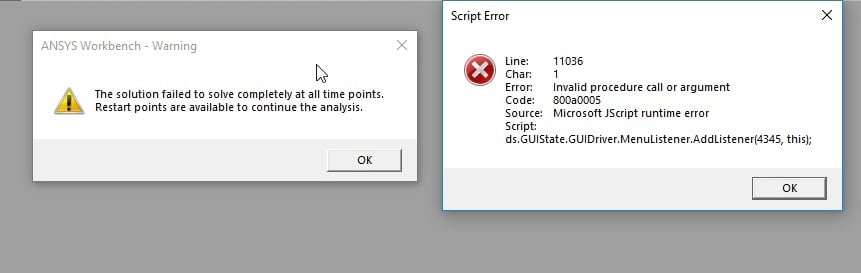
Sorry for late respond. I am facing some problems while running a non-linear analysis when i increase the displacement value from 3 mm to 20 mm. Actually at 3mm displacement i couldn't the get the complete load curve (i.e. decreasing after reaching to maximum) so i tried to increase the displacement but it showing these error continuously. Below is the picture of contact initial information, Please let me know how could i fix this issue.Â
Error: The solver engine was unable to converge on a solution for the nonlinear problem as constrained. Please see the Troubleshooting section of the Help System for more information.
Warning: The unconverged solution (identified as Substep 999999) is output for analysis debug purposes. Results at this time should not be used for any other purpose.
The solver failed almost at the end as seen from the convergence graph.
Many Thanks
Â
-
- The topic ‘Meshing issue / Longitudinal fillet welded lap joints’ is closed to new replies.
-
4803
-
1582
-
1386
-
1242
-
1021
© 2026 Copyright ANSYS, Inc. All rights reserved.