Hi,
I am modelling water droplets falling in air to reach their terminal velocity using a VOF multiphase model. I received the results I was expecting once, and I am now trying to swap out my current mesh for a different mesh to change the droplet size and mesh refinement.
When I try to read in a new mesh file, it reads successfully - however, the following error message is displayed, and the simulation does not run as expected afterward (pressure field becomes unstable, droplet moves in the opposite direction to expected):
Error: CDR: invalid argument [1]: wrong type [not a pair]
Error Object: #f
This occurs right after the mesh finishes building and Fluent replays the case settings onto the new mesh (zone matching, boundary conditions, etc. all complete with "Done" before the error appears). I have triple-checked that none of my setup or solution settings have changed in the process of replacing the mesh.
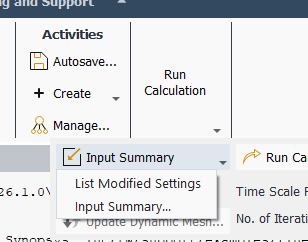
One thing I've noticed that may be related: my case has the Adjoint Solver active (I did not intentionally enable this), and I've found adjoint x-velocity, adjoint y-velocity, and adjoint pressure fields appearing in my Patch panel. I suspect the mesh-settings may be failing while trying to carry adjoint-related data across onto the new mesh, but I haven't been able to find a straightforward way to fully deactivate the Adjoint Solver via the TUI or ribbon. Any guidance on properly disabling it would also be appreciated, in case that resolves the mesh-read issue.
Below is a description of my model, in case it helps:
- VOF model with explicit volume fraction parameters, implicit body force formulation, sharp interface modelling, and interfacial anti-diffusion all activated.
- Phase interaction between water and air with a constant surface tension coefficient of 0.072 N/m; surface tension force modelling and continuum surface force both enabled.
- I am modelling 2D droplets with a diameter of 0.1 mm. I am using an axisymmetric boundary condition (with gravity defined along the positive x-axis, and the domain in the positive y-direction), so I am only modelling half the droplet. The mesh is 15 mm long × 1.5 mm wide, with pressure outlets on all other sides, so that when initialised with hybrid initialisation, the pressure is constant throughout the field. The droplet is patched in after initialisation.
- I am currently using a PISO solution method with the following spatial discretization settings:
- Gradient: Least Squares Cell Based
- Pressure: PRESTO!
- Momentum: Second Order Upwind
- Volume Fraction: Geo-Reconstruct
Any suggestions on how to avoid this error when reading in a different mesh, how to fully deactivate the Adjoint Solver, or general comments on improving my current model/solver settings would be greatly appreciated.
Thanks!

















 You are navigating away from the AIS Discovery experience