Ansys Assistant will be unavailable on the Learning Forum starting January 30. An upgraded version is coming soon. We apologize for any inconvenience and appreciate your patience. Stay tuned for updates.
General Mechanical

General Mechanical

Topics related to Mechanical Enterprise, Motion, Additive Print and more.

material model selection

    • nirvana
      Subscriber

      Hello,


      I have to model a hyperelastic material and I have unixial test data based on nominal stress and strain (figure1).
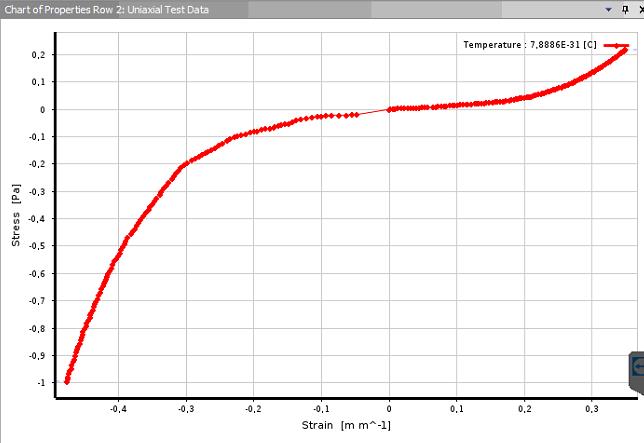

      stress strain experimental uniaxial data


      Should I take experimental values only starting from 0?


      In Ansys there are several models of different orders to be used such as Ogden, Neoo-Hookean, Mooney-Rivlin, Yeoh, how can I decide which one is the most suitable for representing my model? Is the order of these models related in some way to the kind of experimental data I have? (For exemple do uniaxial tests require only 1st order? Biaxial 2nd order and so on?).


      I tried to use Ogden 1st order, but I get this curve fitting with a flat line. Do you have any ideas why?
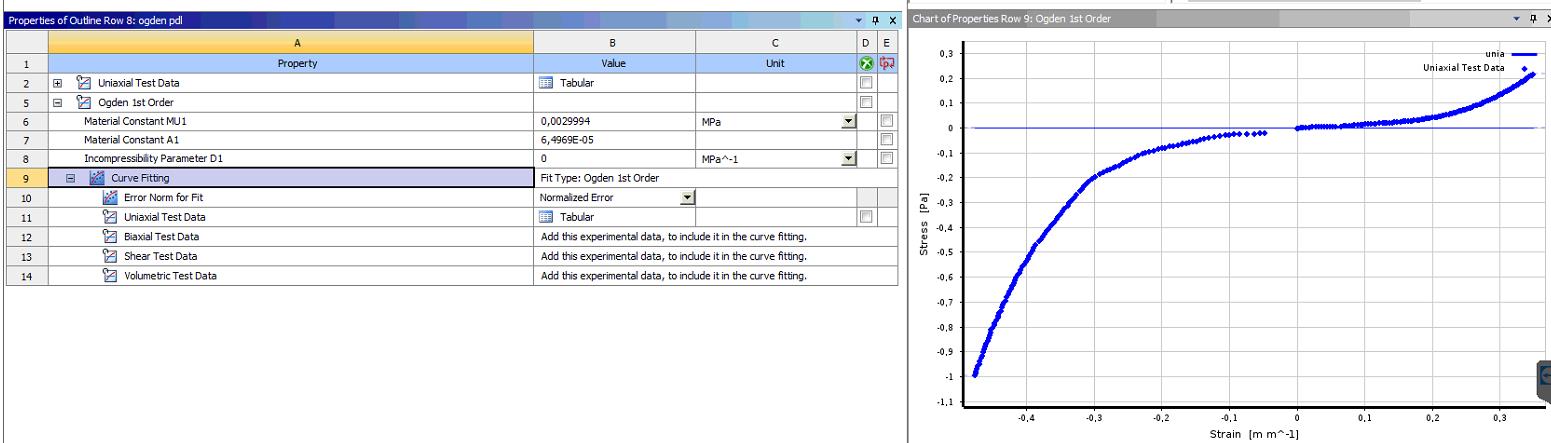

      curve fitting Ogden 1st order uniaxial data


      To conclude, how can I check if the stress values I get after solving  are reliable and consistent with the selected model ?


      Thank you 

    • Sandeep Medikonda
      Ansys Employee
    • nirvana
      Subscriber

      Hi, 


      thank you for your advice! Just a few questions.. .


      1)I have a compression-tension experimental curve as shown in the previous image since I have to choose the material law I should check the percentage of expected strain, in my case looking for exemple at the tension side I expect a strain around 30% and on the compressive side around 47% thus in both cases it is preferable to use a Neo Hookean model as it best fits for strains lower than 1 in/in, is it right? Or should I consider the entire range from compressione to tension to know the exact strain percentage i.e. from |-0.47| to 0.3 thus 0.77->77% again Neo-Hookean?


      2) I'm using engineering values for stress/strain to get the material model, but I've read in your suggested page that the results I get should be converted into true stress/true strain to be compared with the experimental data. Thus, I am a bit confused, should I use true stress/strain values for my experimental data in engineering data? 


      3) How can I adjust the volume parameter using the SOLC command? 


      Thank you in advance.

    • Sandeep Medikonda
      Ansys Employee

      I believe the article was only talking about fits in the tensile direction. But more importantly how des the fit in your case look like for the compressive region in the strain range of interest? Like mentioned in that article this is a bit of a trial and error process. So, you can start with the Neo-Hookean if the fit looks reasonable.


      For Hyper-elastic materials you can just input the engineering data and conversion is done automatically behind the scenes.


      The volume compatibility constraint can be adjusted using the CNVTOL command:


      CNVTOL,COMP,1e-02


    • nirvana
      Subscriber

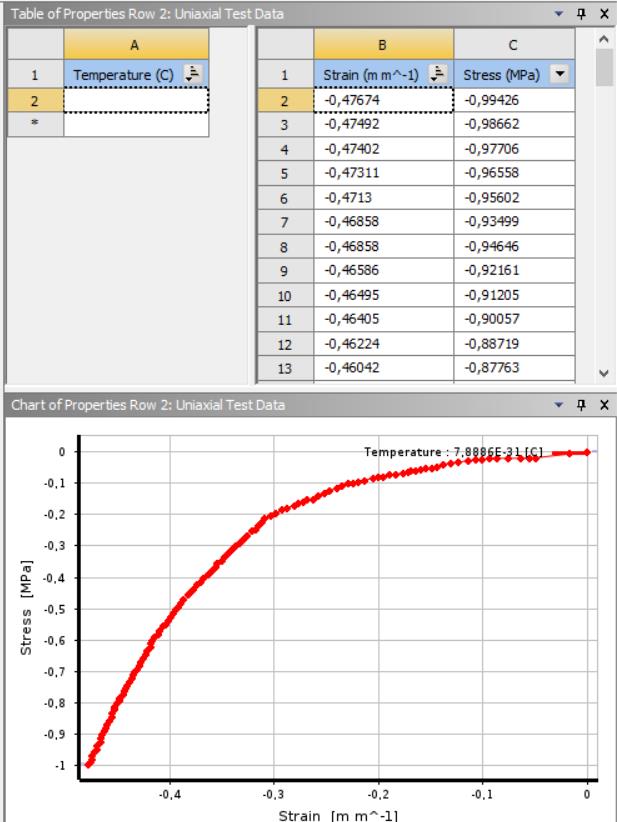
      Hi! Compression data look like in this image. 


      compression experimental data


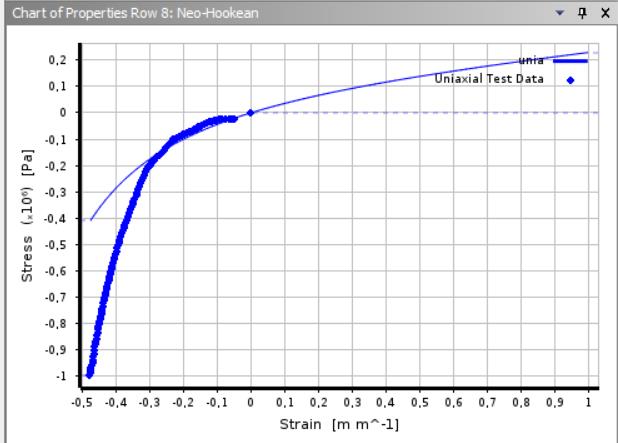
      and the Neo Hookean model doesn't fit properly the curve as you can see


      Neo Hookean fitting


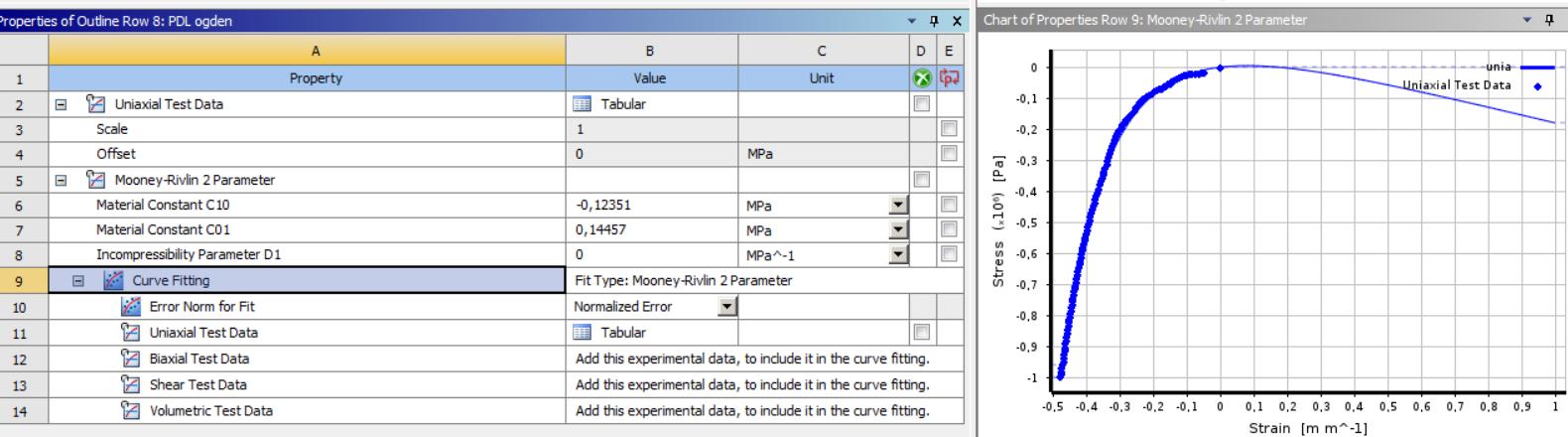
      while a Mooney Rivlin 2 parameters models seems to accurately fit the curve 


      curve fitting of uniaxial compression data Mooney Rivlin 2 parameters


      However, how can I find the strain range of interest? isn't it that one determined by the compressive stress strain curve?


      Regarding the CNVTOL command since I am running a Mechanical simulation should I insert it in the analysis settings?


      Thank you

    • Sandeep Medikonda
      Ansys Employee

      Use the curve that fits the best to your experimental data.


      Strain range of interest is what your part is being subjected to in the simulation. Start with a material model and get an estimate from the results.


      For the CNVTOL, yes, use a command snippet under the analysis branch

Viewing 5 reply threads
  • The topic ‘material model selection’ is closed to new replies.
[bingo_chatbox]