TAGGED: foam, lsdyna, stress-strain-curve
-
-
May 11, 2026 at 9:06 pm
lsdyna928
SubscriberHello,
I want to run a simulation using MAT_063 (Crushable Foam), with Model 1 selected in the material card. I have read the documentation for this material model, and as far as I understand, the material requires the yield stress as a function of volumetric strain. My first question is whether I should provide only the plastic part of the stress–strain curve obtained from experiments, or if the material requires the entire stress–strain curve. Also, is it possible to use stress–strain data obtained from a uniaxial compression test?
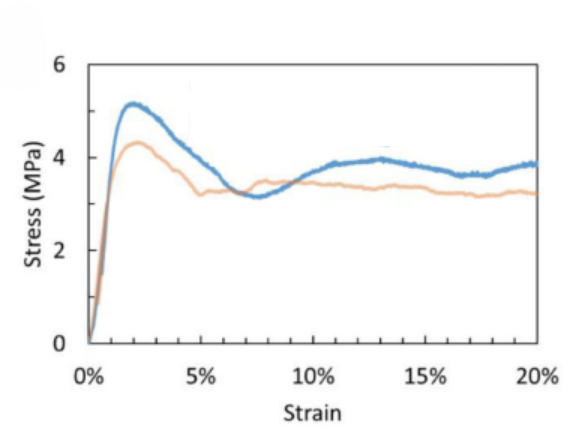
The other question concerns a warning I receive in Keyword Manager → Model Check → Keyword Check for the defined material (MAT_63). The warning message states: "MAT_CRUSHABLE_FOAM (ID: 1): curve 1 does not monotonically increase." The experimental stress–strain curve contains drops in stress, as shown in the figure below as an example. What should I do in this case to be able to use this material model and resolve the warning?
Does anyone have any ideas about these questions?
-
May 15, 2026 at 2:52 pm
Ram Gopisetti
SubscriberHi,
The load curve defines the uniaxial yield stress under compression as a function of equivalent plastic strain for model = 1. This is conceptually similar to providing stress–strain data for MAT_024; however, the required data must be appropriately converted before being input into the material model.
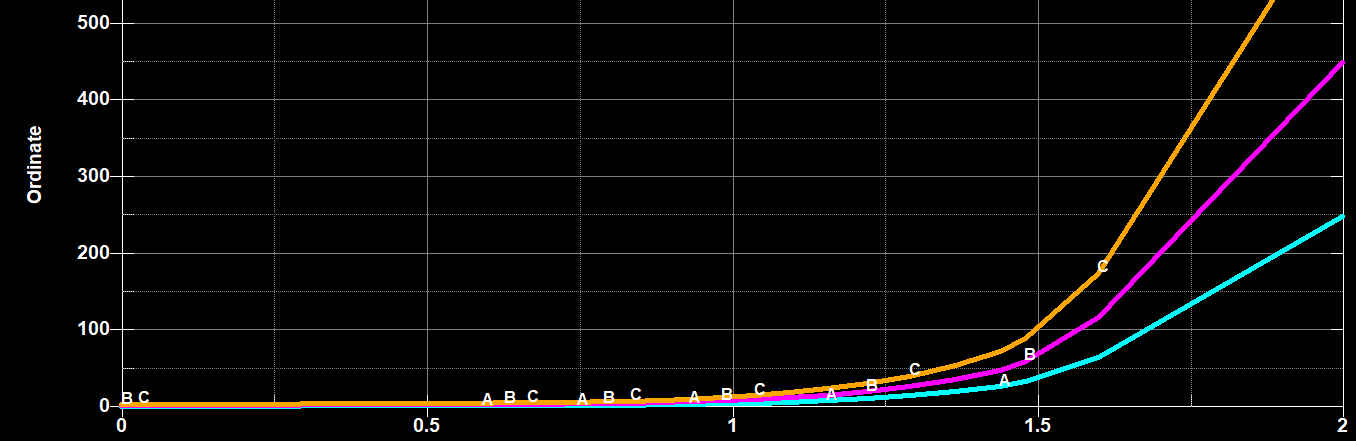
For a given foam material, the stress–strain response varies with strain rate looks as the image below. Nevertheless, the overall behavior typically exhibits three distinct regions:
- Elastic region, governed by the Young’s modulus (E)
- Plateau region, characterized by relatively constant stress during progressive cell collapse
- Densification region, where the material stiffens rapidly due to compaction
This characteristic response represents the true mechanical behavior of foam materials. For a deeper understanding, it is recommended to refer to standard studies and literature on foam mechanics.
https://www.researchgate.net/figure/Stress-strain-curves-of-crushable-foams-under-quasi-static-loadings-in-two-rates-a_fig1_259878739
https://www.researchgate.net/figure/Crushable-foam-model-calibration_fig4_317250268
Based on the image, the material behavior appears to resemble that of a thermoplastic rather than a typical foam response. I would recommend revisiting the analysis or experimental data to ensure the interpretation is accurate from a material characterization standpoint.Cheers, Ram
-
May 16, 2026 at 12:09 am
lsdyna928
SubscriberThank you for your response.
Could you please explain in more details what you mean by the data being “properly converted”? Do you mean in terms of unit conversion, or something else?
Thank you as well for the references. You pointed out an important aspect regarding the material behavior. Actually, the image I attached earlier corresponds to a different material (not a foam). However, I found several papers where this material was modeled using the Crushable Foam material model (MAT_63), which is why I am also interested in using MAT_63 for this material.
At the same time, as you mentioned, the material behavior differs from that of typical foams such as polyurethane. In addition, LS-DYNA gives a warning because the stresses are not increasing monotonically. Therefore, I was wondering whether there is something I might be missing about this material model that allows others to successfully use MAT_63 for materials with stress-strain curves similar to the one I sent, while I am unable to do so.

-
May 18, 2026 at 1:44 pm
Ram Gopisetti
SubscriberHi,
You need to make sure to convert the given stress strain response to equivalent yield stress to plastic strain and inital idea is given in this link From engineering to true strain, true stress — Welcome to the LS-DYNA support site and also following consistent unit system of your prefered model.
Cheers, Ram
-
- You must be logged in to reply to this topic.
-
6765
-
1906
-
1490
-
1330
-
1127
© 2026 Copyright ANSYS, Inc. All rights reserved.