

TAGGED: explicit-dynamics
-
-
October 13, 2020 at 6:04 pm
Nikke
SubscriberHi,
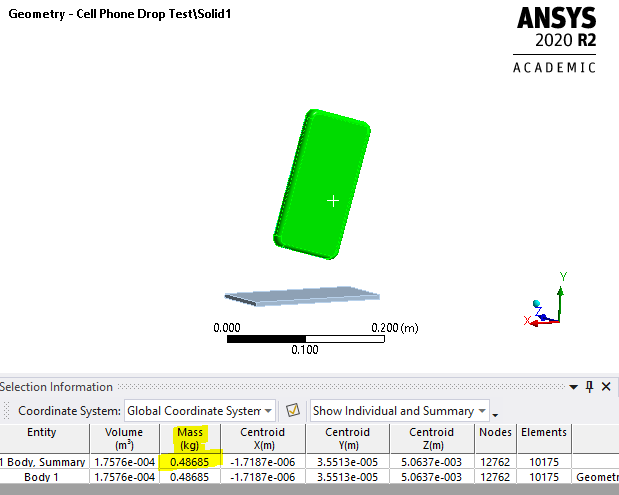
I was running an Explicit Dynamics simulation of a cell phone drop test (as part of Ansys Innovation Course called Strain in Deformation Analysis). In the simulation mass scaling was used and after getting the results I started wondering how much did the mass scaling affect to the mass of the cell phone.
I got the following results as shown in the figures:
October 14, 2020 at 2:49 amMissy Ji
Ansys EmployeeMass from solver output is more accurate, the mass shown at the selection information is an estimation.nOctober 14, 2020 at 8:36 pmSubscriberHi mji,nThank you very much for your comment!n I checked the solver output file admodel.prt for the analysis with mass scaling turned on. I found this data from the file (the unit of mass is milligrams):n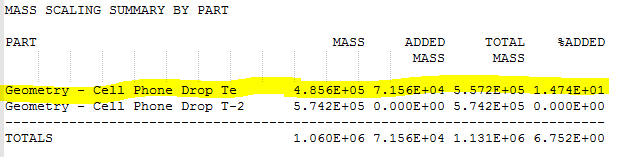 The highlighted row corresponds to the phone part. I guess these are the correct values for the mass scaling that I should use when checking how much the mass scaling affected to the mass of each part.nHowever, I'm a little bit confused now what do those MASSALL results mean that I showed in the first message, especially the row saying Total [kg].n-Nikken
October 17, 2020 at 4:46 pm
The highlighted row corresponds to the phone part. I guess these are the correct values for the mass scaling that I should use when checking how much the mass scaling affected to the mass of each part.nHowever, I'm a little bit confused now what do those MASSALL results mean that I showed in the first message, especially the row saying Total [kg].n-Nikken
October 17, 2020 at 4:46 pmKp_9079
SubscribernCan you please elaborate the steps to do the mass scaling in Explicit Dynamics nActually i am doing turning operation Simulation in 3D and my simulation shows me 350hours to run the whole simulation nso can you explain me how to do the mass scaling , so my simulation time gets small to about 3-4 days without change in Result when compared to the Experimental FormulaOctober 18, 2020 at 1:26 amSubscriberHi Kp_9079,nYou turn mass scaling on in the analysis settings:n nI don't know all the details about the settings but as I understand them Minimum CFL Time Step sets the smallest time step you allow for the solver and if the time step would go below it mass scaling will be applied to keep the time step larger than that. Maximum Element Scaling gives the maximum amount how much the mass of an element can be scaled and Maximum Part Scaling how much the mass of a part can be scaled up. I'm guessing that Update Frequency defines how often the solver checks the need of mass scaling and if needed updates the mass scaling values for the elements.nAlso, in case if you didn't know, time step is defined by the characteristic length of the smallest element in your mesh based on the CFL condition. So by increasing the mesh size and trying to make sure that your elements in the model are as equal size as possible with each other can help to reduce the simulation time. Also using hex mesh with linear element order is highly recommended. n
 Hopefully this helps and others can comment also since I have just got started with learning about explicit dynamics too. n
October 21, 2020 at 6:58 pmSubscriberThank you nIn these photo i can see min mesh metric characteristic length and the graph nso can you tell me how to locate these element with min mesh metric characteristic length from the graphnOctober 22, 2020 at 11:24 am
Hopefully this helps and others can comment also since I have just got started with learning about explicit dynamics too. n
October 21, 2020 at 6:58 pmSubscriberThank you nIn these photo i can see min mesh metric characteristic length and the graph nso can you tell me how to locate these element with min mesh metric characteristic length from the graphnOctober 22, 2020 at 11:24 ampeteroznewman
SubscribernClick on the tall blue bar and those elements are shown in the graphics window. n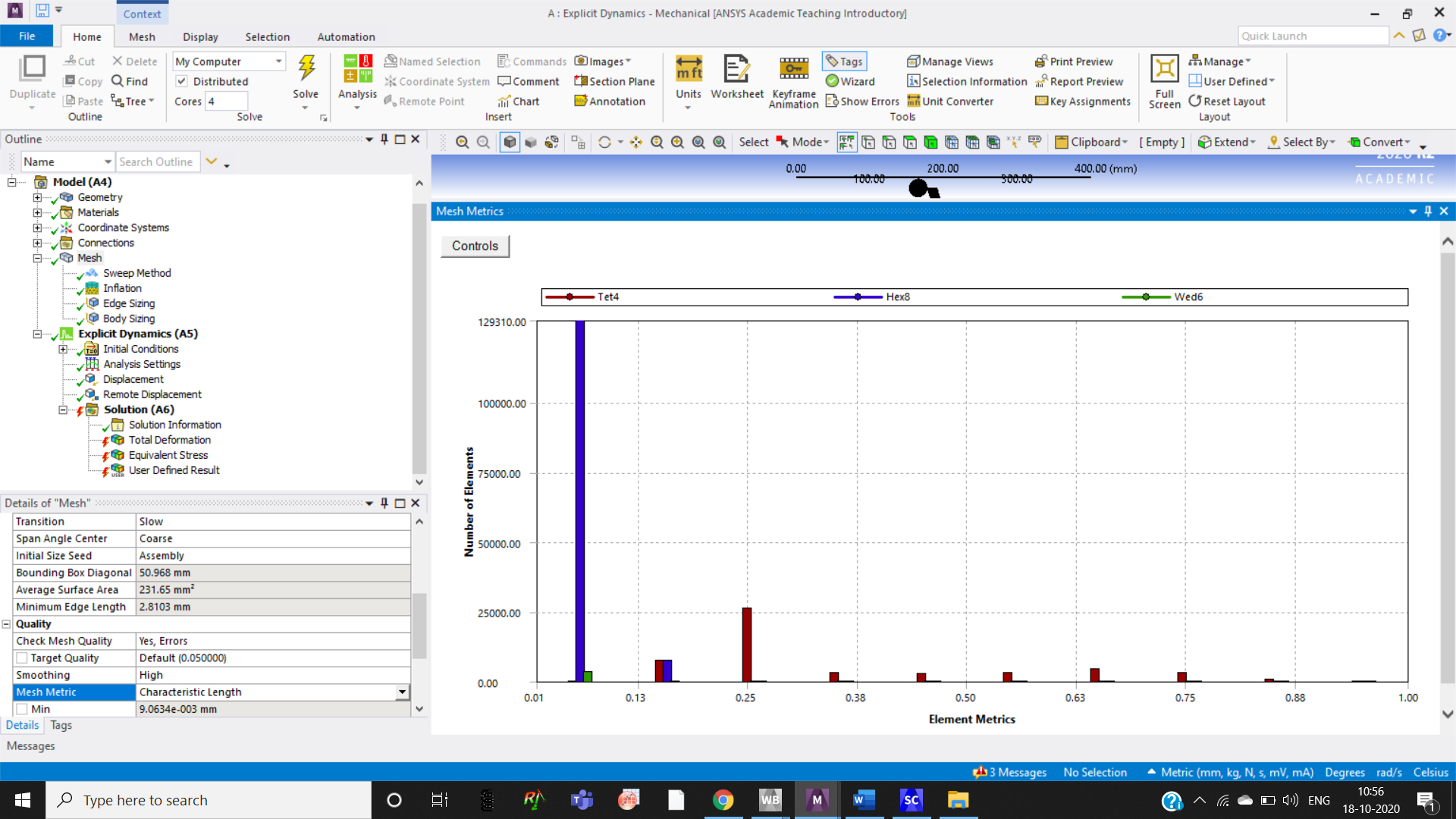 There may be some elements with shorter CL but those bars are too short to see with the top of this tall blue bar visible on the scale. Watch this video to learn how to use the Controls button to zoom in on a small number of elements and the short end of the CL scale.nn
March 3, 2021 at 3:40 am
There may be some elements with shorter CL but those bars are too short to see with the top of this tall blue bar visible on the scale. Watch this video to learn how to use the Controls button to zoom in on a small number of elements and the short end of the CL scale.nn
March 3, 2021 at 3:40 amdjtan
SubscribernViewing 7 reply threads- The topic ‘Mass Scaling in Explicit Dynamics’ is closed to new replies.
Innovation Space Trending discussions
 Top Contributors
-
peteroznewman
 6660
6660 -
scabo
 1906
1906 -
Dennis Chen
 1469
1469 -
javat33489
 1313
1313 -
Shyam Prasad V Atri
1022
Top Rated Tags
© 2026 Copyright ANSYS, Inc. All rights reserved.
Ansys does not support the usage of unauthorized Ansys software. Please visit www.ansys.com to obtain an official distribution.
-


The Ansys Learning Forum is a public forum. You are prohibited from providing (i) information that is confidential to You, your employer, or any third party, (ii) Personal Data or individually identifiable health information, (iii) any information that is U.S. Government Classified, Controlled Unclassified Information, International Traffic in Arms Regulators (ITAR) or Export Administration Regulators (EAR) controlled or otherwise have been determined by the United States Government or by a foreign government to require protection against unauthorized disclosure for reasons of national security, or (iv) topics or information restricted by the People's Republic of China data protection and privacy laws.

 You are navigating away from the AIS Discovery experience