-
-
August 9, 2022 at 9:00 pm
kpriu
SubscriberI am creating a simulation in Rigid Dynamics, where I test the effects of best and worst case friction. I have defined a nonzero coefficient of friction for each joint, but when I increase the coefficients of friction, the force at the joints decreases, which does not make sense. This is leading me to assume I have done something wrong, since I am relatively new to the program. Is there anything else I need to do to properly create a joint with friction other than defining the joint and setting the coefficient of friction?
Note: I have tried adding a contact region at the joint, but that does not seem to change anything.

-
August 10, 2022 at 12:40 am
greg2835
SubscriberHi kpriu, can you provide a descriptive layout of the assembly and the the joints defined?
-
August 10, 2022 at 12:23 pm
kpriu
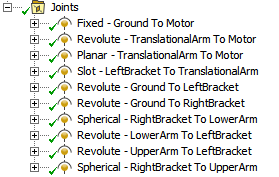
SubscriberI have attached a screenshot with the joints. There is a motor that outputs translational motion, and when it pushes the bottom of an arm (TranslationalArm) forward, that arm pivots about its center, and the top of the arm then pulls the bracket (LeftBracket) it is connected to back. That bracket is connected to another bracket by two arms, so when that bracket rotates backwards, the other one does as well.
Â
-
December 30, 2022 at 5:34 am
bhagwantP
Ansys EmployeeHello kpriu,
Thanks for more eloboration. Will you please show us how friction has been defined for joint?
Thanks
-
December 30, 2022 at 5:38 am
bhagwantP
Ansys EmployeeThis will help us to ensure it;s defined correctly.
Thanks
-
- The topic ‘Joints with Friction’ is closed to new replies.
-
6284
-
1906
-
1457
-
1308
-
1022
© 2026 Copyright ANSYS, Inc. All rights reserved.