

TAGGED: mesh-generation, multizone, share-topology, shared-topology, spaceclaim
-
-
January 6, 2022 at 8:10 pm
sarbakhshian
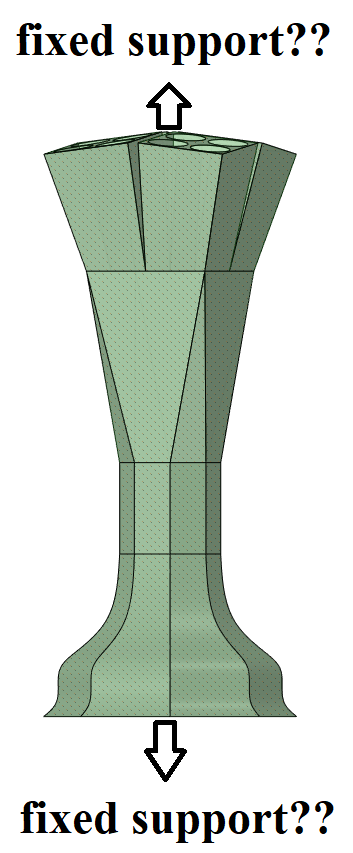
SubscriberI have a geometry with multiple body parts, whenever I choose "share" option in SpaceClaim, Ansys mesher fails to mesh my geometry with "multizone" method and I'm not satisfied with unstructured mesh using other methods. However, when I set my Component in "grouped" mode in SpaceClaim, I have more control on edge sizing and a good structure mesh happens with multizone method.
Would I face a problem in future if I do not choose "share" option? Would I get correct results from my analysis?
I'm also attaching a picture of my geometry
Thanks for your attention.
January 7, 2022 at 10:59 amSaumadeep Choudhury
Forum ModeratorHi @sarbakhshian
Share Topology (Share Topology (ansys.com)) is used when bodies are grouped into multi-body parts and the solid(s) and surface(s) are touching or intersecting.If the bodies are Shared then the nodes will also be shared and thus the mesh.
When "Group" (Groups (ansys.com)) is used the multi parts are saved as individual parts and no node is shared between them. Thus Contacts will come up during analysis.
Both the approaches are suited for different conditions and the correctness of your analysis depends on your problem statement.
Please refer to this to get a clear idea - Contact or Shared Topology ÔÇö Ansys Learning Forum
Regards, Saumadeep
Ansys Help
Ansys Learning Forum (Rules & Guidelines)
Viewing 1 reply thread- The topic ‘Is it Ok not to use Shared Topology in SpaceClaim’ is closed to new replies.
Innovation Space Trending discussions
 Top Contributors
-
peteroznewman
 6189
6189 -
scabo
 1906
1906 -
Dennis Chen
 1452
1452 -
javat33489
 1308
1308 -
Shyam Prasad V Atri
1022
Top Rated Tags
© 2026 Copyright ANSYS, Inc. All rights reserved.
Ansys does not support the usage of unauthorized Ansys software. Please visit www.ansys.com to obtain an official distribution.
-


The Ansys Learning Forum is a public forum. You are prohibited from providing (i) information that is confidential to You, your employer, or any third party, (ii) Personal Data or individually identifiable health information, (iii) any information that is U.S. Government Classified, Controlled Unclassified Information, International Traffic in Arms Regulators (ITAR) or Export Administration Regulators (EAR) controlled or otherwise have been determined by the United States Government or by a foreign government to require protection against unauthorized disclosure for reasons of national security, or (iv) topics or information restricted by the People's Republic of China data protection and privacy laws.

 You are navigating away from the AIS Discovery experience