Ansys Assistant will be unavailable on the Learning Forum starting January 30. An upgraded version is coming soon. We apologize for any inconvenience and appreciate your patience. Stay tuned for updates.
General Mechanical

General Mechanical

Topics related to Mechanical Enterprise, Motion, Additive Print and more.

Input real engineering data

    • Erme
      Subscriber

      Hi everyone,


      I have been trying for 2 months to simulate non-linear material behavior. I would like to ask three questions:


      1. Must I insert strain data in percent or would strain automatically be transformed in percent in kinematic isotropic hardening? 


      2. For bilinear isotropic hardening, does anyone have any suggestions to calculate the yield strength of a thermoplastic?


      3. Can tangent modulus be calculated from a randomly chosen point or is there any specification for this value?


      I would be appreciated if someone might help me.


      Thanks!

    • peteroznewman
      Subscriber

      Read this discussion.  The data should be Plastic Strain and True Stress, not percent strain.


      Do you have a Stress-Strain table of values from a tensile test of a material sample?  If you have data, then plot the data and look for a break in the curve from the steep slope of E in the linear elastic portion of the curve to the lower slope of the hardening curve. Here is an example.


      If you don't have data, then you must look up values from the manufacturer of the plastic. Here is an example. This example does not list a yield strength. I think that is because the material is brittle. It just goes up the linear elastic slope until fracture at the Ultimate Strength at 2.12% strain. If that is the case, you don't need to use a nonlinear material at all.


    • peteroznewman
      Subscriber

      The first table is not correct for use in ANSYS Plasticity material models, which do not use % strain. They use strain.


      The second table does not show plastic strain, it only shows true strain. ANSYS Plasticity material models use plastic strain not True Strain.


      So the answer is neither table is correct, but the second table is at least correct as far as calculating true stress and strain. I edited my earlier post to say Plastic Strain, sorry if that confused you, but it is clear in the link I provided.


      Just because one wrong table gives better agreement with experimental data than another wrong table isn't a good reason to use a wrong table.  It is a sign to check everything and look for other mistakes in the inputs to the model and the processing of the experimental data.

    • Erme
      Subscriber

      That was my fault, sorry. I added plast?c strain to the data. I marked with yellow.
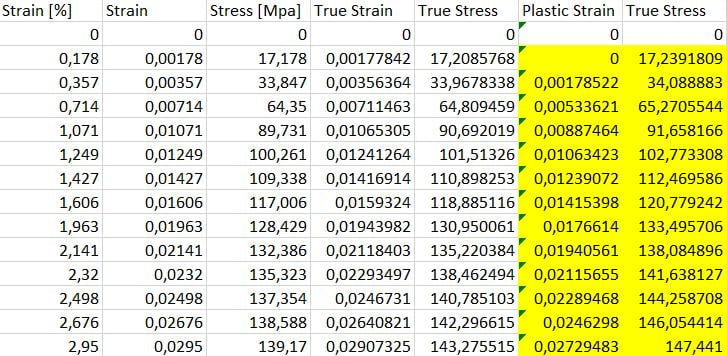


      It is totally clear from my side, that I must define a plastic strain, also according to your recommendation. According to true strain values I defined plastic strain. 


      I assume, that I can use and input them also according to my calculations, or?


      Moreover, I checked the database you recommended. However, there is no information, especially for yield stress. But I think, I can define yield stress, according to my plastic strain data, which I defined above. By assuming, that the yield stress is for example 17 MPa and defining a tangent modulus in the plastic field, I can also define bilinear isotropic hardening. 


      Thanks!

    • peteroznewman
      Subscriber

      Erme,


      It is good to have a Stress Strain curve, but you also have to know when necking began because the equations that convert the data to True Stress and True Strain are not valid after necking begins.


      If you plot your data, you can see there may be a good break point between a linear elastic portion and the next slope.  The last few points may be after necking began. You have to know that before you can use that data. In the plot below, the red line has a slope of 8985 MPa which would be the Young's Modulus, while the blue line has a slope of 5507 MPa which would be the Yangent modulus for a Bilinear Hardening plasticity model. The yield strength is a the intersection of those two lines at about 80 MPa.


Viewing 4 reply threads
  • The topic ‘Input real engineering data’ is closed to new replies.
[bingo_chatbox]








