

-
-
October 7, 2021 at 3:39 pm
dcerantola
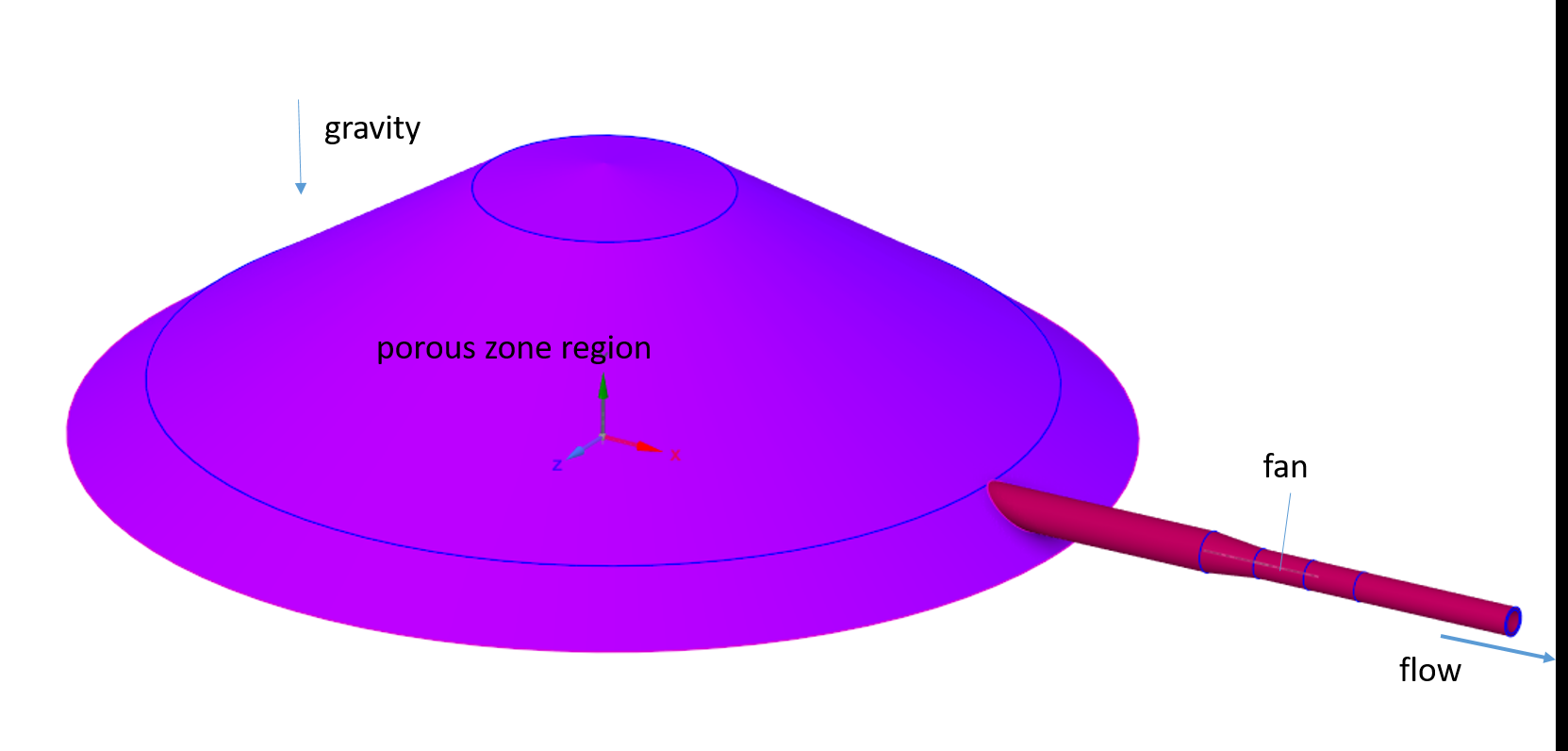
SubscriberMy geometry consists of a porous zone region (R=2m) that pulls air from a R=25m hemispherical inlet plenum and exhausts through a pipe originating from the center of the pile. Source terms are applied in the fan subvolume to achieve the desired flow rate. Gravity is turned on since I will eventually replace the porous region with a DEM packed bed geometry.
I want to simulate the inlet plenum with quiescent air and believe a total pressure inlet boundary condition is the correct choice; however, I am uncertain if I should specify total pressure as constant 0 Pa(g) or -gravity*density*y. Both options give something similar to the shown vector plot that has the bulk of the streamlines hitting the pile originating from the top of the hemisphere.
My expectation is that the stream function in the plenum should be characteristic of a line sink (psi = m*theta) and therefore am suspicious of the inlet boundary condition definition. Thoughts?
October 11, 2021 at 12:10 pmKarthik Remella
AdministratorHello I'm not completely sure if I understand your expectation. Are you trying to include the effects of gravity (hydrostatic pressure)? If I understand your problem, I'd assume that the total pressure boundary condition seems appropriate for this problem.
Karthik
October 12, 2021 at 12:35 pmSubscriberTo elaborate on what I want to do:
I want to run a coupled DEM-CFD simulation whereby the porous zone region shown above will be replaced by a Rocky solution of discrete particles. The DEM solution requires gravity and therefore it is my expectation that I need to include the effects of gravity in the CFD solution so a total pressure inlet with -density*gravity*y makes sense to me.
The desired outcome is a transient temperature field. I intend to initialize the transient simulation with the shown velocity field and solve the transient equations with the frozen flux option.
Because I will be disabling diffusion, I am suspicious of the obtained steady velocity field in the plenum and question if it is a consequence of the specified total pressure inlet boundary condition and/or the location of the computational domain inlet.
At this point, I'm going to proceed with setting up the problem with the assumption that the velocity field is representative. I will eventually have experimental results to compare against.
The reason for this post was to find out if others who have simulated quiescent plenums have also identified that the obtained velocity field does not match an inviscid flow solution.
October 18, 2021 at 2:26 pmRob
Forum ModeratorSet the inlet pressure (outlet pressure boundary) as zero, but set the operating density to be exactly that of the bulk fluid at the boundary conditions. Also use "from neighbouring cell" to avoid the near boundary cell flow direction being forced.
October 19, 2021 at 6:01 pmSubscriberThank-you for the tips Rob.
Only setting outlet boundary conditions is a new one for me but I'm favourable to using 'from neighbouring cell' to alleviate concerns regarding how big I need to make the plenum.
I gather from the user manual that the main motivator for using a non-zero operating density is to improve convergence behaviour. A concern that I do have is that the streamlines will change in the plenum with time, so hopefully this helps.
Even with these changes, my plenum flow still shows entry from the top and exits on the sides. I guess my intuition was wrong that the flow would be more characteristic of a line sink.
October 20, 2021 at 10:11 amForum ModeratorSet the operating density to be exactly that of the bulk fluid at the boundary conditions. Ie if you're using a variable density fluid initialise from the outer (pressure) boundary, find the EXACT density to all decimal places that Fluent sees (contours with node values off or reports are good for this) and use that as the operating density.
Viewing 5 reply threads- The topic ‘Inlet boundary condition definition for quiescent air flow’ is closed to new replies.
Innovation Space Trending discussions
 Top Contributors
-
peteroznewman
 6520
6520 -
scabo
 1906
1906 -
Dennis Chen
 1463
1463 -
javat33489
 1310
1310 -
Shyam Prasad V Atri
1022
Top Rated Tags
© 2026 Copyright ANSYS, Inc. All rights reserved.
Ansys does not support the usage of unauthorized Ansys software. Please visit www.ansys.com to obtain an official distribution.
-
Ansys Assistant will be unavailable on the Learning Forum starting January 30. An upgraded version is coming soon. We apologize for any inconvenience and appreciate your patience. Stay tuned for updates.


 You are navigating away from the AIS Discovery experience