Ansys Assistant will be unavailable on the Learning Forum starting January 30. An upgraded version is coming soon. We apologize for any inconvenience and appreciate your patience. Stay tuned for updates.
General Mechanical

General Mechanical

Topics related to Mechanical Enterprise, Motion, Additive Print and more.

Incorrect results

    • Ghost3507
      Subscriber

      My structure is a bit complicated to describe but I will simplify. Assume we a rectangular beam with 20x5x5(LxWxH)mm and I applied an acceleration load of 14715 mm/s^2 in the +ve Z direction and I supported the body from the Height edges (4 edges) what is expected is that the beam will bend about the lateral plane where the face with tension and the face with compression will move/deform toward the +ve Z direction. The problem is the deformation animation is in the -ve Z direction. 

    • peteroznewman
      Subscriber

      If you have a simply supported beam along the X axis, and apply an acceleration load in the +Z direction, the center of the beam will deform in the -Z direction.


      The way to think about this is the ends of the beam are being accelerated in the +Z direction, while the mass at the center of the beam experiences an inertia force in the -Z direction, bending the center in that direction.


      Note that Standard Earth Gravity has the opposite sign convention. If you assign the Standard Earth Gravity to the +Z direction, think of that as the direction that a mass will fall if unsupported.  So the center of a simply supported beam along the X axis will deform in the +Z direction. I know, it's confusing.


      What is even more confusing is that in Fluent, accelerations work the same way as Standard Earth Gravity does and opposite to the way accelerations work in Structural.

    • Ghost3507
      Subscriber

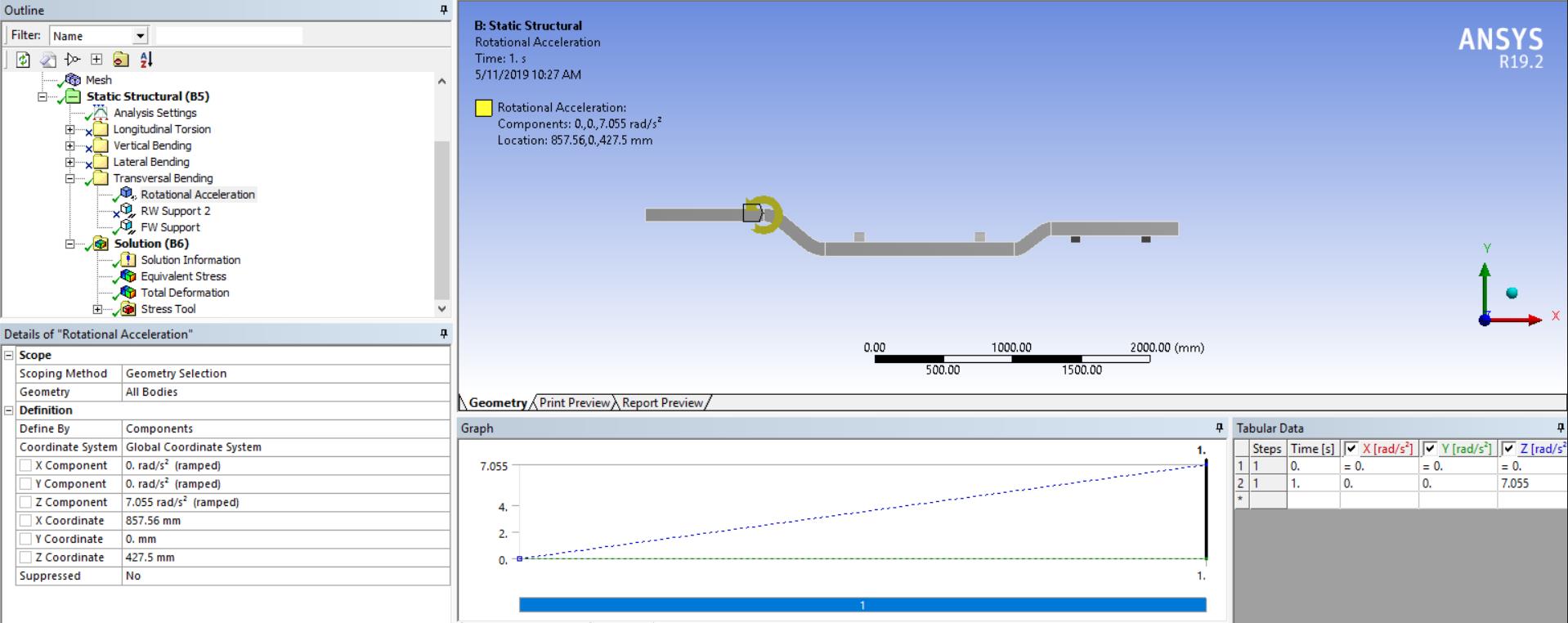
      To be clear I am dealing with a ladder chassis. Another situation is when the car decelerates the car the rear end bend toward the front end transversal bending to the side beams. so I apply a rotational acceleration about +ve Z  and support at the from wheels mounts. what I get is a rotation (in the animation) about the -ve Z axis.

    • Ghost3507
      Subscriber

      No I currently don't use earth gravity

    • peteroznewman
      Subscriber

      It's still not clear what you put in your model, what the results are and what you expected.


      Please capture a screen image using the Snipping Tool in Windows 10. Once you save a screen image to a file, you can insert the image in your reply.

    • Ghost3507
      Subscriber


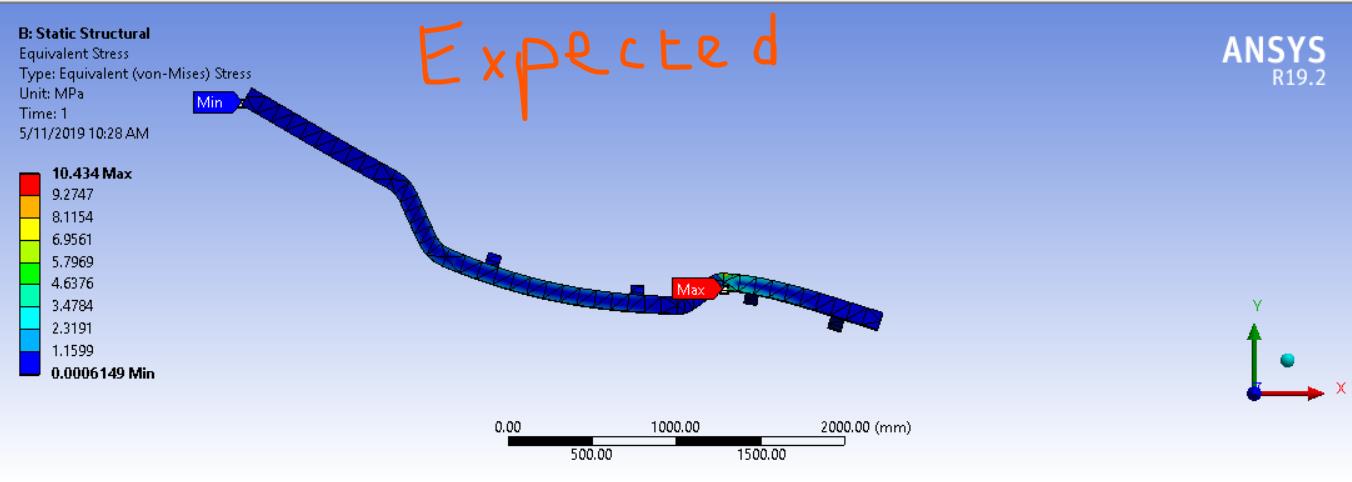
      The load direction should be about -ve Z but I inverted to show the expected deformation.


      This is what I expected as the car decelerates.


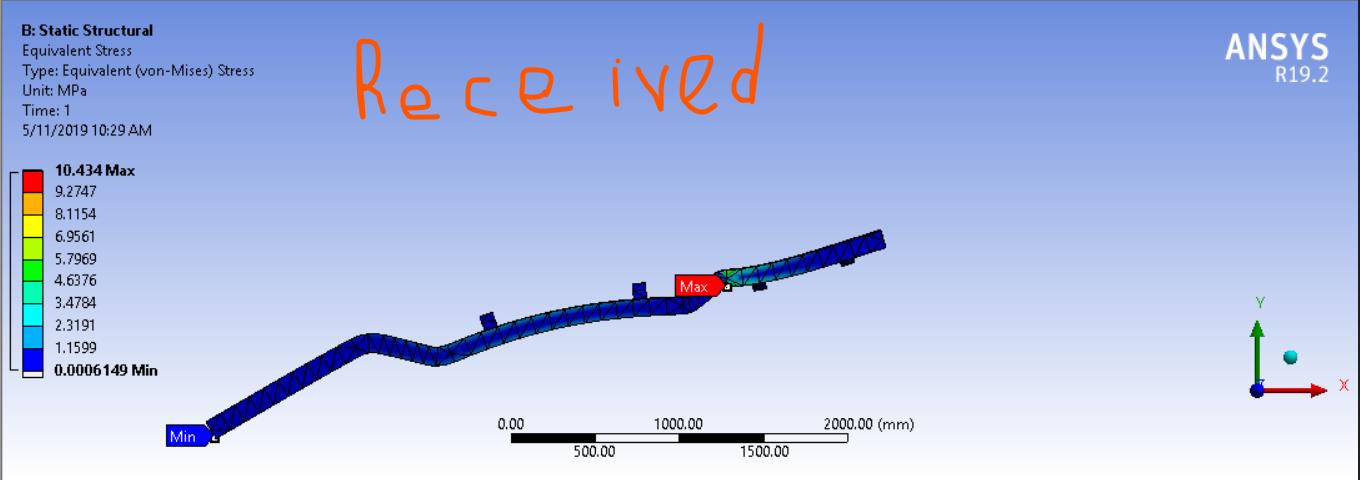
      This is the result when I set the load in +ve Z direction.

    • peteroznewman
      Subscriber

      What you received is what I expect. By rotationally accelerating a beam about a point at the left end, the mass at the right end is going to lag behind, pulled by the inertia forces.


      Imagine you have a very flexible steel ruler, the long direction along the x axis and the thin dimension aligned with Y so the ruler lies in the XZ plane. At the left end, the ruler is fastened to shaft with a crank handle. A large mass is attached at the right end. Suddenly turn the crank about +Z and imagine what happens. The mass will lag behind and the ruler will bend the way the frame did in the received image.

    • Ghost3507
      Subscriber

      Thank You so much explaining to me this concept.

Viewing 7 reply threads
  • The topic ‘Incorrect results’ is closed to new replies.
[bingo_chatbox]