Ansys Assistant will be unavailable on the Learning Forum starting January 30. An upgraded version is coming soon. We apologize for any inconvenience and appreciate your patience. Stay tuned for updates.
General Mechanical

General Mechanical

Topics related to Mechanical Enterprise, Motion, Additive Print and more.

Implementation of Member Size Constraint and AM Overhang Constraint in Topology Optimization

    • christopher
      Subscriber

      Hello,


      how are the Minimum member size constraint and the AM Overhang constraint implemented in the Topology Optimization Tool of ANSYS 19.2?


      From the results I get from the Topology Optimizations with ANSYS I would think the mimimum member size is implemented either as a filter or with the Perimeter method.


      For the AM Overhang constraint I would guess it´s implemented somehow implicid e.g. with a penalty factor in the objective function, since the overhang constraint is violated for small retained volume percentages.


      Can anyone tell me how both are really implemented? That would be very helpful to understand the problems I figured out with the constraints.


      Best regards


      Christopher

    • Sandeep Medikonda
      Ansys Employee

      A typical optimization is defined as follows:
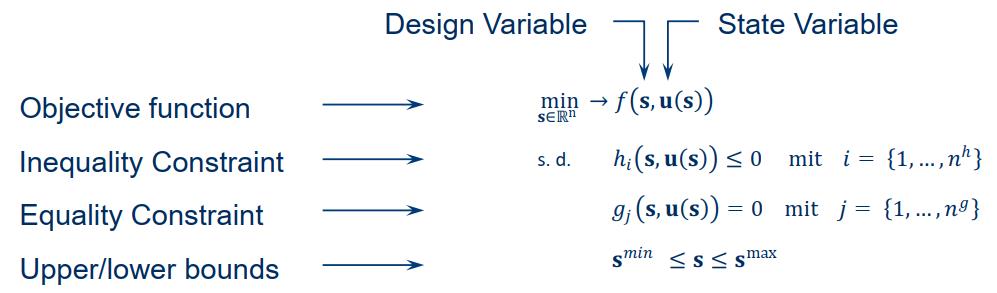


      Now, the constraints such as minimum member size etc. turn this problem into a constrained optimization problem.


      Minimum member size is implemented as a manufacturing constraint in the optimization problem. By default when you specify program controlled it is chosen to be 2.5 times the minimum element size. The primary goal of the AM Overhang Constraint is to be able to print parts without adding supports. Some details on the implementation of the constraints can be found in Section 2 below along with the subsequent references.


      From the Help:


      Section 1


      Section 2


      Section 3


      The penalty factor, on the other hand, transforms a discontinuous optimization problem into a continuous one. Ideally, you would want to choose as high value to minimize the intermediate zones. However, this often leads to convergence problems. Hence a value of 3 is suggested as a default for most problems in the analysis settings. To the best of my knowledge, this is not changed based on the constraints chosen.


      Regards,
      Sandeep
      Guidelines on the Student Community
      How to access Online Help

Viewing 1 reply thread
  • The topic ‘Implementation of Member Size Constraint and AM Overhang Constraint in Topology Optimization’ is closed to new replies.
[bingo_chatbox]








