Ansys Assistant will be unavailable on the Learning Forum starting January 30. An upgraded version is coming soon. We apologize for any inconvenience and appreciate your patience. Stay tuned for updates.
General Mechanical

General Mechanical

Topics related to Mechanical Enterprise, Motion, Additive Print and more.

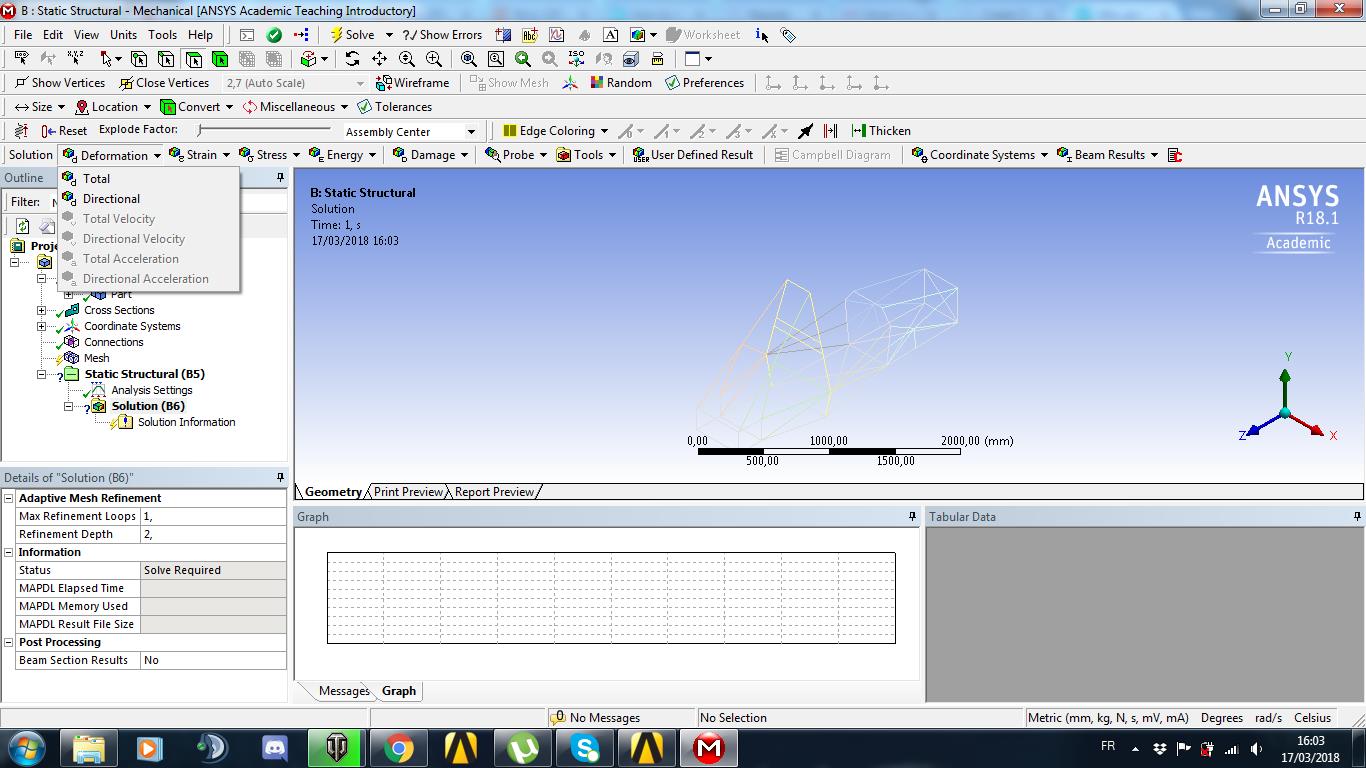
I can only insert Total and directional deformation in the solution.

    • Emiros143
      Subscriber

      Hello everyone.

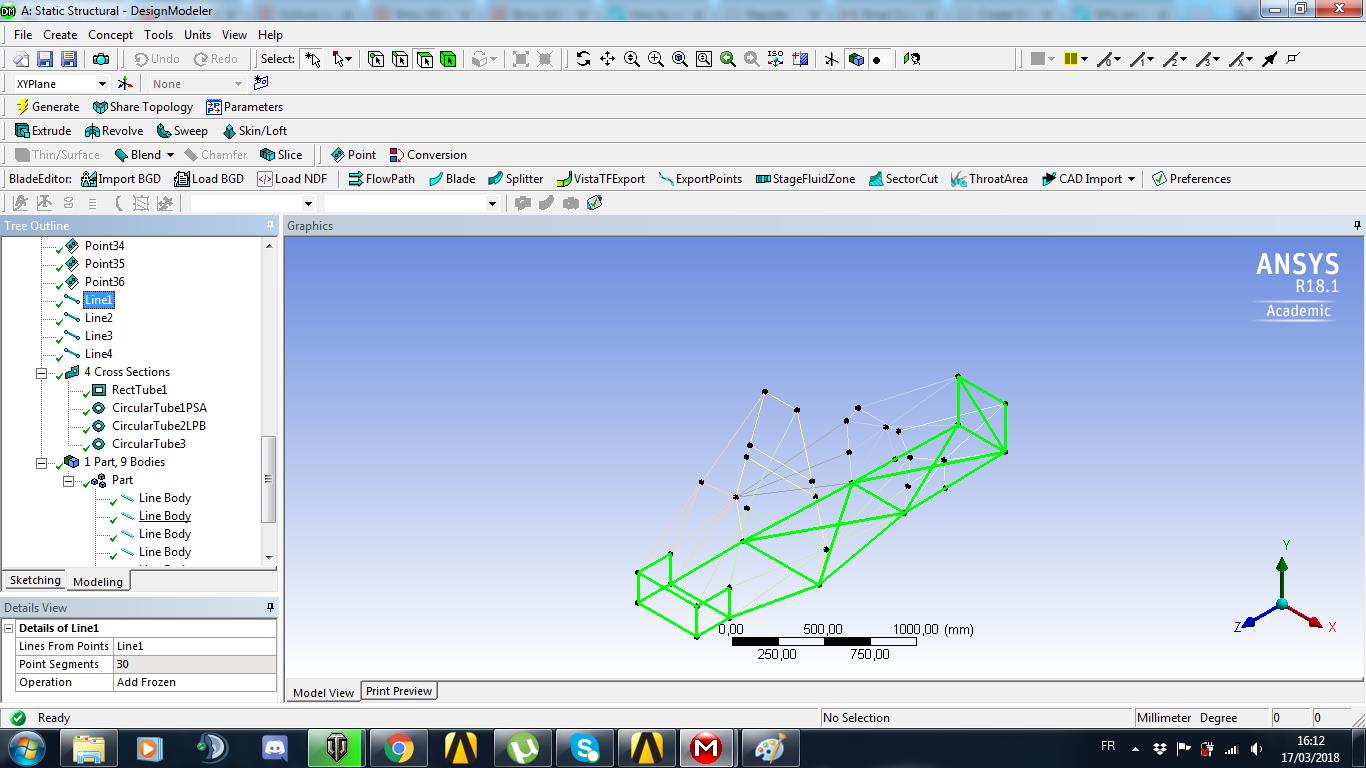
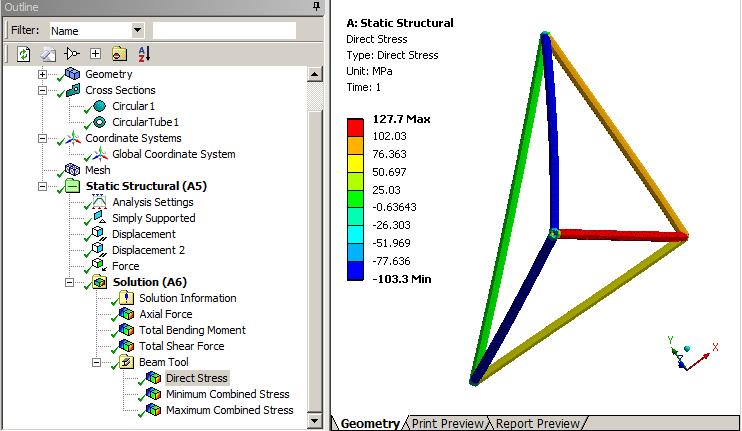
      Since I'm working on my end of studies project , I have designed a chassis in DM made of points and lines with different cross sections as shown in the pictures I will provide.

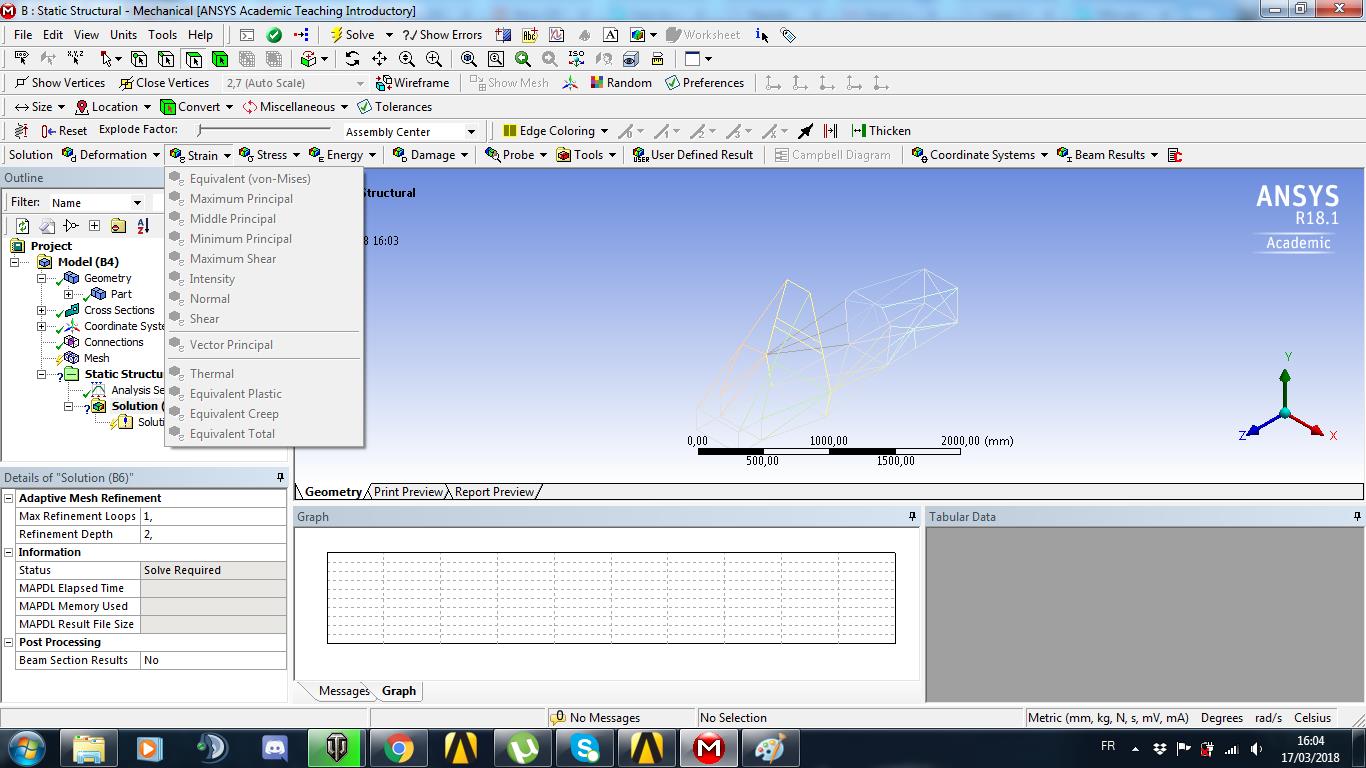
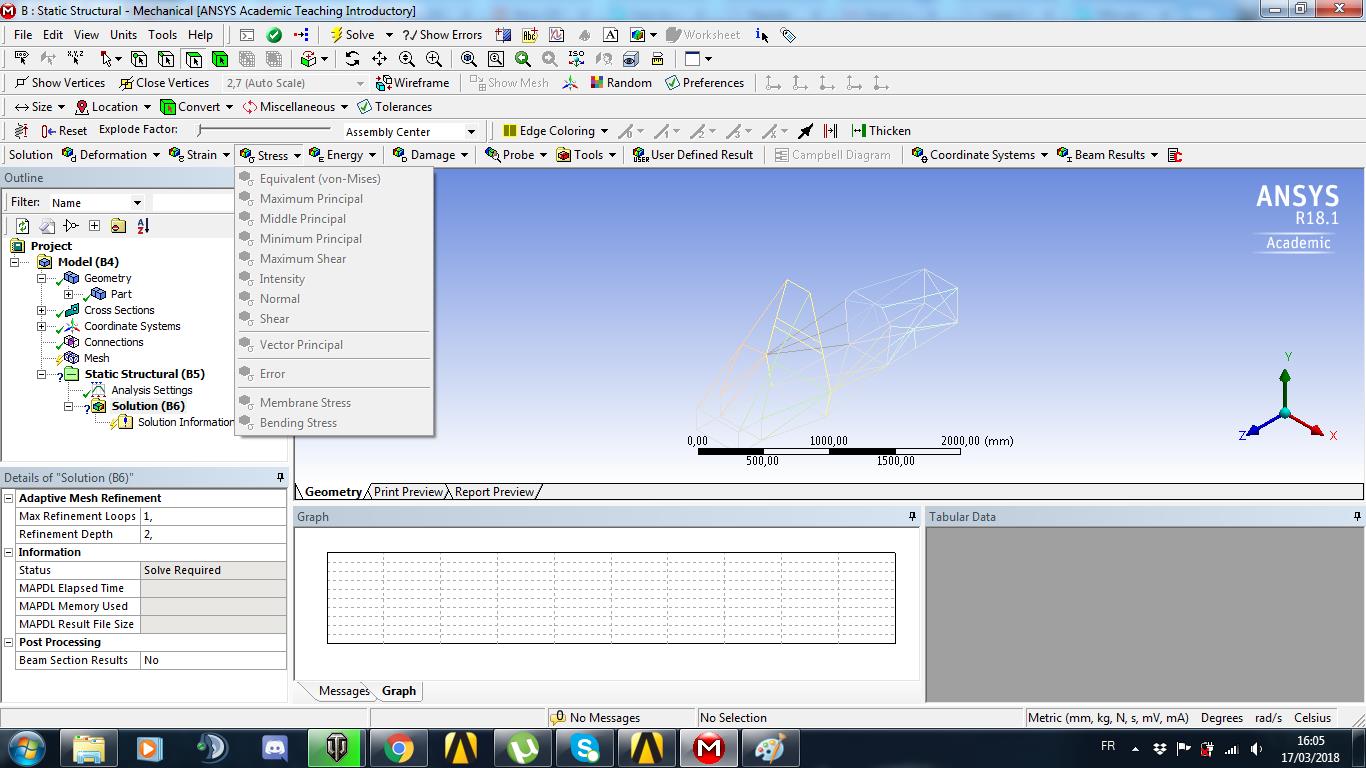
      All is good until I went to Mechanical where as the title suggests I can only use 2 deformations while strain , stress... etc are unavailable.

      I thought the problem could be of my student Ansys version  18.1  , but turns out the software is okay since I tried mechanical with another simpler object and didn't have the same problems.

      Regards.

      Emir.

    • Emiros143
      Subscriber

    • Emiros143
      Subscriber


      The geomtery

    • Emiros143
      Subscriber

    • Emiros143
      Subscriber

    • peteroznewman
      Subscriber

      Look past the Stress pull down and look in the the Tools and Beam Results pull down.


    • Emiros143
      Subscriber

      Thank you sir that is helpful however the original problem is still the same , for example I still can't get the strain...

    • peteroznewman
      Subscriber

      You can calculate strain from stress because you know Young's Modulus, E.


            strain = stress/E  

    • Emiros143
      Subscriber

      Thanks very much Peter. I think the problem is with  the fact that I desined the chassis based on points and the fatigue tool therefore presents the same problem , appears in grey and is unselectable. Can you please provide me with geometry file preferably in design modeller so I can apply fatigue tests on it I really need this for my assignements.


      Thanks in advance.

    • peteroznewman
      Subscriber

      Hello Emir,


      Attached is a zip file that contains a Parasolid binary file of a car frame constructed of tubes. Open a new Static Structural, open DesignModeler, then use File, Import External Geometry File...


      This geometry comes from vaibhav jain where we were crashing the frame into a wall using Explicit Dynamics on a full license.


      Your problem Emir, is that on a Student license, this body uses over 100,000 nodes+elements using a default mesh, and the Student limit is 32,000. I don't know if you will be able to stretch the elements along the tubes enough to get under this limit.


      You can do fatigue calculations in a spreadsheet and put the stress results from your beam model into the spreadsheet.


      Regards,
      Peter

    • Emiros143
      Subscriber

      Thanks a lot peter, however in the geometry the two bodies have 0 thickness   I'm a beinner tb and would appreciate more elp.


      I need to simulate te fatigue suffered by the chassis in corners ( catalunya circuit) I don't know from were to begin..

    • peteroznewman
      Subscriber

      You get to assign the thickness to the tubes. You can assign 1 mm, 1.5 mm, 2 mm, 3 mm. Whatever you want.  This geometry is not the same as your beam model.  If you are going to stay with your beam model, it would help if you archive that project and send me the .wbpz file.  You do that in Workbench (not Mechanical) by clicking File, Archive...


      You can attach the .wbpz file to your post by using the Attach button.

    • Emiros143
      Subscriber

      here it is mate and many thanks in advance 

    • peteroznewman
      Subscriber

      Hello Emir,


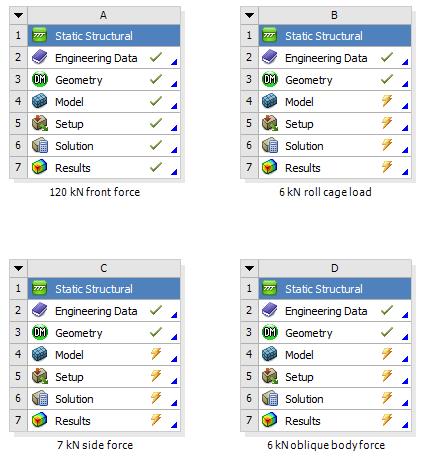
      Thanks for your archive. I see you have four load cases.


      Do you have the number of cycles of each load that are expected?
      That is the next step to calculate a fatigue life for this chassis.


      Cheers, Peter

    • Emiros143
      Subscriber

      Hello Peter.

      Well thanks infinitely , as for the cycles well l don't know really but I'd say let it run till it fails? at least 500 cycles I would suggest.

      I will attach to you a file showing the lateral acceleration that the chassis suffers in one lap of the circuit.

      Would be nice if we can simulate fatigue suffered by the chassis in 500 laps ( or a lot more tbh maybe till it fails or it doesn't? ) 

      Lateral acceleration is theoratically to be appleid in the rear part where the engine is.

      I would very much appreciate if you could help me with that , as for the geometry it's the same one u currently have.

      Once again Peter thanks a bunch mate.

    • Emiros143
      Subscriber


    • peteroznewman
      Subscriber

      Hello Emir,


      You can attach zip files to your posts on this site. So if you have data in Excel, or some other file format, put it in a zip file archive and attach that zip file.


      Your model had four load cases. The front force seemed like a front impact, while the roll cage seemed like it would be if the car rolled over. I don't think you want to estimate a fatigue life for those loads.


      The side load and oblique loads may be closer to loads experienced during a lap. One important choice in fatigue analysis is whether the load reverses, or does it go between zero and the maximum value. You have to say what happens during a lap. Maybe the lateral acceleration record of a lap will help decide.


    • Emiros143
      Subscriber

      Hello Peter.


      All of what u mentioned above is correct, I managed to zip te lateral accelerations that the cassis suffers during one lap. 

    • Emiros143
      Subscriber

      BTW Peter


      In that table there are two transitions in oranje , they have the same lateral accelerqtions as the 2 curves before them.


      Thanks.  

    • peteroznewman
      Subscriber

      Hello Emir,


      Looks like the course starts on the right and you are driving clockwise with right turn on R44 and a left turn on R62.


      Since most of the turns are right, let the right turns be a positive lateral acceleration and a left turn be a negative lateral acceleration.


      Use the course map and the lateral acceleration table to make a signed-acceleration vs turn history of the lateral acceleration for one lap.


      The cycles of left and right accelerations cause a reversal of stress that is important for fatigue. Fill out the rest of the spreadsheet.  Do you know how to count cycles?  Look up the rainflow method of counting. See if you can create a rainflow table of cycles.

    • Emiros143
      Subscriber

        Hello Peter


      Thanks for the feedback.

      As you mentioned above yes.

      I have filled in the sheets but I'm sorry  I don't know the method however I'll have a look on it and see what I can get from it.

      Regards.

      Emir

    • peteroznewman
      Subscriber

      Hello Emir,


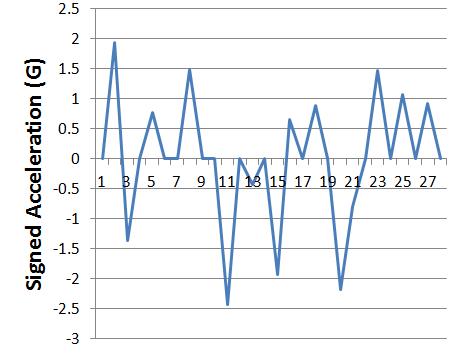
      So here is the graph of lateral acceleration vs course section.
      (After row 22 got the -1 that was mistyped as *1).


      Once you have studied Rainflow counting, count the peak-peak range and the number of half or full cycles, it looks like this after sorting:  Can you get this same table?   You can bin numbers that are close to each other and add up the cycles, so instead of 14 ranges, you can have 6-8 bins with a higher number of cycles. Please bin these numbers and provide that table.


      •    Range(G)  Cycles 

      •     3.648     0.5

      •     3.067     0.5

      •      2.82      0.5

      •     1.933      0.5

      •     1.933     0.5

      •     1.933     0.5

      •     1.492      1

      •     1.467     0.5

      •     1.063      1

      •     1.058      1

      •     0.924      1

      •     0.766      1

      •     0.649      1

      •     0.423      1


      You can calculate the amount of fatigue damage each range does. A large range does more damage than a small range. Read about Miner's rule for Fatigue Damage. A half cycle does half the damage of a full cycle. In this way you can add up the total damage for one lap.


      The next step is to establish the load case that best represents lateral acceleration. If we have a 1 G lateral acceleration, with the wheels resisting the lateral force, what is the stress in the frame?  That maximum stress is what we can scale up and down according to the table above.  Please reply with your version of the lateral acceleration load and boundary conditions on your frame model.  You will need to represent the mass that the frame is supporting. Significant mass like the engine can be added as a point mass.  The rest of the mass can be distributed over the frame by assigning the frame a density calculated so the entire model weighs the same as the car.

    • Emiros143
      Subscriber

      Hello Peter.

      I am indeed reading tutorials so the rainflow method as you mentioned is what am reading now, should be able to feedback with you soon.

      Many thanks for your help.


    • peteroznewman
      Subscriber

      Hello Emir,


      You also should read about Miner's Rule, which is a method of calculating the accumulated damage from different amplitudes of different numbers of stress cycles and predicting when fatigue failure will occur.


      Regards.

    • Emiros143
      Subscriber

      Well yes I'm actually doing that as well Peter but I forgot to mention it lol.

      Thanks anyway and see you soon. 


    • Emiros143
      Subscriber

      Hello Dear peter I hope you're doing okay.

      I'm advancing in my projects , thanks a lot for your assisstance.

      However I'm experiencing a bit of a problem , attached is the project with 3 parts , the main body , a line body I surpressed because I replaced it with the sweep function, so it's a solid body.

      What I need to do is weld the line body of the chassis with the solid body I generated , problem is that it keep giving me errors , and in geometry you can't make a single part composed of line bodies and solid bodies

      Thanks in advance.

      Emir.

      Thanks in advance.

    • peteroznewman
      Subscriber

      Hello Emir,


      You are lucky to catch me during my break.


      I don't think you want solids on the roll bar, I think you want shell elements, so I changed the Sketch for the sweep to a single circle half way between the 10 and 12.5 mm diameter circles and set the sweep to Thin which creates a surface body.


      In Mechanical, I assign a 2.5 mm wall thickness to the surface body so it behaves very similar to the solid body. To get a nice looking mesh on the surface body, I added Face Meshing.


      To connect the surface body ends to the end of a beam element, I added Bonded Contact between the edge and the vertex.


      If you really want the solid instead of the surface, you can have bonded contact between the face and the vertex.


      Attached is an ANSYS 18.1 archive. Good luck,


      Peter

    • Emiros143
      Subscriber

      Dear Peter.

      This is beyond what I expected.

      I can't express enough how grateful and thankful I am for your contribution and help to my work.

      Thank you very much sir.

      Sincelerly.

      Emir.


    • Emiros143
      Subscriber

      Hello Peter.

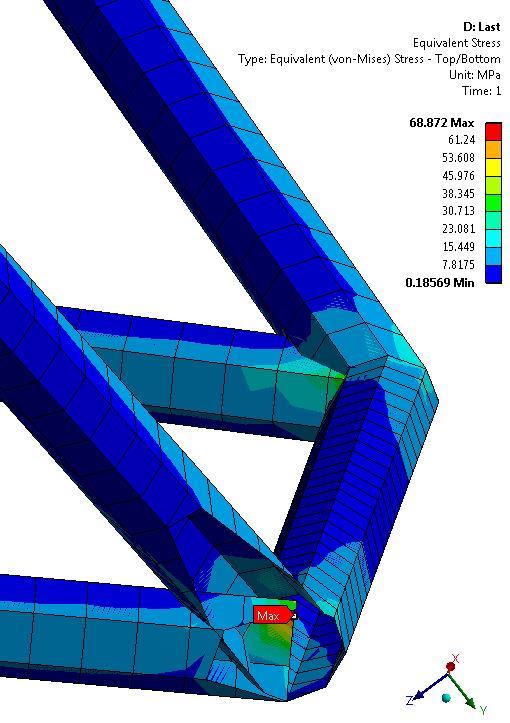
      I have tried a fatigue run in the model and the rainflow and damage matrix don't seems to be giving me any logic results.


      the parts with surface elemnts are the parts I changed from beam to shell elements because they showed the highest stress during the static analysis while the entire chassis bean a beam model.

      it's attached here , the D static structural one with name " Last ".

      I'm finalizing my project but I'm stuck here , does this mean the cahssis will last forever?

      Thanks in advance

      Emir.

    • peteroznewman
      Subscriber

      Hello Emir,


      Why does the Fatigue Tool show a range of 0.8 to -1 when the data from above had a range of 2 to -2.5?


      Please explain how you came up with the two forces of 365 N (82 lbs) each. That seems low. I thought you would add several point masses to represent the engine and other massive parts and a lateral gravity load as I suggested above.


      You can't use this model to calculate the peak stress because the peak stress is on an edge that is used by a bonded contact.


      You want continuum or shell elements in the area of peak stress to get an accurate estimate of the peak stress. That means you cut out a section near that joint and replace it with solids and model the actual geometry of the weld fillets connecting the three pipes.


      I post this now and will look for an example to show you exactly what I mean.


      Best regards,


      Peter


    • Emiros143
      Subscriber

      Hello Peter 

      Thank for your reply , the range from 0.8 to -1 is what I got after normalizing the forces , the 2*365 N is the maximum force I calculated due to lateral acceleration ( ~-729N ) which I obtaiend by multiplying the top values of the graph in G's using the F=m.a formula. In previous example I used 2* 1N forces and used the history data unnormalized. ( values ranging between ~ -729N and ~580N) but the fatigue results where somewhat the same.


      I used another model to determine high stress point , it was the example with the full chassis in beam elements( Maximum stress determination right) with It I went to change parts of the chassis into surface bodies like you helped me achieve, from which I can insert fatigue tool adn study fatigue.

      It woukld be nice to add a point mass like the engine but I sadly do'nt know how to do such thing in mechanical, also do you think the displacements supports I put can interfere with the fatigue signficantly? I used fixed supports before but it made the chassis behave like a one beam so I canceleld that and went to use displacements while liberating the chassis from some axis like Z and X to try and approach the behaviour of the wheels resisting the lateral accelerations.


      I'm trying to understand the rainflow calculation method and I think I got it , however the values you provided here 

      "


      •  Range(G)  Cycles 

      •     3.648     0.5

      •     3.067     0.5

      •      2.82      0.5

      •     1.933      0.5

      •     1.933     0.5

      •     1.933     0.5

      •     1.492      1

      •     1.467     0.5

      •     1.063      1

      •     1.058      1

      •     0.924      1

      •     0.766      1

      •     0.649      1

      •     0.423      1 " 

        Should I insert them in engineering data? 

        I'm really lost and running out of time, it's why I didn't write to you in a while, nonetheless thank you infinitely for your continous help.

        Attached is an excel that might help to explain the " normalized forces process" 

        Best regards and thank very much sir .

        Emir.

    • peteroznewman
      Subscriber

      Hello Emir,


      DISPLACEMENT BCs
      I used to drive in Rally-Cross competitions in a parking lot in my street car which was not sporty at all. The frame was so flexible that I could get the inside rear tire to lift off the ground while cornering. Your frame is probably much stiffer and most of your weight is in the back.


      The displacements you applied are well thought out, and would be great if you were bolting the frame to a platform but there are springs in the car between the frame and ground. If you replace the seven displacement=0 constraints that your BCs use in this model with seven springs to ground, that will let the frame twist as the lateral forces are applied and allow more realistic stresses to develop in the frame.


      At the vertex where Displacement 4 is located, you can insert a Bearing to Ground to enter values for the X, Y and Z spring directions. At Displacement 2 vertex, a Bearing to Ground and enter non-zero values for X and Y. At the other two vertices, you can just enter a Spring to Ground in the Y direction.


      POINT MASS
      Right click on Geometry and Insert Point Mass. The battery is heaviest right? Enter the mass of the battery. Scope the Point Mass to the four vertices that support the battery tray on the frame. It will automatically put the Point Mass at the center of those points. You can override the coordinates after that.


      Add another point mass for where the driver's seat attaches to the frame. Enter the mass of the driver. Tweak the coordinates of the point mass to put it at the driver's center of mass (navel).


      Click on Geometry and look at the Properties. The Mass of the model is shown. If you want a higher mass for the car, subtract off the mass of the driver, and that is the car, say it is 100 kg. If you want a 300 kg car, edit the density of Structural Steel and multiply it by 3.  Now the car will weigh 300 kg.


      LOADS
      Delete those forces you had and add a Standard Earth Gravity load, and make the direction +X.


      When you solve that model, that is the 1G response of the car frame to lateral acceleration. In the Fatigue Tool, you paste the history data that has the lateral acceleration in the units of G.


      I am available all day so I will monitor this thread often. Post your email address if you have other questions and when I get that, I will remove it from the posting.


    • Emiros143
      Subscriber

      Hello Peter.

      Thanks infinitely.

      I'm starting what you told me and I'll feedback soon.

      Can't thank you enough.

      Keep in touch!

      Emir.


Viewing 32 reply threads
  • The topic ‘I can only insert Total and directional deformation in the solution.’ is closed to new replies.
[bingo_chatbox]