Ansys Assistant will be unavailable on the Learning Forum starting January 30. An upgraded version is coming soon. We apologize for any inconvenience and appreciate your patience. Stay tuned for updates.
Fluids

Fluids

Topics related to Fluent, CFX, Turbogrid and more.

hydrostatic boundary condition: subsea VOF

    • casey
      Subscriber

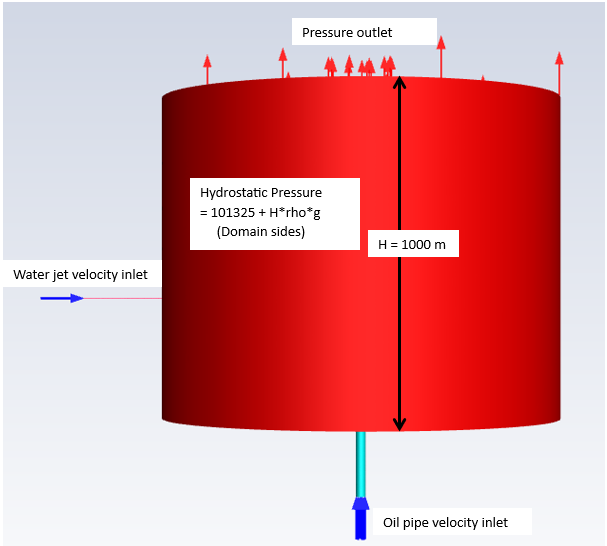
      I am currently working on a Volume of Fluid (VOF) simulation. The setup comprises two inlets: a vertical oil pipe and a horizontal water jet inlet positioned 5 meters above the oil pipe orifice. The domain takes the form of a cylinder with a diameter of 20 meters and a height of 16 meters. The oil pipe has a height of 5 meters, with 1 meter extending into the domain. The water jet pipe is positioned 2 meters away from the center of the oil pipe and extends to the exterior of the domain.

      I have simulated this scenario by specifying velocity inlets for both the oil and water jet pipes, setting pressure outlet at the top, and defining the domain sides as walls. Currently, I am exploring the utilization of a hydrostatic boundary condition on the domain sides instead of using a wall. This involves setting say a height of 1000 meters from the base (at 4 meters) to the top (16 meters). The reason is I want to model it in a more realistic way and may include a third phase: gas in subsequent simulations. i have written a udf that would distribute the pressure with atmospheric pressure at the top and increasing linearing down to the bottom of the domain. What is the right approach to hook this to the domain considering the physics and all the other boundary conditions specified at the inlets and outlet? 

    • Rob
      Forum Moderator

      It's a little complicated.  What material is going to flow in through the sides of the domain? If it's all one phase (water?) then if you set the operating density to that of water you don't need the UDF: the term you're trying to account for is (density - operating density), so if they're exactly equal they cancel and there is no need to complicate the boundary set up. 

    • casey
      Subscriber

      Thank you Rob. The entire system is surrounded by water. While Water jet (pipe diameter = 0.05 m, density  = 998.2 Kg/m3 &velocity = 26 m/s) go into the system via a horizontal pipe and oil (pipe diameter =0.5 m, density = 700 Kg/m3, velocity =1.5m/s) released into the system through the vertical pipe. The scenario is an oil spill in a subsea. 

    • casey
      Subscriber

      Thank you Rob. The entire system is surrounded by water. While Water jet (pipe diameter = 0.05 m, density  = 998.2 Kg/m3 &velocity = 26 m/s) go into the system via a horizontal pipe and oil (pipe diameter =0.5 m, density = 700 Kg/m3, velocity =1.5m/s) released into the system through the vertical pipe. The scenario is an oil spill in a subsea. So we want to account for the flows (both phases) in and out of the domain from all sides. We also plan to introduce a third phase: gas in subsequent runs. 

    • Rob
      Forum Moderator

      OK, thanks. Set the operating density at 998.2 kg/m3 and you shouldn't need the UDF. Backflow setting for the boundary is then water. 

    • casey
      Subscriber

      Thank you, Rob. Initially, I implemented that with wall boundary conditions for the domain sides. However, my current issue is that I don't want the sides of the domain to be wall; instead, I want them defined by the hydrostatic pressure as atmospheric pressure + h * rho * g, with h set to say 1000 m. What boundary condition do I set the sides to in order to achieve this without using wall?

    • Rob
      Forum Moderator

      You just change the operating pressure, or leave that alone and alter the gas density. For a 10m high domain at 1000m down the effect of depth on gas density will be near enough zero. 

    • casey
      Subscriber

      Thank you very much Rob. That means I dont need to change the boundary type (wall) assigned to the domain sides? I have attached an image with the BC intended. 

    • Rob
      Forum Moderator

      You can change the wall to be a pressure outlet, and then set the operating density as discussed. In Fluent we're looking at the change in pressure, so unless the gas density is pressure dependent the actual operating pressure doesn't really matter. 

      Depending on how the oil inlet and cross flow interact you may find you pull water in from the sides due to entrainment effects. I'd also be very wary of modelling 1km of domain without access to a lot of compute. The cell count is going to be VERY high. 

    • casey
      Subscriber

      Thank you, Rob. I understand that. So, I modeled it with a 16-meter cylindrical tank. Now, I want the hydrostatic pressure distribution on the cylinder sides to simulate that of a 1000-meter height tank, where the top corresponds to the water surface (P = 101325 Pa).

    • casey
      Subscriber

      As a follow-up question, can one modify the gravitational acceleration value (g) so that it is scaled to match what it would be for a 1000-meter height tank in comparison to a 16-meter height, and then use this modified g value in the simulation? The BC will then be as you stated earlier.

    • Rob
      Forum Moderator

      If you adjust the pressure on the sides you'll then need to mess with operating density to counter - which defeats the original objective of altering the operating density. 

      If you're looking at gas expansion over the height, then you may need to model the whole lot. If you're looking at gas flow at a well head failure then you may be able to just model the local region. 1000m of bubbly flow is going to be incredibly expensive in both cpu and cell count. 

Viewing 11 reply threads
  • The topic ‘hydrostatic boundary condition: subsea VOF’ is closed to new replies.
[bingo_chatbox]