Ansys Assistant will be unavailable on the Learning Forum starting January 30. An upgraded version is coming soon. We apologize for any inconvenience and appreciate your patience. Stay tuned for updates.
3D Design

3D Design

Topics related to Ansys Discovery and Ansys SpaceClaim.

Huge difference between the results of Discovery Live and Fluent

    • maheshkannan.solaimalai
      Subscriber

      Hi, 

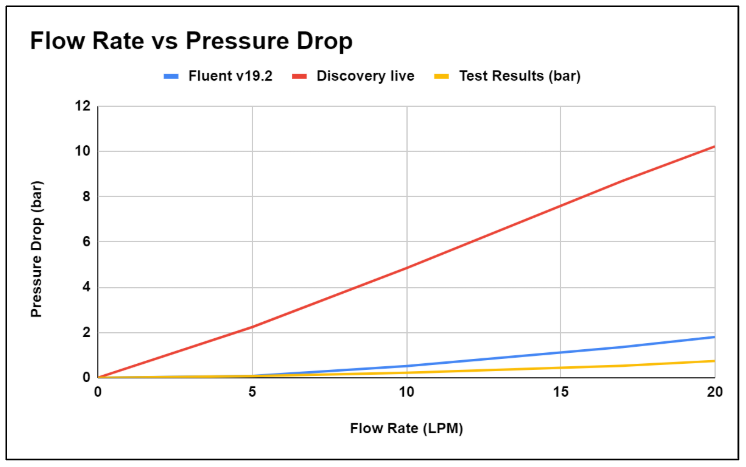
      I am doing a benchmark study in discovery live. I took a Fluent 19.2 case and solved the same model in Discovery Live R2. I am facing a huge difference in results. Discovery Live predicts almost 10 times more than Fluent.

    • subashni.satish
      Forum Moderator

      Hello Mahesh Kannan S

      In Discovery Live the accuracy largely depends on the GPU and therefore it is intended to show the Result trend for design concept refinement and not intended for design Validation, which ideally require higher accuracy as provided by our Flagship products.

      Now that said, by simplifying the design, such as reducing the number of simulation bodies and retaining only essential components in the simulation can to some extent help achieve better simulation results in Discovery Live.

      I would recommend you to go through this Verification and Benchmarking post for more information on Discovery Live and also refer the links mentioned in the above post for additional explanation.

      Please feel free to write back to us with more information on your problem if you feel there is an issue. 

    • maheshkannan.solaimalai
      Subscriber

      Hello Subashni

      Thank you for your support. I just solved a simple pipe flow (20mm radius and 2000 mm length). In fluent, I used sst k-omega model. I got 167, 365 and 788 Pa pressure drop for 0, 1000 and 2000 rpm respectively. But in Discovery Live, I am getting 2730, 4880 and 7625 Pa for 0, 1000 and 2000 rpm respectively. I am not getting 10-15% deviation as in the  Verification and Benchmarking post.

    • subashni.satish
      Forum Moderator

      Hello Mahesh Kannan S

      Is it possible for you to share the model with us for better understanding?

    • maheshkannan.solaimalai
      Subscriber

      Hi Subashni

      Please check the model.

      🛈 This post originally contained file attachments which have been removed in compliance with the updated Ansys Learning Forum Terms & Conditions
    • subashni.satish
      Forum Moderator

      Hello Mahesh Kannan S

      Thank you for sharing the file. I'm getting similar results to what you have described. I will need to investigate this problem further by running a few iterations. I will get back to you soon.

    • subashni.satish
      Forum Moderator

      Hello Mahesh Kannan S

      I have gone through your model and following are the observations I made:

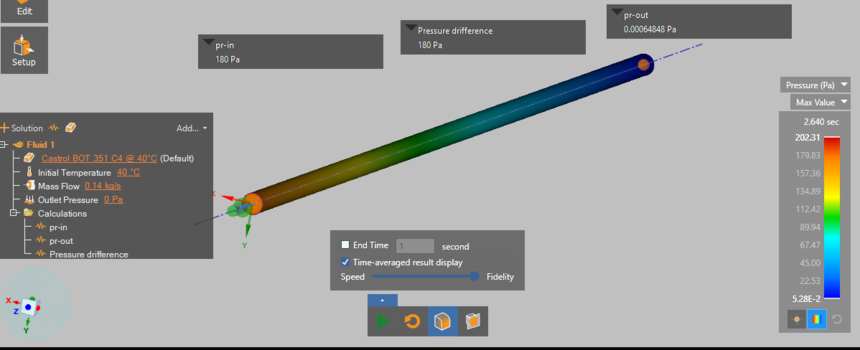
      1. I see that in your previous comment you have mentioned the radius as 20mm whereas in the model you shared the diameter was set to 20mm. Changing the diameter to 40mm and deleting the rotating boundary condition ( 0rpm condition) I got the pressure drop close to 180 Pa at max fidelity (64Gb graphics card). This value is much more comparable to the 167Pa obtained from ANSYS Fluent.
        (refer image below)

         
      2. The Reynold's number for the problem (without rotation) seems to be in the Laminar range. Could you please confirm if the mass flow rate was intentionally set to 0.14kg/s as it seems very low? As k-omega is a turbulence model, it may be advisable to use a laminar model in Fluent to evaluate the results. 
         
      3. I would also like to clarify that the Rotating wall condition imparts the specified rotational velocity to the wall elements and does not simulate the effect of a fan/rotor. 
    • maheshkannan.solaimalai
      Subscriber

      Thank you for your clarifications Subashni

      I modified the Discovery model and got better results for 0 rpm case for a simple shaft.

      For 1000 rpm and 2000 rpm, even though boundary conditions are same for Fluent and Discovery Live (speed given to wall, not for volume in fluent), the results are not same.

      Please conform whether we can simulate rotating components in Discovery Live or not.

    • subashni.satish
      Forum Moderator

      Hello Mahesh Kannan S

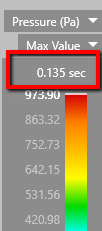
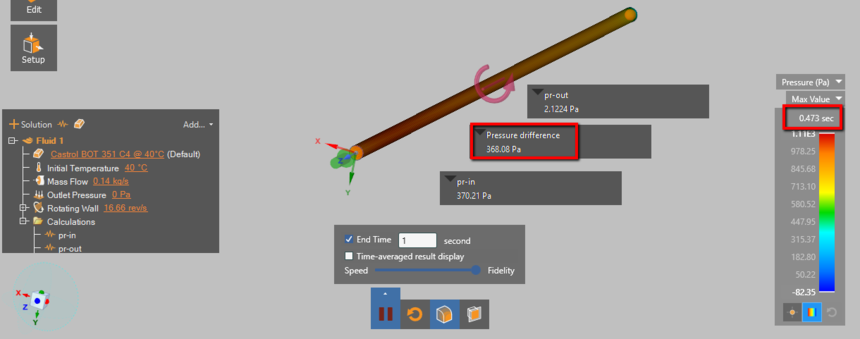
      I would recommend you to allow the simulation in Discovery Live to run for a few seconds before comparing the results. You can see the duration for which the simulation has run above the contour table as shown below. 


      As the simulation runs for over 0.4 seconds, I get more comparable results. (Approx~370.5 Pa) 

      I hope this solution is clear. 

    • maheshkannan.solaimalai
      Subscriber

      Thank you for your explanation Subashni

Viewing 9 reply threads
  • The topic ‘Huge difference between the results of Discovery Live and Fluent’ is closed to new replies.

[bingo_chatbox]