Hello,
I am trying to set a symmetry on a model which has a repetitive structure so I am trying to use a symmetry region of a linear periodic type.
My model is a sandwich panel with a kagome lattice type core. The core consists of beam bodies and the facesheets of surface bodies:

The original sandwich is after hiding the top face can be seen here:
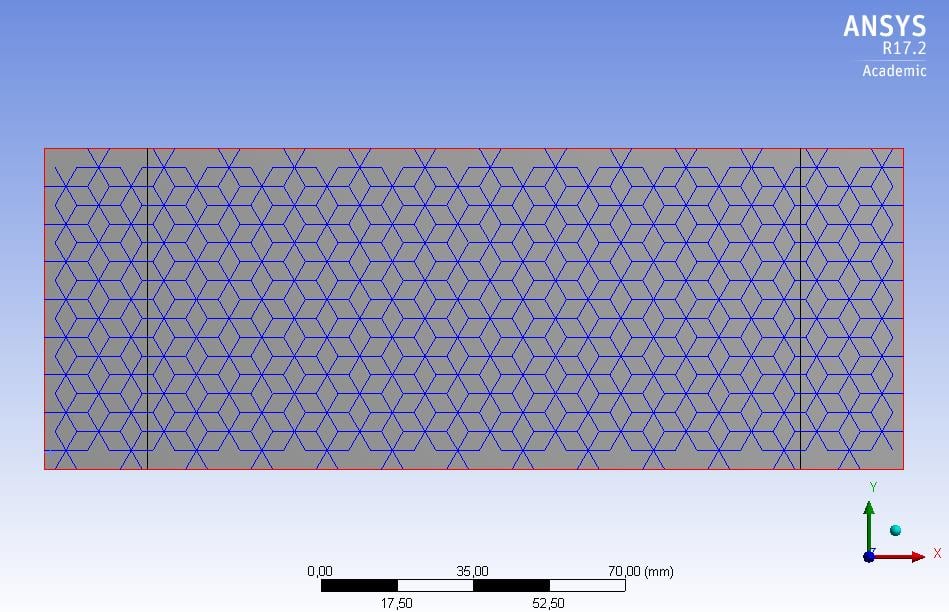
I want to cut the panel in half and model the 1/2 of it by applying a symmetry boundary condition, but since the core is not normal symmetrical but has a repetitive pattern I am trying to use linear periodeic symmetry region.
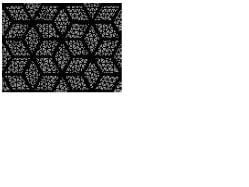
After cutting accordingly the repetitive half that remains is the following:
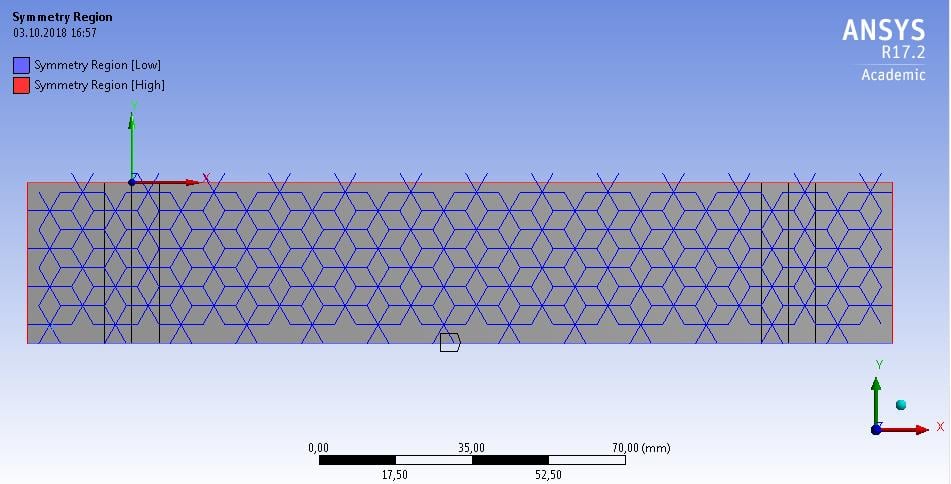
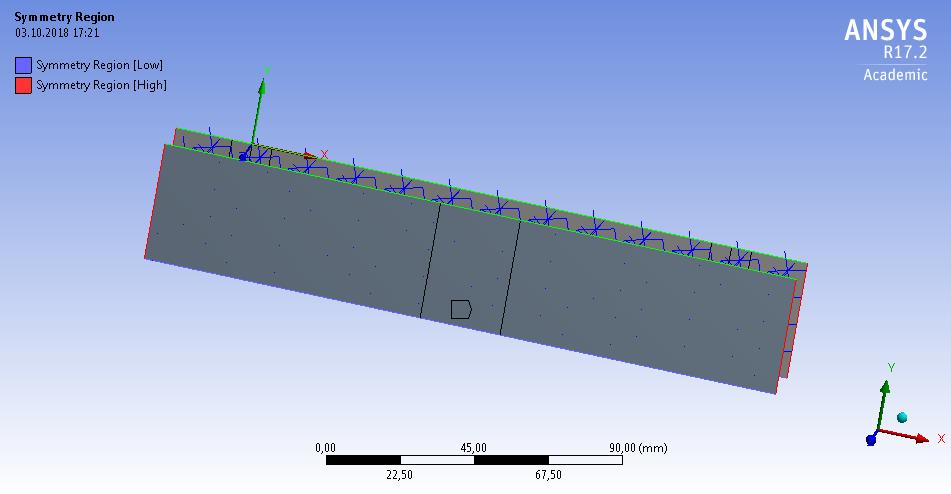
I set the low boundary in the following edges of the facesheets:

and the high boundary in the according opposite edges of the facesheets :
I set the coordinate system at the high boundary edges:
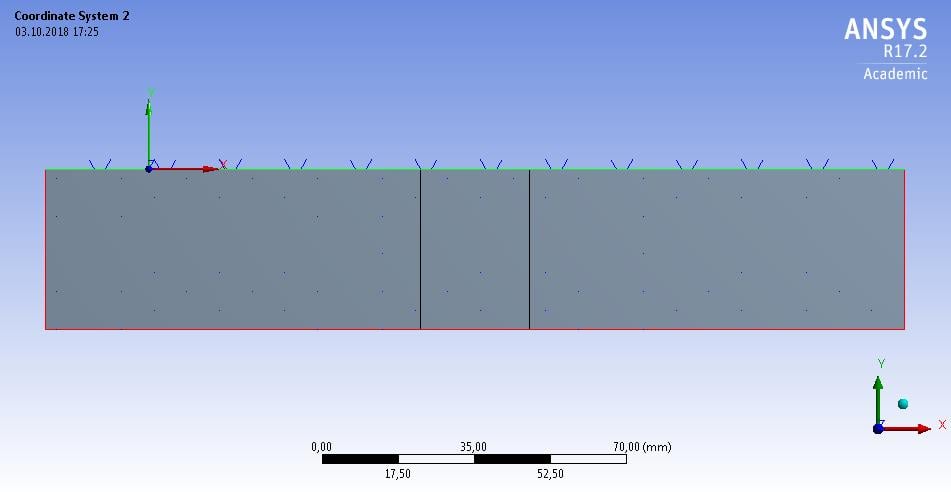
and set the linear shift value as the distance of these edges: 36,83mm in the Y periodicity direction.
The model gets meshed but it doesn't run, I get different pivot warnings each time and have to limit a node every time with a remote displacement bc.
After setting the grapcical extension in ΔY : 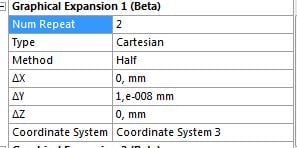
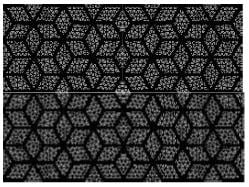
I hit show mesh and I get the following :

(again the upper facesheet is hided).
So the linear periodic symmetry is not applied, or at least is not shown to be applied. A normal symmetry is showed and the core is not as it should be.
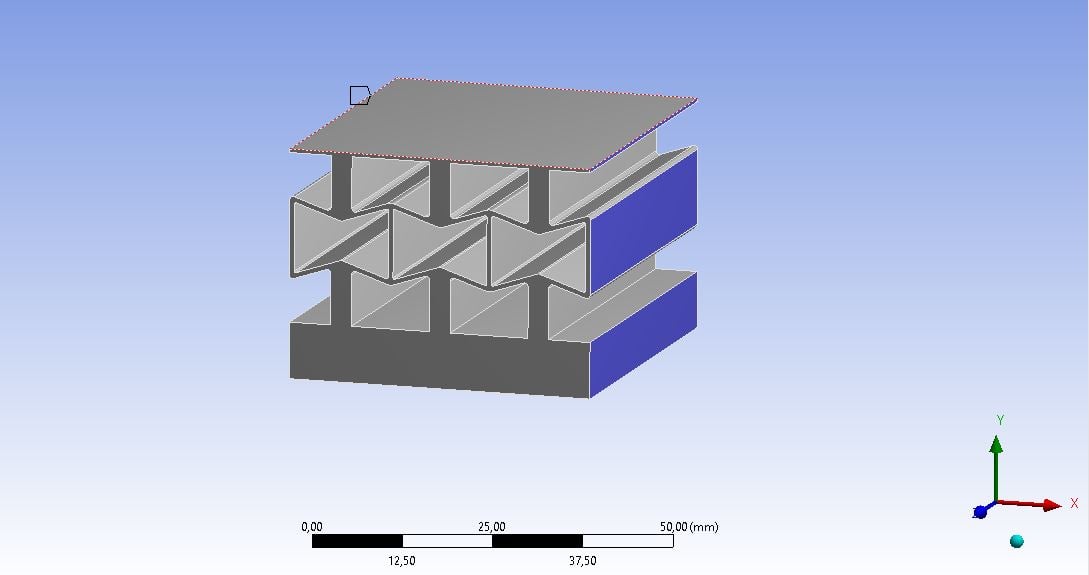
The surface bodies of the facesheets and the beam bodies of the core share topology from spaceclaim. The setup is a three point bending test:

How can I correctly set the symmetry in this model? It is also of interest to model th 1/4th of the panel by applying another linear periodic symmetry bc along the X direction.
Also does this idea of linear periodic symmetry make sense for two repetitions, or is the linear periodic feature only for infinite repetitions?
I want to use the symmetry in order to get necessary constraints in the static structural analysis of the sandwich panel.
Can you help me?
With Gratitude,
Achilleas Milios






















 You are navigating away from the AIS Discovery experience