Hello Zemax community,
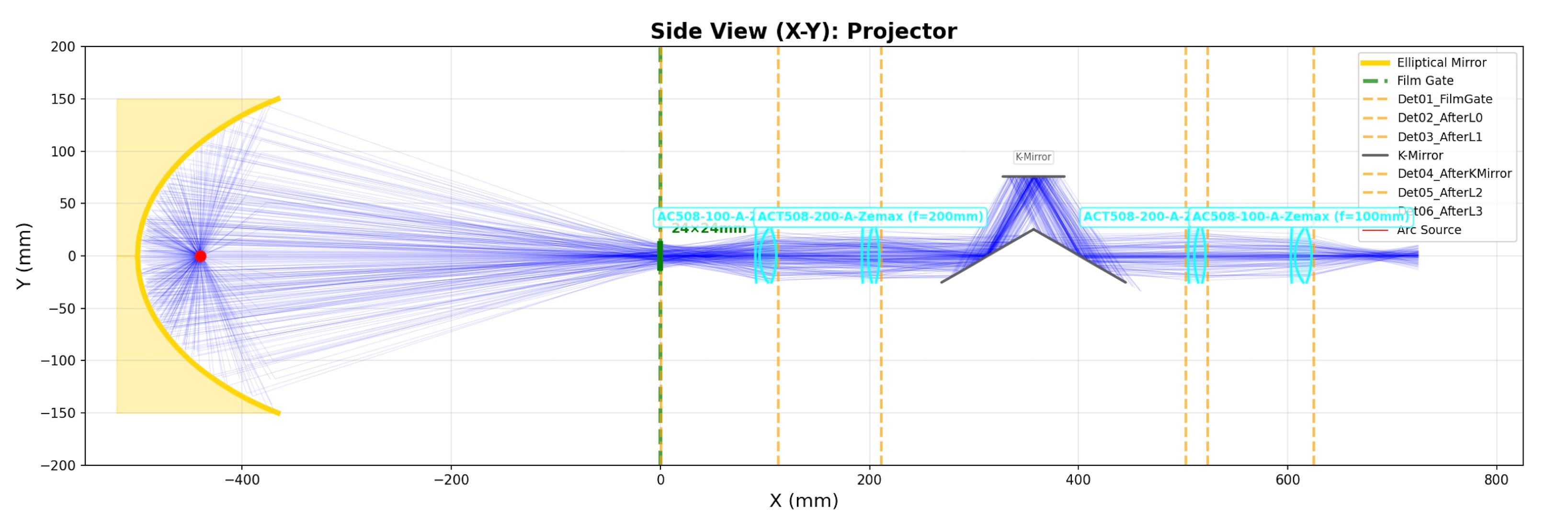
I'm designing a projection lens system for a 35mm film projector and struggling with the correct sequential mode setup for the illumination geometry. The light source is a Xenon short-arc lamp reflected by an ellipsoid mirror, which creates a converging cone with a 40.6 degree full angle that passes through the film gate. The film gate is my object plane, but the light doesn't diverge from it like a typical Lambertian source. Instead, the converging cone from the ellipsoid passes through the film gate, focuses at a point 40mm after the film gate, and then diverges.
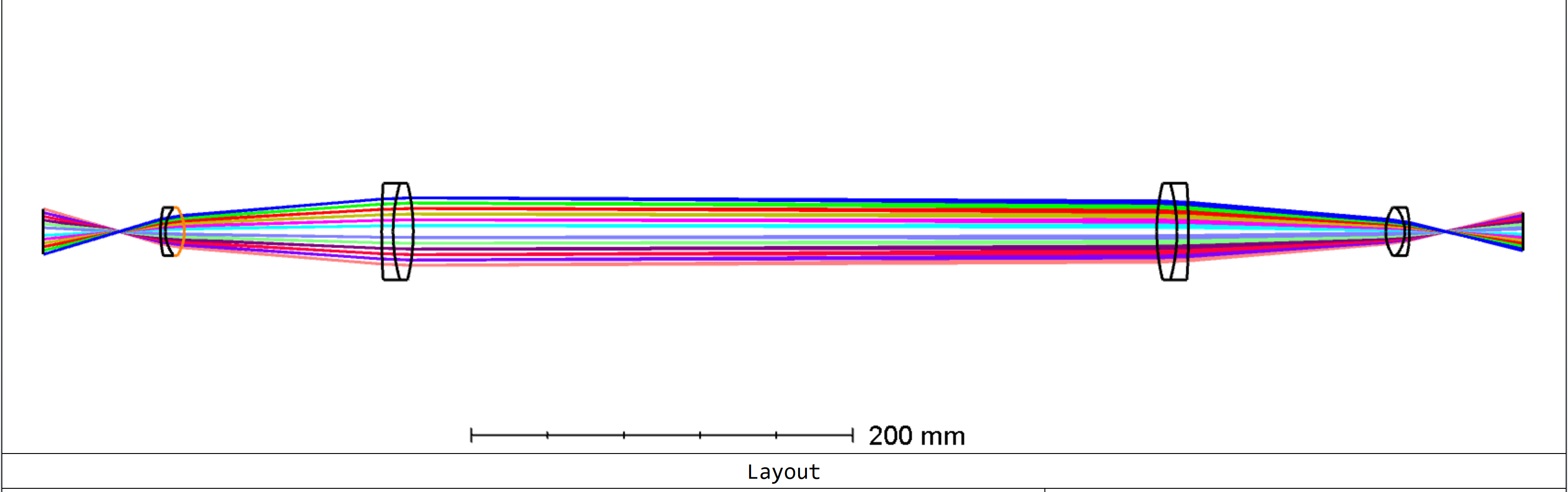
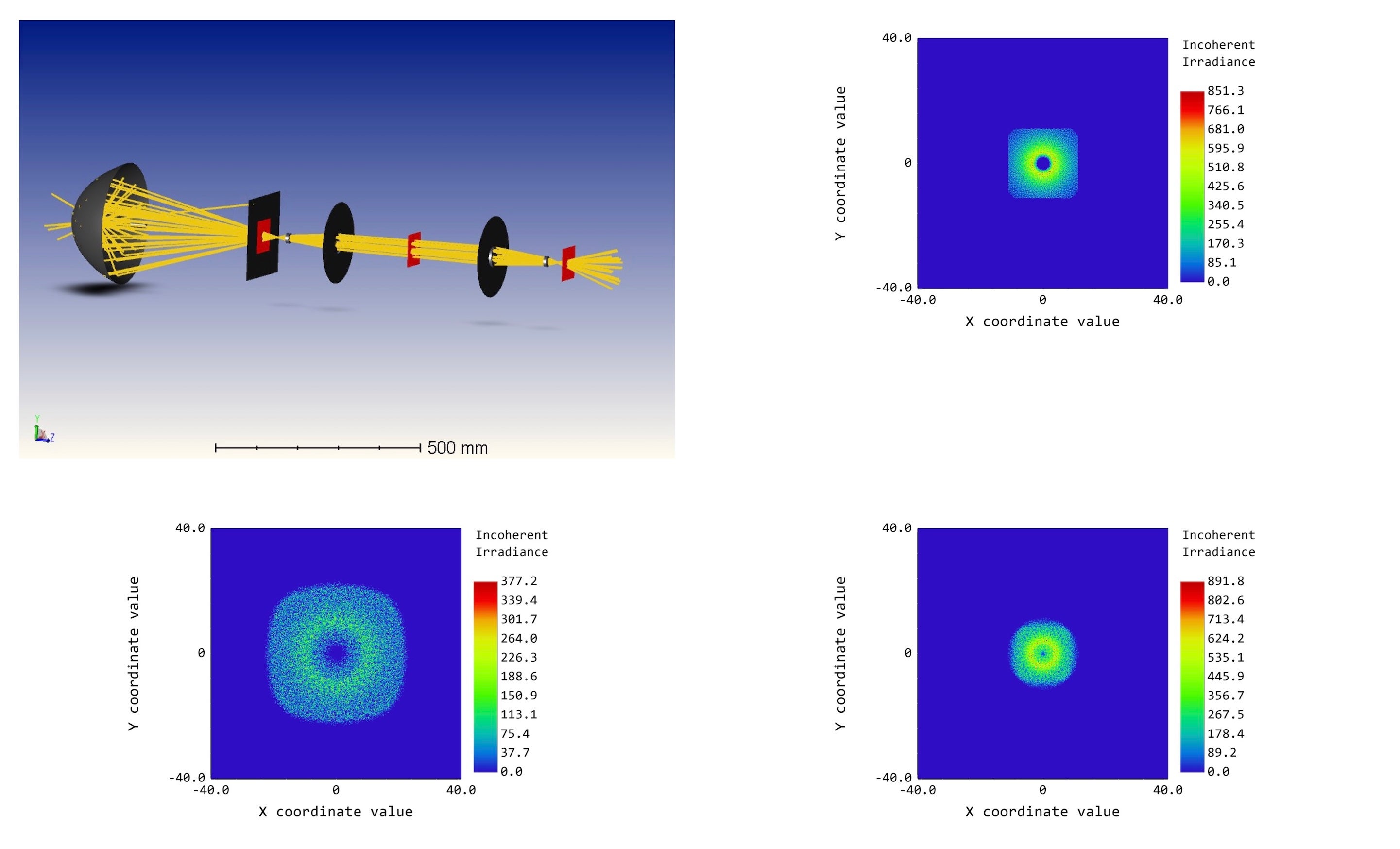
The actual goal is to design a relay system that creates space between the film gate and projection lens for inserting an image rotator, while using standard projection lenses. The key design requirement is that the relayed image at the end must have the same converging cone geometry as the original film gate, so that a standard projection lens can be positioned at the correct distance from the relayed image with optimal light throughput. I need to preserve étendue through this geometry to maintain light throughput, but I'm unsure how to properly set this up in sequential mode to optimize for both relay image quality and throughput simultaneously. I can model the illumination system in non-sequential mode, but I don't know how to approach the combined relay and projection lens design where both imaging performance and étendue conservation are critical.
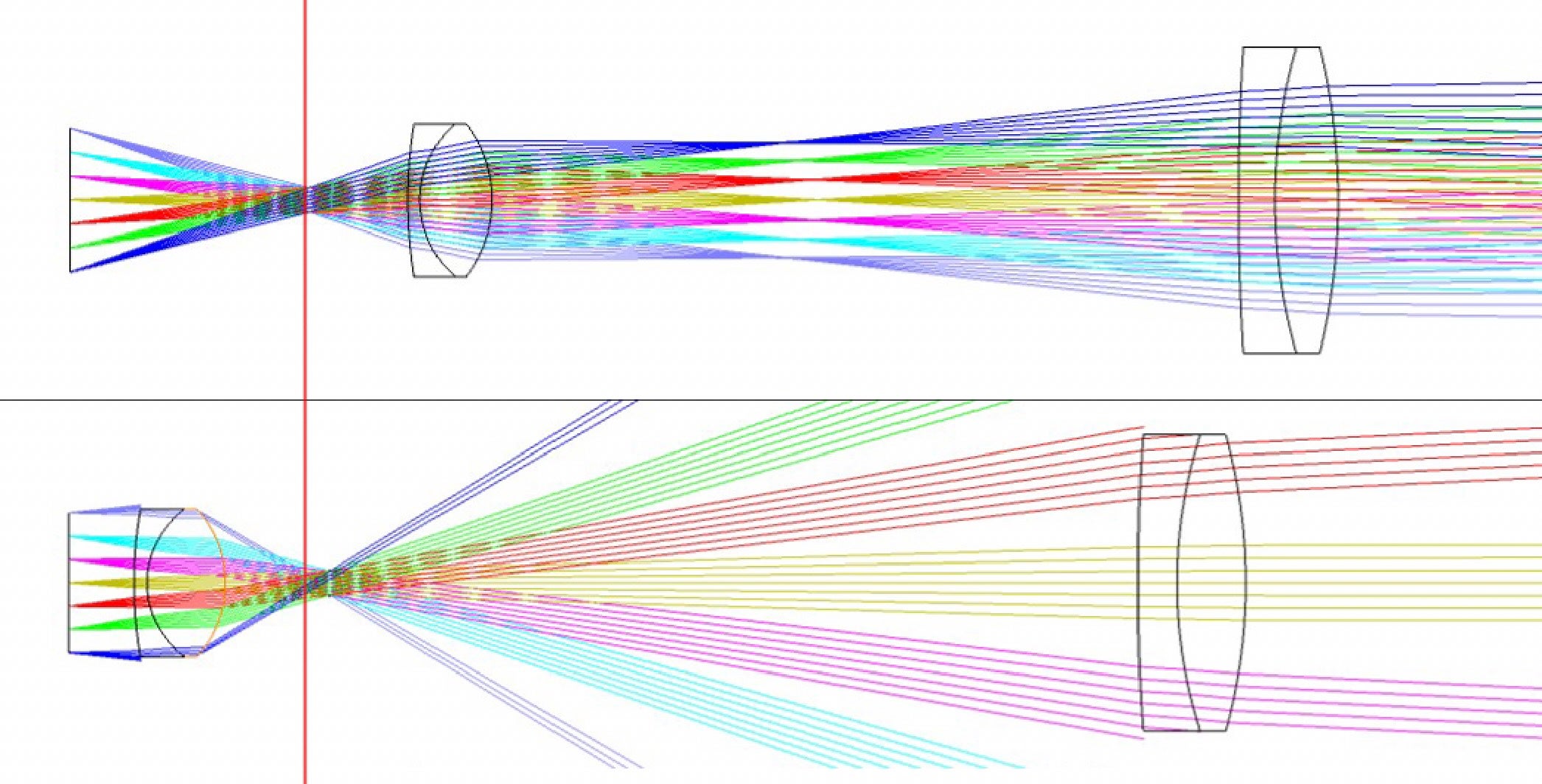
My current approach is to place the object surface at the film gate with field points defining the 35mm format, then place a stop surface 40mm after the object with a very small semi-diameter of approximately 0.1mm to represent the convergence point. I'm using Float By Stop Size as the aperture type with ray aiming enabled. However, I'm uncertain if this correctly models the converging illumination geometry for sequential mode design purposes, and whether this setup allows me to optimize for both image quality and light throughput.
Film projectors are standard optical systems, so I assume there's an established method I'm missing. Any guidance on the correct sequential mode setup for this Köhler-type illumination geometry would be greatly appreciated. I've attached a visualization of the complete setup showing the ellipsoid mirror, film gate, and convergence geometry.
Thanks!
Paul


















 You are navigating away from the AIS Discovery experience