-
-
April 9, 2018 at 8:03 am
maetha
SubscriberHei there
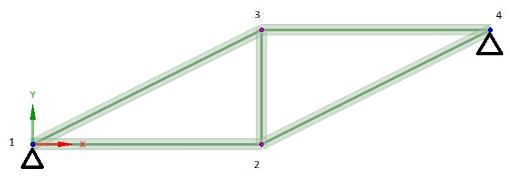
Is there an easy way to model a rotatable joint of a truss construction? In Mechanical i just found the way of freeing some degree of freedoms, but this is not working at supported notes (nodes 1 and 4 in the attached file).
How am I supposed to do this?
I'm using Ansys 19.0 student edition.
Thanks!
-
April 9, 2018 at 12:57 pm
peteroznewman
SubscriberHello Maetha,
In your truss, you show two points connected to ground. Both points cannot have a spherical joint to ground, because then the truss would be free to spin around the line connecting the two points. At least one of the two points has to fix a rotation that would prevent that motion, or a third point, not on the connecting line, would need a constraint to prevent the spinning.
How did you free some degrees of freedom at nodes 2 and 3?
Regards,
Peter
-
April 9, 2018 at 1:47 pm
maetha
SubscriberHello Peter
thanks for your fast response! I think I have to add some information. My goal is to model the behavior of this beam-structure as there would be some rotational joints at each node.
I tried to solve the problem in two ways:
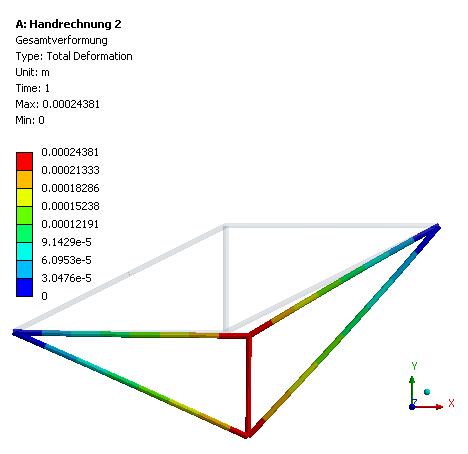
1) I assembled the whole structure in SpaceClaim and free the rotational degree of freedom at nodes 2 and 3 with the tool (contacts/joints => free degrees of freedom). There will be a result, but the system is still behaving as the nodes would be welded. (see attached file "way1") There was somehow no failure message because of the rotation you mentioned above.
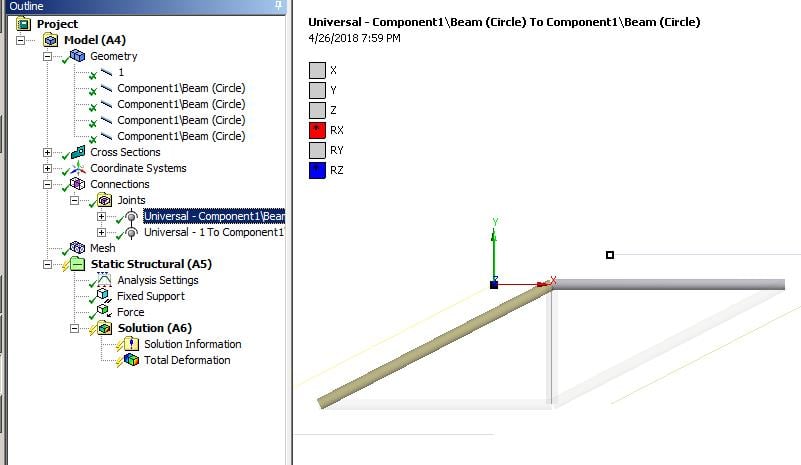
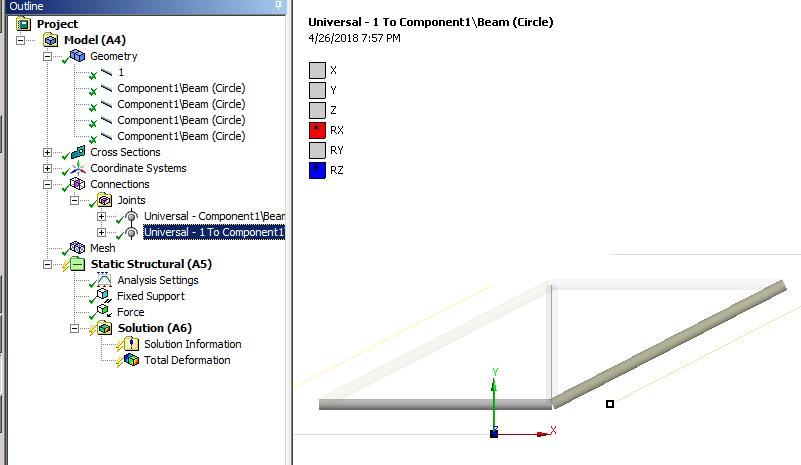
2) I tried to handle the five beams as a single structure and join them in Mechanical by locking the rotational degree of freedom. But I couldn't find a proper way to do that. (attached file "way2")
Thanks in advance!
Maetha
-
April 9, 2018 at 11:47 pm
peteroznewman
SubscriberHello Maetha,
I haven't used beams much and when I did, they were "welded" together into one big structure.
I have used your problem to explore how to connect beams with joints. Attached is an ANSYS 19.0 archive that has two beams that have a fixed support at one end, have universal joints in the middle, and have a displacement BC at the other end. This is a different method than your "beam release" method.
I don't yet know how to have three beams come together at a common intersection.
Don't know if this is useful. I would like to understand your beam release method.
Can you attach a project archve?
Cheers,
Peter -
April 10, 2018 at 12:43 am
-
April 10, 2018 at 6:34 am
maetha
SubscriberDear Peter
thanks for your answers! You can find the project archive attached.
I have to try your solution with an additional body.
Thank you!
Greetings
Matthias
-
April 10, 2018 at 10:47 am
-
April 10, 2018 at 11:32 am
maetha
SubscriberThank you very much! This is pretty much what I wanted!
Greetings!
-
April 10, 2018 at 1:21 pm
peteroznewman
SubscriberDear Matthias,
You can show your appreciation by clicking Like below the posts that are helpful.
Cheers
-
April 26, 2018 at 12:39 pm
deepmech.maurya
Subscriberhello sir
i was learning the truss then i saw this post,
i modeled the same truss as you built in above attached file:
i have some question:
1) why you didn't use the share topology.
2) you construct separate pat in spaceclaim why?
2) when i am using the universal joint pivot error is there,(file attached below)
-
April 27, 2018 at 12:22 am
peteroznewman
SubscriberHello Deepak,
You are getting a pivot error with the universal joint because the center beam has no connection.
This is the reason for the extra body. You need a body to connect a universal joint from each beam coming into the corner, so there would be three universal joints on the top corner body and three universal joints on the bottom corner body.
If you drop a Modal analysis onto the Model line of this project, then in Mechanical, drag and drop the Fixed Support onto the Modal system you can solve and see all the beams that are loose.
If share topology is used, then the beam ends get welded together, then this becomes a weldment and beams will experience bending loads. A true truss carries only tension and compression and no bending moments are put into the links.
-
April 27, 2018 at 2:27 am
deepmech.maurya
Subscriberhello sir
thankyou , i missed that "A true truss carries only tension and compression "
thankyou
-
April 27, 2018 at 4:11 am
deepmech.maurya
Subscriberhello sir,
when i choose fixed support or force on any vertices/joint of two trusses i select two vertices one by each link. I was doing continuous mistake at last i win to find my error.
But i saw your file you select one vertices at your selection but simply supported( again required for truss).
That still i have a doubt why? just i want to clear the thing for future analyses.
(file attached below): just check if i am selecting one vertices it is not solving.
thanks
-
- The topic ‘How to model a joint of a truss construction’ is closed to new replies.

-
6379
-
1906
-
1457
-
1308
-
1022
© 2026 Copyright ANSYS, Inc. All rights reserved.