Ansys Assistant will be unavailable on the Learning Forum starting January 30. An upgraded version is coming soon. We apologize for any inconvenience and appreciate your patience. Stay tuned for updates.
General Mechanical

General Mechanical

Topics related to Mechanical Enterprise, Motion, Additive Print and more.

How to input true stress, when the stress falls

    • Adisa
      Subscriber

      Hello anyone,


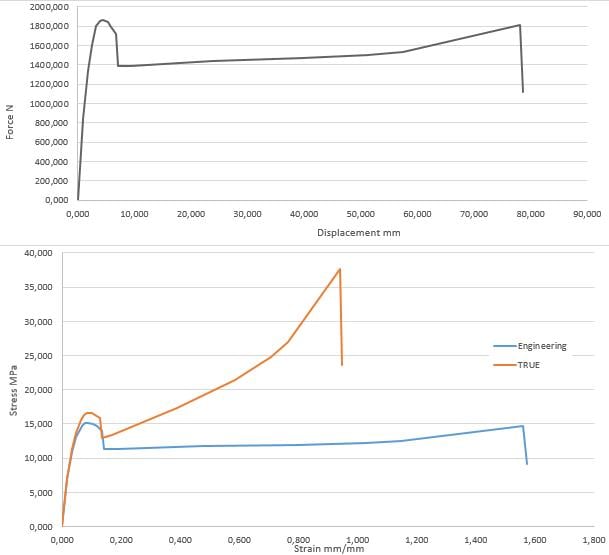
      I have the experimental date of PC material (plastic), from tensile test I got force-displacement, when It converted in the engineering and true stress, I got that the true stress falls. As we know that in Ansys can not be input decreasing stress, can anyone help me with this problem.


      First I think that this true stress strain use for the pipe specimen with diameter of 12,5mm, Where I need the max force which pipe can endure during tensile test. And I got that is about 1800N as in the below pic.


      Second I think to use true stress strain for drop test, where need to determine when  the plate (500x500x15) will break (when strain is about 1mm/mm) if on it drops the sphere of 0,5kg.   The plate is of the same material as the pipe, PC.


    • peteroznewman
      Subscriber

      Please give more details about the material. Is it a fiber reinforced material?

    • Adisa
      Subscriber

      Peter, I use this video of tensile test as the experimental test:


      https://youtu.be/z9mDVsaVyxI 


      In the test is used the specimen of PC without fiber reinforced material.  I think that fiber reinforced 


       materials do not have so much elongation as well materials without reinforced. Am I right?


      Did You have any example where the true stress decrease of any material, If yes, How did you input it in Ansys. 


    • peteroznewman
      Subscriber

      Necking of the specimen occurs during the test. Once necking begins, the displacements beyond the point at which necking began cannot be used to create Stress-Strain material data because the assumptions of uniform plasticity are invalid and the conversion of Engineering Stress and Engineering Strain to True Stress and True Strain becomes invalid.

    • Adisa
      Subscriber

      Peter,


      Yes, the necking occurred during the test.


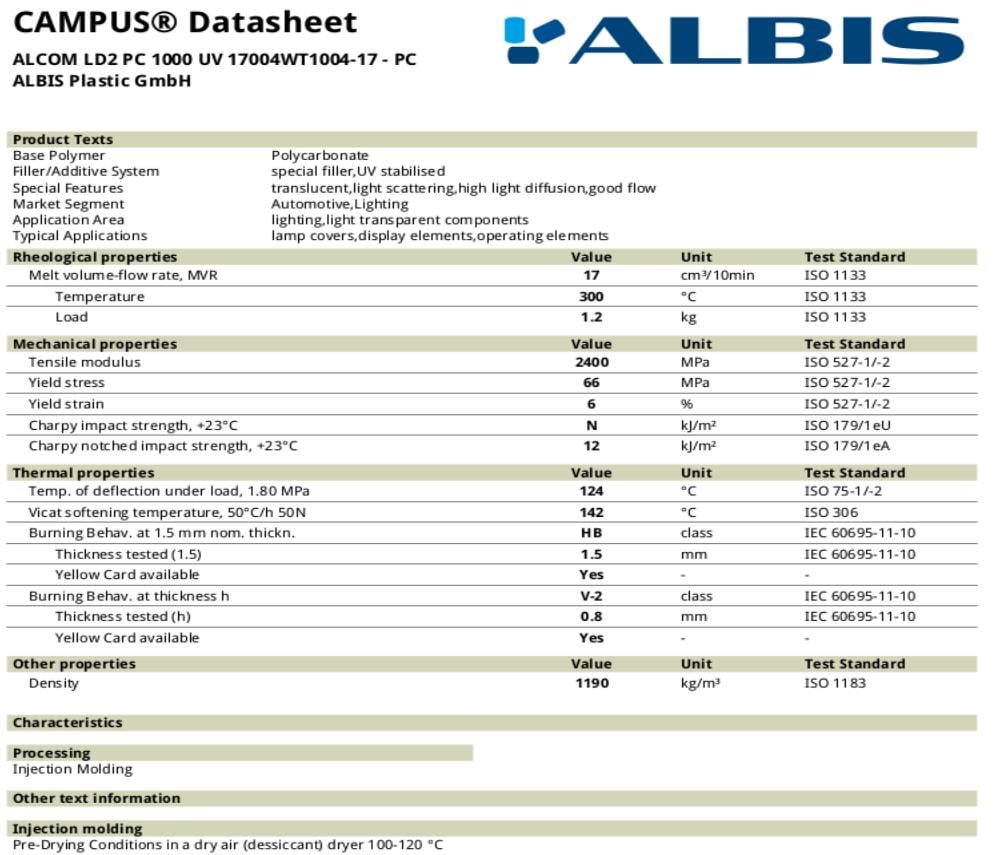
      Thanks for the information. Which the parameters from material needed to be used for determination when the part will totally separation. I attached data sheet of the one another material which has all parameters which some of them maybe can be used for drop test for determination separation. I sent this as example not the parameter of PC.


      Did You have any suggestion how to simulation drop test with this material, where I need to determine the dimension of ball steal which will cause totally separation of the plate (500x500x15).


      I can not tell that when occur the necking that the construction will the totally separation, only in that point is the necking?


    • peteroznewman
      Subscriber

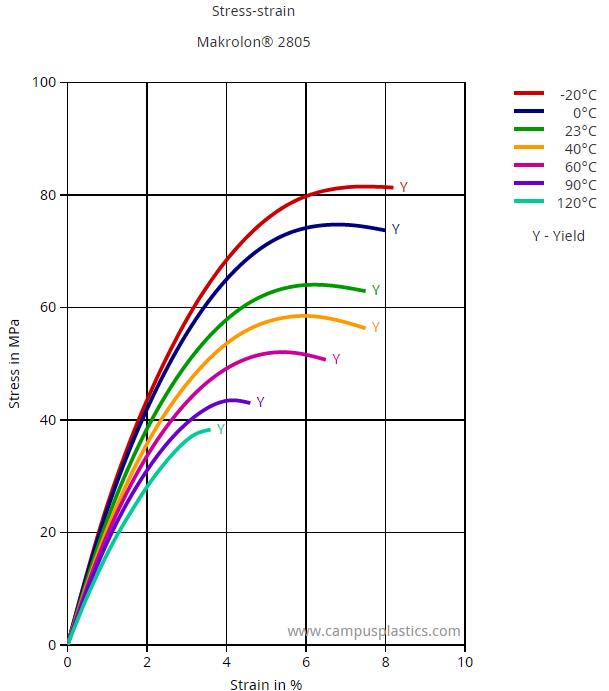
      Look for another PC on Campus Plastics that has a Stress-Strain diagram.


      Here is one.


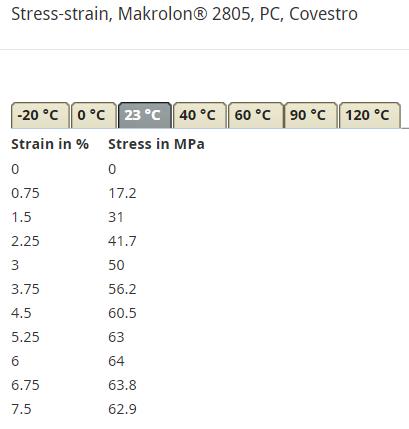
      Click on Control Points to get the Excel numerical data.


      Convert this Engineering Stress-Strain data to True Stress-True Strain for use in a Multilinear Plasticity material model.


      Regards, Peter

    • Adisa
      Subscriber

      Peter thanks,


       From the above stress-strain diagram for temperature 23C, at stress 62.9 and strain 7.5%,  I can guess  that will occur the totally separation of the part during drop test, or ?

    • peteroznewman
      Subscriber

      The above plastic stress-strain curve is up to the point of Yielding. Perhaps this is where the necking begins.


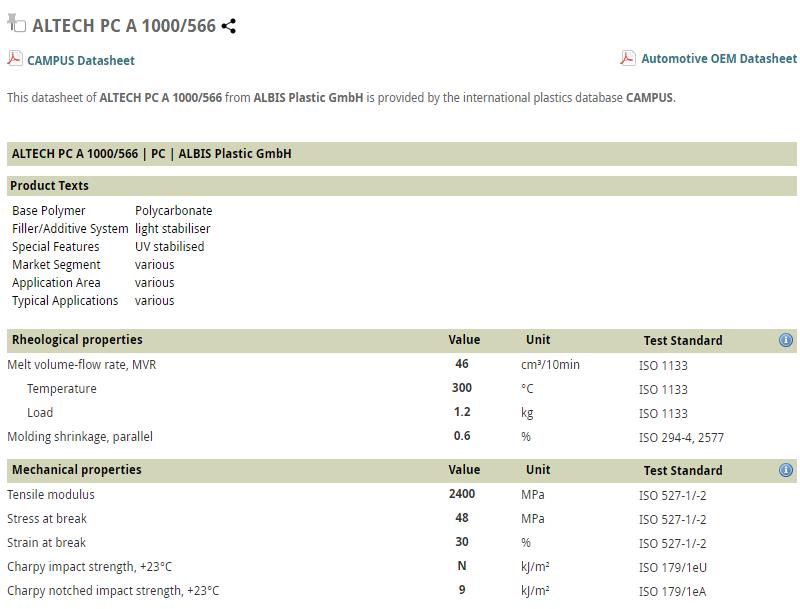
      Here is another plastic that shows the strain at break is 30%, but this plastic doesn't have a Stress-Strain diagram.


      Another property of plastic is strain rate sensitivity, so the elongation at break might be function of strain rate. In other words if the material is stretched at 0.1 mm/sec it might get to 30% strain when it fractures, but if the material is stretched at 100 mm/sec, it might only get to 5% strain when it fractures.


      Can you run your own samples at your own settings in the Tensile Testing Machine?


      Regards, Peter

    • Adisa
      Subscriber

      Peter thanks for the information,


      I can not run samples in the Tensile test machine,  I only use the online properties.


      I thought whether the properties from tensile test can be used for the drop test, because the strain rate during the drop test I did not know in advance.


      Peter now I did not know which the parameters use at the drop test, I am confused.


      So far, I used the parameters from tensile test where I used the point of yield point as that the crack will occur.


      Now, I did now know.


    • peteroznewman
      Subscriber

      Here is a very good article on strain rate and temperature effects on plastics. It says the low temperature properties of the material at low strain rates are similar to the high temperature properties at high strain rates. Maybe you can use this concept to get properties for your drop test simulation that will have less error to a physical test.  Here is a polymer website that explains different types of stress-strain curves.


      You need to know the strain at break for your material.  Where did you obtain the data from your first post?


      I looked in the Engineering Data library and found POLYCARB. It has a Multilinear Plasticity curve that goes out to a Plastic Strain of 0.7 and the reference given is S.M. Walley et al. "Strain rate sensitivity of polymers.." DYMAT Journal-vol.1-3-sept 1994.  Can you obtain that journal article?


    • Adisa
      Subscriber

      Peter,


      I obtained the data from video which is attached at the second post (experimental results of PC). And that the break strain is shown in the pic.


Viewing 10 reply threads
  • The topic ‘How to input true stress, when the stress falls’ is closed to new replies.

[bingo_chatbox]