Ansys Assistant will be unavailable on the Learning Forum starting January 30. An upgraded version is coming soon. We apologize for any inconvenience and appreciate your patience. Stay tuned for updates.
Photonics

Photonics

Topics related to Lumerical and more.

how to create Plasma drude model material with complex input

    • SAURAV GAUTAM
      Subscriber

      hi

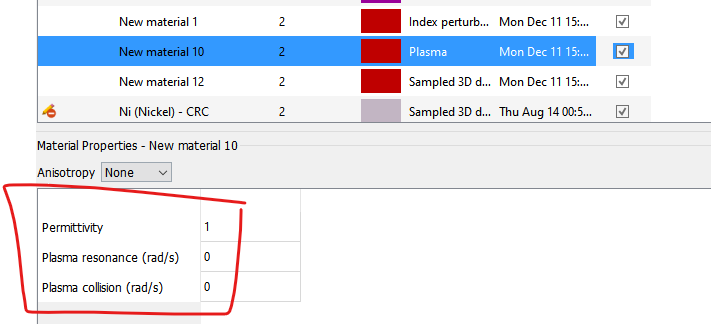
      i want to create plasma drude mode with plasma and collision frequencies complex values (2.28430091876467e+15 - 4717903266445.45i,  5311954144330.36 + 1.83655713200182e+15i) but while creating matetial i can't input imaginary part as input is only real number. 

      Please suggest how to input complex value or shall i remove the imaginary part?

      thanks

    • Dimitris Polyzos
      Ansys Employee

      Hello, 

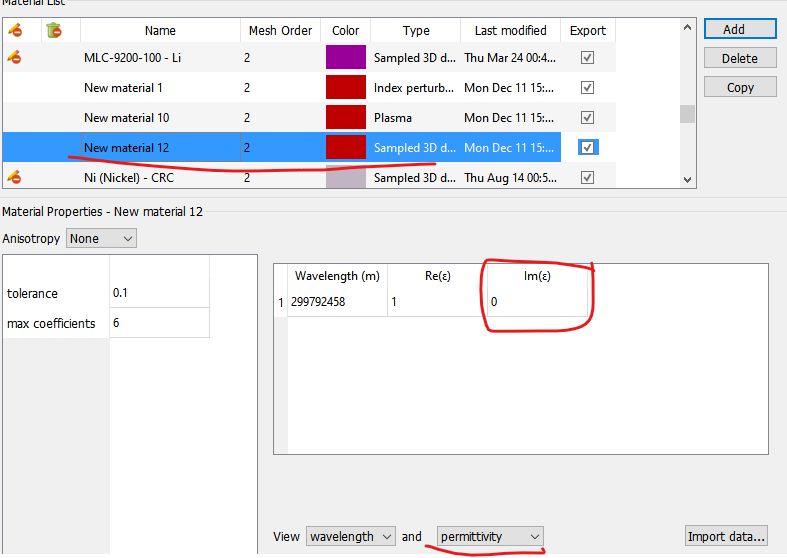
       It seems that there is not an option to input the imaginary part for the collision and plasma frequencies in the plasma material. However, I would suggest to add the real parts and use the plasma material model. On the other hand, you could use the real and imaginary part of permittivity/refractive index of a material (Sampled 3D). If you have the Refr indices of your material you could make a comparison between these two input materials and check if this is aligned with the reference you use. Please check both pictures below. 

      Also, a useful link that explains the Drude model can be found here: https://optics.ansys.com/hc/en-us/articles/360034382494-Charge-distribution-to-change-in-refractive-index-theory.

      I hope I helped. Let me know if you need firther help with your model.

      Kind regards

      Dimitris

    • SAURAV GAUTAM
      Subscriber

      Hi Dimitris

      Thank you for your support. I used refractive index constants and calculated resonance and collision frequencies by curve fitting using equation from . https://optics.ansys.com/hc/en-us/articles/360034394634-Standard-optical-permittivity-material-models-in-FDTD-and-MODE

       i considered only real parts of frequencies, the results for reflectance and transmittance are not similar with what i got from Sampled 3D.

      Thanks i will check the link

    • SAURAV GAUTAM
      Subscriber

      hi i also noticed that the Drude equation explained in https://optics.ansys.com/hc/en-us/articles/360034382494-Charge-distribution-to-change-in-refractive-index-theory is different than https://optics.ansys.com/hc/en-us/articles/360034394634-Standard-optical-permittivity-material-models-in-FDTD-and-MODE

    • Dimitris Polyzos
      Ansys Employee

      Hello Saurav, 

      This link (Charge-distribution-to-change-in-refractive-index-theory) describes the models used to calculate perturbation in refractive index from charge density data. On the other hand, this link (Standard-optical-permittivity-material-models-in-FDTD-and-MODE) describes the mathematical models of the basic permittivity (or refractive index) to create a material and import it in the material database. 

      The standard plasma-drude model has no imaginary part, thus means that the material you use is lossless. It is expected to not get the same results. However, I reckon that according to the reference you use the transmission/reflection results are close to the model with the imaginary part included. Is that correct?

      In the meanwhile I will check with my colleagues if there is a feature that will include the imaginary part of plasma and collision frequencies in the future.

      I hope I helped.

      Kind regards

      Dimitris

Viewing 4 reply threads
  • The topic ‘how to create Plasma drude model material with complex input’ is closed to new replies.

[bingo_chatbox]