Ansys Assistant will be unavailable on the Learning Forum starting January 30. An upgraded version is coming soon. We apologize for any inconvenience and appreciate your patience. Stay tuned for updates.
3D Design

3D Design

Topics related to Ansys Discovery and Ansys SpaceClaim.

How can I calculate a radial force of a stent pushed in by rigid flat bodies?

    • Leomilei
      Subscriber
      Hello,I am trying to simulate the crimping of a Nitinol stent using Static Structural. I have stent ring in the center and planes placed around it. Over the Remote Displacement option are they moving towards the center and by this pushing the stent together. I am using the probe Force Reaction selecting the Remote Displacement to calculate the radial force created by the stent.nIs that the right way to get the radial force or is ther maybe another one? I have compared my calculated results to experimentally generated data and the force is much too small. Is there an obvious mistake I have made here or something I could try?nI am glad for any suggestions.n
    • peteroznewman
      Subscriber
      Please insert images of your stent and the surfaces that are crimping it.n
    • Leomilei
      Subscriber
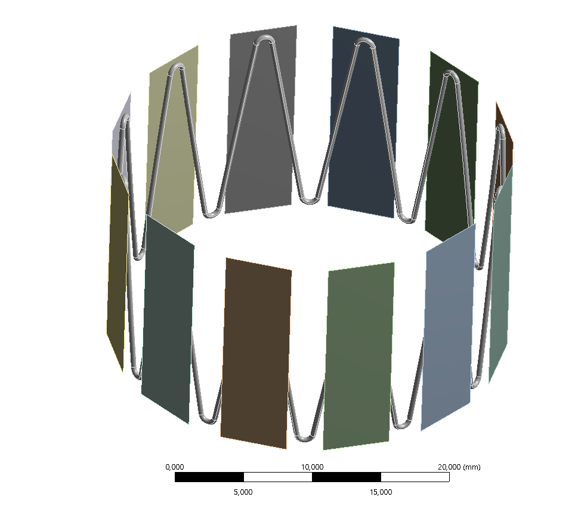
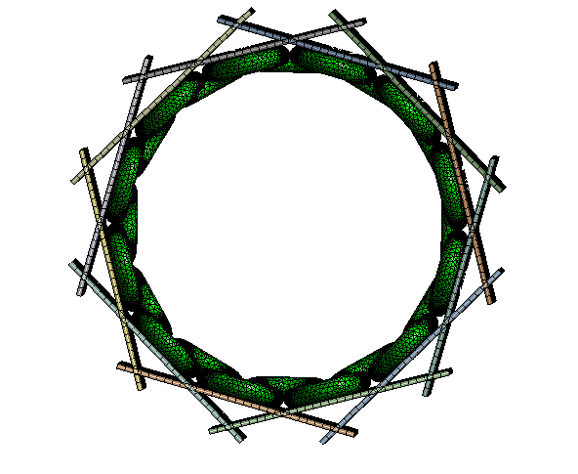
      Hello, here are a general view and in a crimped position from above. The rigid surfaces are meshed with a face sizing (element size 0,5 mm) and the stent with the tetrahedron method. I have also used symmetry to make my model smaller but also want to solve the whole thing to validate using symmetry.n
    • peteroznewman
      Subscriber
      Remote Displacements moving the surfaces to the center is one way to do it.nAnother way is to create a cylindrical surface, and have a cylindrical coordinate system on the stent central axis. Then you can apply a Nodal Displacement on all the nodes on the cylinder to move in a radial direction (X direction in the cylindrical system) and hold Y and Z at 0.nThe contact force reported by the contact elements can tell you the total radial force.nIf you use Frictional Contact, you might not need any constraints on the stent.nIf you use Frictionless Contact, pick three vertices around one end of the stent, approx. 120 degrees apart, and using the cylindrical coordinate system, add a Displacement holding Y and Z fixed at 0 while leaving X free.n
    • Leomilei
      Subscriber
      Thank you for these tips. So if I add the Contact Forces of all involved objects (whether there are multiple planes or one cylindrical one) I get the radial force, right?n
    • peteroznewman
      Subscriber
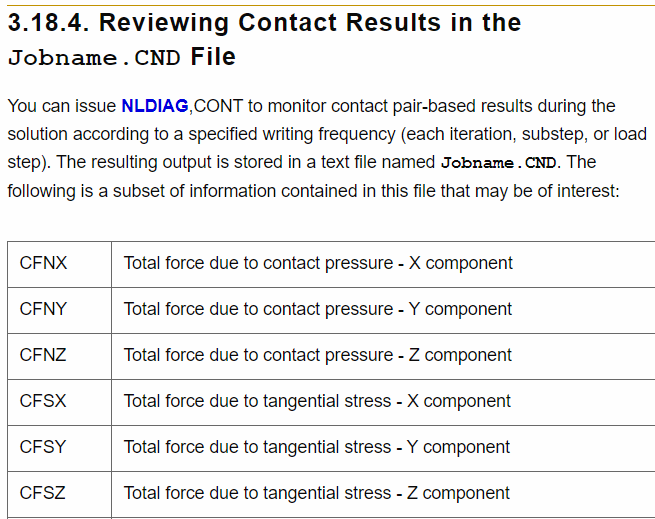
      Please read the ANSYS help system. Maybe if you have 12 contact pairs, you can get 12 components of total force written to the .CND file. I don't know, I've never tried it. If you have one cylindrical surface, I expect the total force will be zero. However, you could slice the cylindrical surface up into 12 strips to get 12 contact pairs.nPlease write what you learn in a reply so others who find this thread while searching the forum can benefit from your work.n
Viewing 5 reply threads
  • The topic ‘How can I calculate a radial force of a stent pushed in by rigid flat bodies?’ is closed to new replies.

[bingo_chatbox]