LS Dyna

LS Dyna

Topics related to LS-DYNA, Autodyn, Explicit STR and more.

Help to validate Plastic deformation

    • shrihari_sampathkumar
      Subscriber

      Hello, 

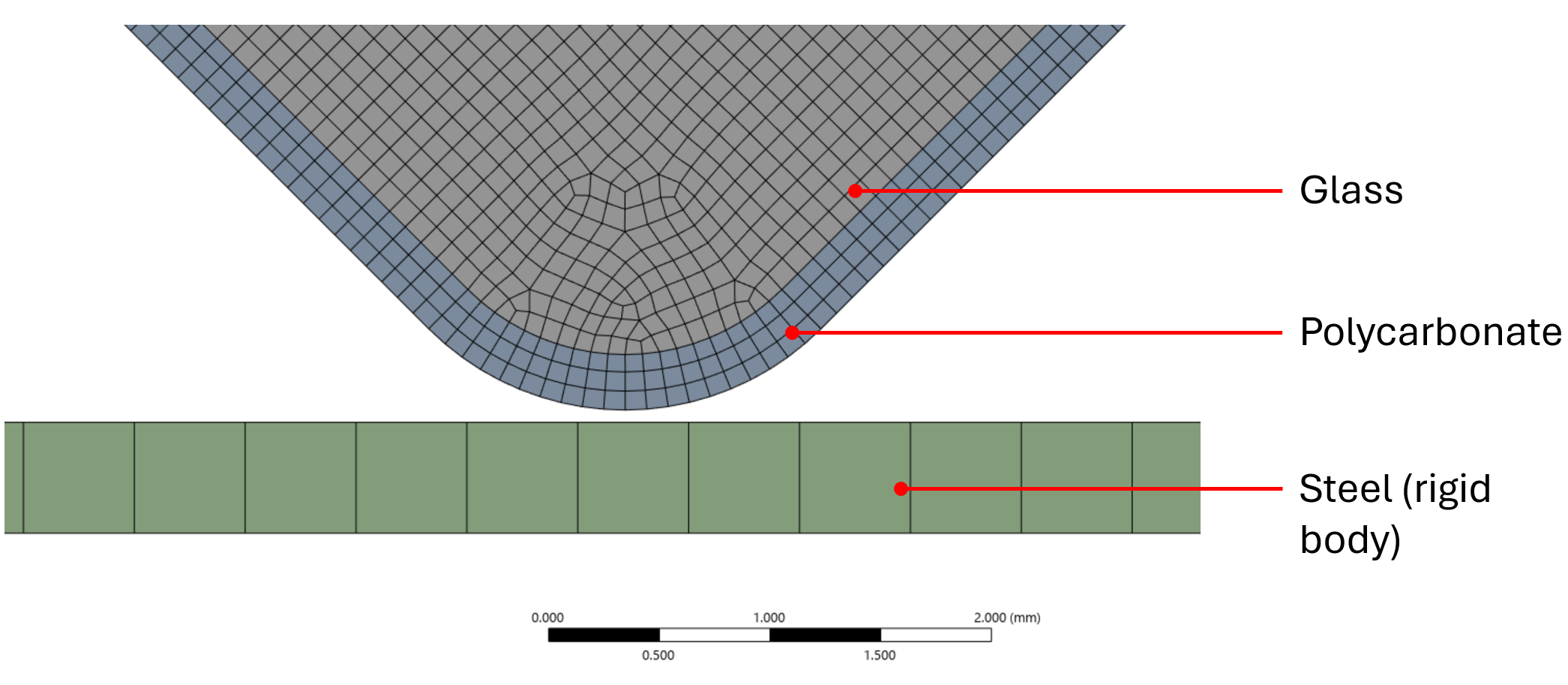
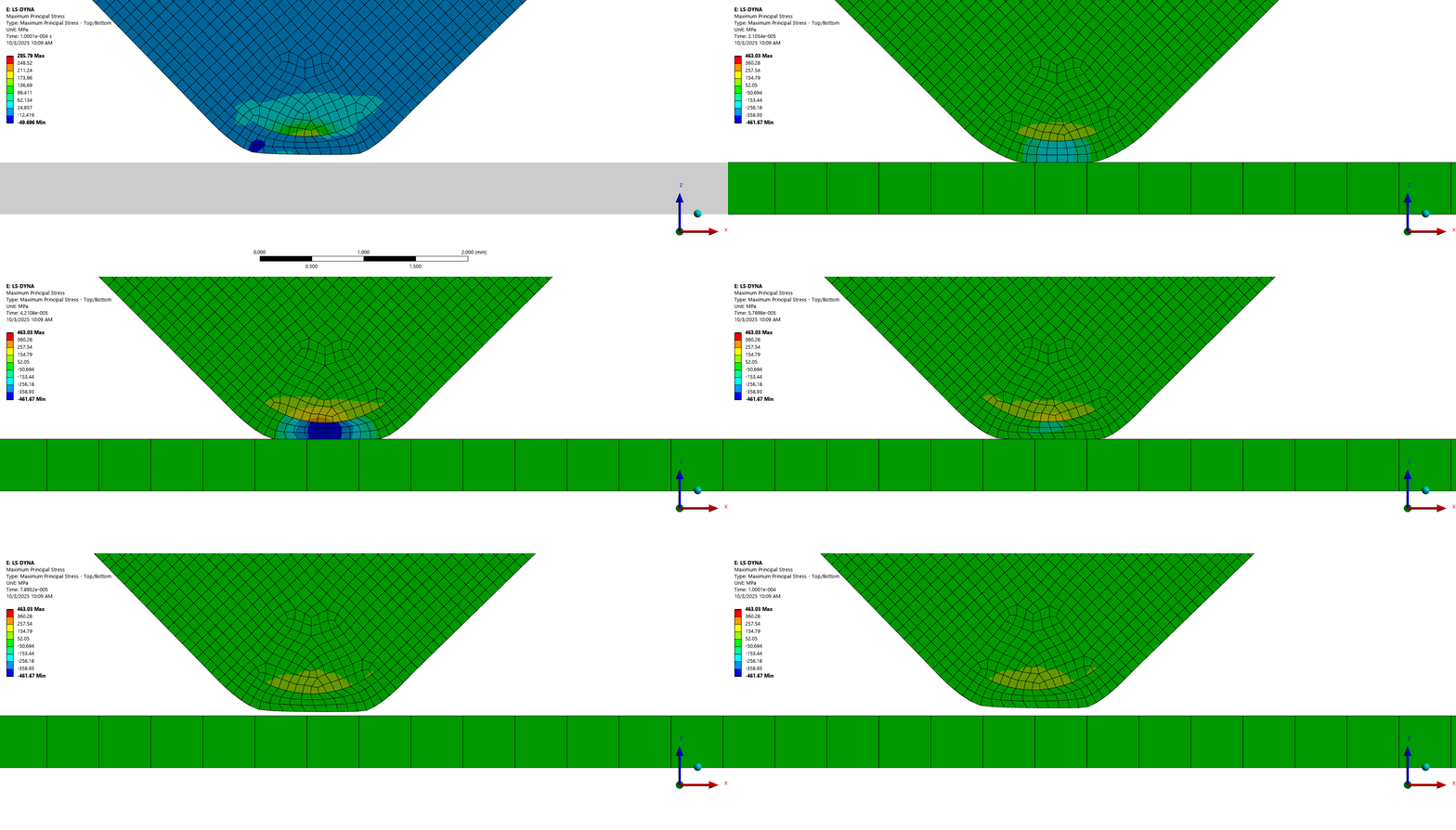
      I have a drop-impact simulation of a Glass+Plastic (polycarbonate) assembly. I'm get results that look like the Polycarbonate is undergoing plastic deformation.

      However, I have limited experience validating plastic deformation in LS-DYNA and would like some help on this. I'm especially worried if i've artificially introduced some non-physical plastic deformation in my attempts to eliminate Hourglass energy. 

      Setup:

      • Materials: Glass - Proprietary (substrate) , Plastic, PC High viscosity - Ansys default library (around the glass perimeter) , Steel - Default library(rigid body- shell) 
      • Contacts:
        • Glass <-> PC : Shared topology
        • PC <-> Plate : Frictional
          • Behavior: Asymmetric
          • Formulation: Pure Penalty (Automatic_nodes_to_surface)
          • Viscous damping coefficient: 0.1
          • Contact / Target Penalty Scale Factors: 10 
          • Soft Constraint Formulations: Segment Based
          • Soft constraint Scale Factor: 1
          • Depth: 2
      • Mesh: Hex8 (for glass, PC), and Quad4 (plate)
      • Hourglass controls: 
        • PC: ID 7 (Belytschko-Bindeman Linear Total Strain), coefficient = 1
      • Element Controls:
        • PC: Fully Integrated S/R Solid
      • Analysis setting:
        • Global Hourglass control: ID 5 (Exact Volume Flanagam-Belytschko Stiffness Form), coefficient = 0.1

      Points to note / Concerns: 

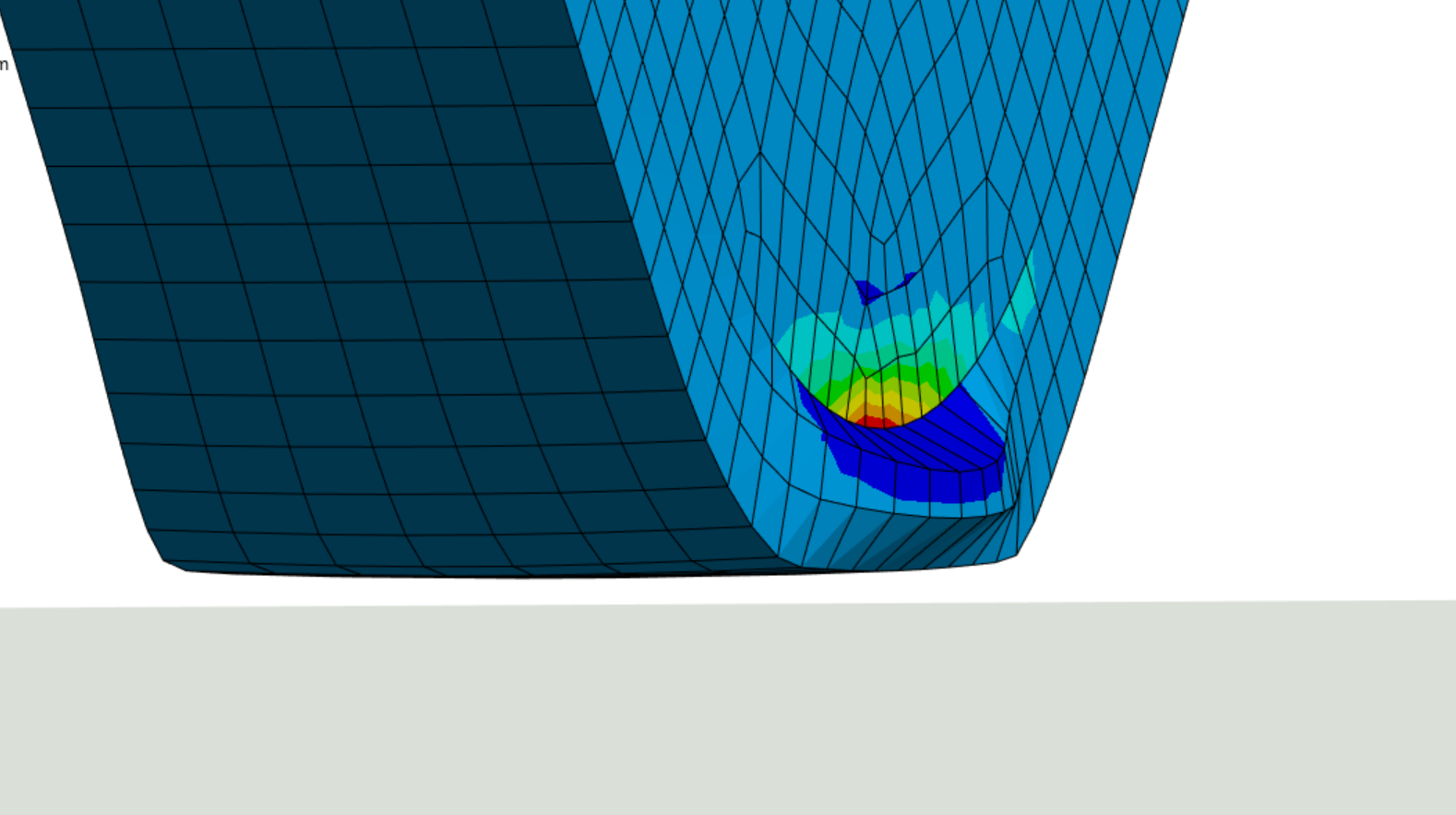
      • High distortion of the PC (not sure how I can check this is actually physical/ potential mesh issue)
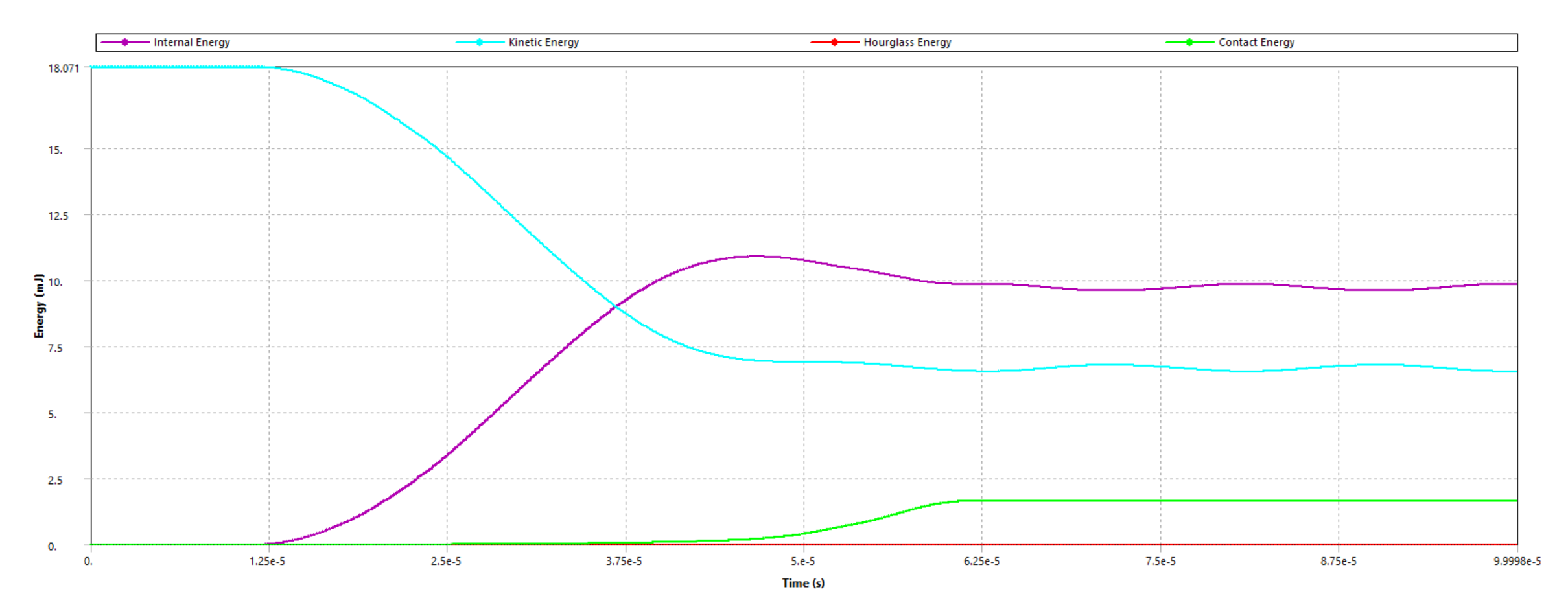
      • The contact energy increases and stays high (I think this is ok since there's sliding at the frictional interface)
      • Internal energy stays high after impact (again, I think this is physical since there's work done on the PC layer)


    • Dennis Chen
      Subscriber

      you really can't use workbench for LS-Dyna.   It will show you stuff but it will never give you all the info LSPP can give you.  You also have to inspect your input file, you cannot rely on a ton of workbench defaults that's introduced when you click "solve" inside the GUI. 

      1) You can check hourglass energy with matsum in LSPP.   Section_solid elform 2 for 8 noded brick is fully integrated and has no hourglass energy

      2) please post your mat card used with the ANsys library material.   The ansys library material isn't really designed for LS-Dyna if you are talking about the ones used with Mechanical

      3) you can probe plastic strain inside LSPP as well as characteristics like sliding interface energy to evaluate your contact pair

      4) PC material is highly rated dependent so you will want to consider rate effects (such as with Mat_24 and define_table for different rate effects or set your model with the appropriate material model for the strain rate closed to your problem) 

      Overall, I really would suggest get out of workbench to try to learn Dyna fully.   You can do this by studying the input file closely and then by postprocess inside LSPP.   When you can correlate everything you see in workbench to a keyword and know exactly how to replicate it in LSPP, you can then use workbench for its convenience but I really do not believe it's the place to start in its current incarnations. 

Viewing 1 reply thread
  • You must be logged in to reply to this topic.