-
-
February 19, 2024 at 7:25 pm
Divyam Pandey
SubscriberHello ANSYS community,
I am relatively new to ANSYS Fluent and currently working on a 2d fluid simulation problem that involves a channel with two inlets and a porous zone. I am seeking guidance on setting up the simulation correctly, especially regarding the concentration boundary conditions for the second fluid.
I have a channel where water enters through one inlet at a slow velocity. Simultaneously, another fluid enters through a second inlet (which is at the beginning of the porous zone), and this fluid needs to mix with the water after it passes through the porous zone. The concentration of the second fluid is 1 at the second inlet and decreases along the porous zone, leading to diffusion into the water. The goal is to monitor the increasing concentration of the second fluid over time and plot the results.
Questions and Challenges:
- Which Fluent model is most suitable for this scenario?
- How should I define the concentration boundary conditions for the second fluid at the second inlet and the porous zone?
- Are there specific settings or considerations I need to be aware of when dealing with porous zones and species transport?
I would greatly appreciate any guidance or suggestions from experienced users on how to correctly set up the Fluent simulation for this two-phase flow with species transport. Any insights into model selection, boundary conditions, or general best practices for similar scenarios would be immensely helpful. Thank you in advance for your assistance!
-
February 21, 2024 at 2:32 pm
Ahmed Hussien
Ansys EmployeeHi Divyam,Â
What is the phase of the second fluid? If it is in a liquid state similar to water, there is no need to use a two-phase model. Instead, you can simply enable species transport and define both species. However, if the second fluid is in a gaseous state, you will need to use a multiphase model. You can choose between the mixture model and the Eulerian models. In your particular case, I would recommend starting with the mixture model.ÂÂWhen it comes to the concentration at the second inlet, you should set the species mass fraction to 1 if it is a liquid, or the volume fraction to 1 if it is a gas.ÂÂFor the porous zone, it is important to ensure that you provide the correct fluid porosity and resistance, as this can affect the convergence of the simulation. Additionally, it is crucial to check the quality of your mesh and ensure that it is properly defined in regions with high gradients and near walls.Â
-
February 26, 2024 at 1:18 pm
Divyam Pandey
SubscriberHi Ahmed,
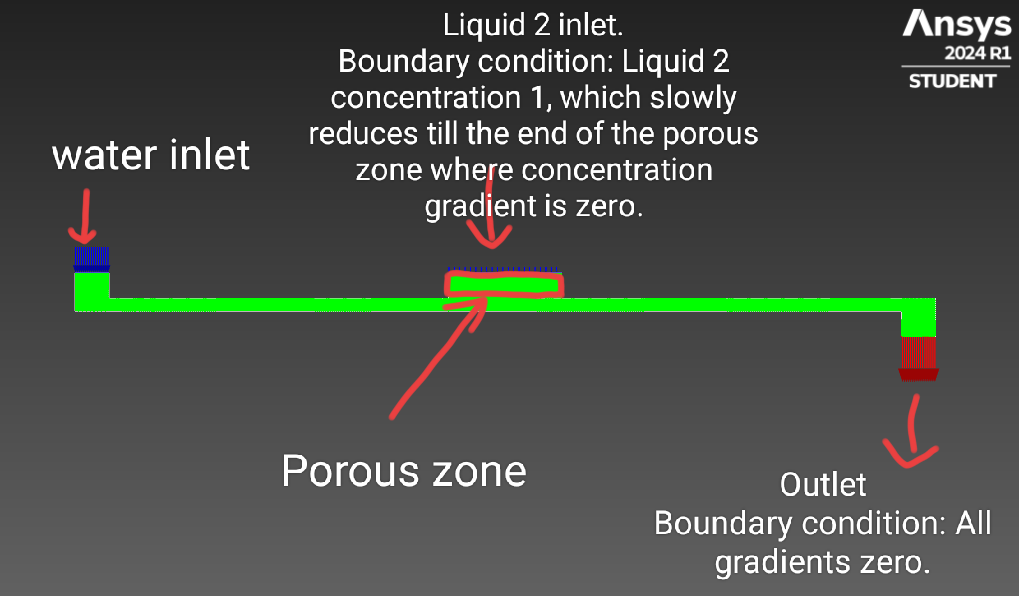
Thank you for your response.Both of the fluids are non reacting liquids. One is water, and the other is slightly more viscous newtonian liquid. Water inlet is a velociy inlet while the other liquid's inlet is at the beginning of the porous zone where the liquid 2 concentration is 1. Initially there is no liquid 2 in water, this concentration difference causes liquid 2 to slowly diffuse through the porous zone into the water flow. At the outlet all the normal gradients are zero. I wish to plot the increase of concentration of liquid 2 in water against time at the outlet. I am attaching the photo of my domain for a clearer explanation.
-
-
- The topic ‘Help Needed with Two-Phase Flow and Species Transport in Fluent’ is closed to new replies.
-
5834
-
1906
-
1420
-
1305
-
1021
© 2026 Copyright ANSYS, Inc. All rights reserved.