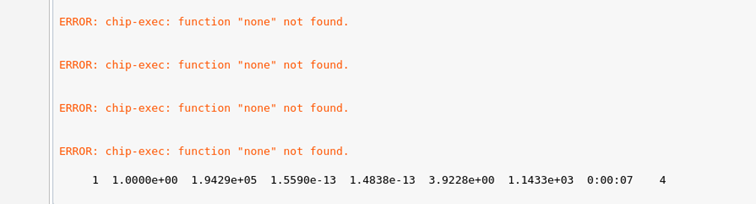
Getting ERROR: chip-exec: function “none” error when trying to run Fluent
TAGGED: #fluent-#cfd-#ansys, error
-
-
February 6, 2025 at 11:12 pm
-
March 18, 2026 at 11:51 am
roberto.scipioni
SubscriberHi there,
I keep getting this error
> /solve/dual-time-iterate 1e-2
ERROR: Invalid integer or integer not within limits [0 to #f].
Error object: 0.01[Hit ENTER key to proceed...]
300
Maximum Number of iterations per time step [10]ERROR: chip-exec: function "none" not found.
ERROR: chip-exec: function "none" not found.====================================
Anything I can do to debug this?
Details:
Ansys v222 and v242
Operating System Linux Almalinux
Intel or OpenMPI
Roberto Scipioni
Red oak Consulting UK
-
March 18, 2026 at 12:02 pm
Rob
Forum ModeratorPut the /solve/dual-time-iterate command into an interative session and see what Fluent asks for.
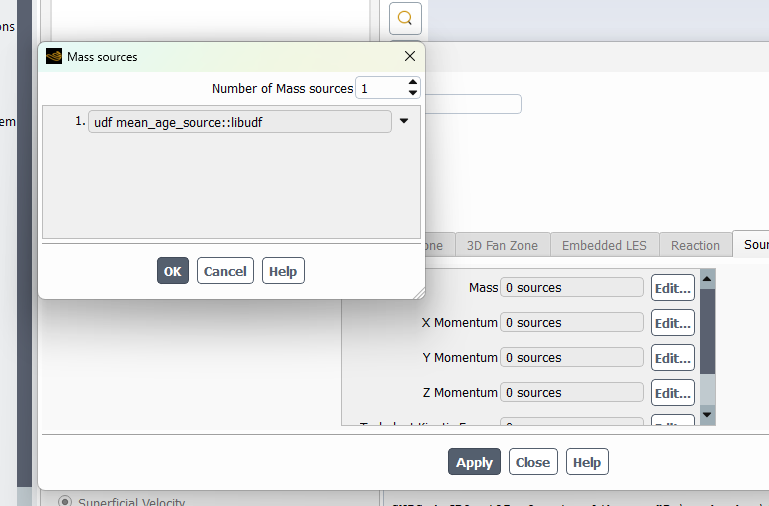
Re the chip-exec it's also associated with UDFs so check you've not got something loaded that's not necessary.
-
March 20, 2026 at 4:29 pm
roberto.scipioni
SubscriberIs there documentation on using UDF with Fluent?
The thing is : I am only the sys admin so not really an expert wit Ansys Fluent :-)
Any suggestion?
R.
-
March 20, 2026 at 4:43 pm
Rob
Forum ModeratorLearn? 😉
More usefully. If you’re on Windows if you put the .c file into the folder with Fluent when you Compile (that’s covered in the manual) use the Built in Compiler. We’ve bundled the CLANG compiler with Fluent for the last few years, this negates the need to mess with Visual Studio. If you have Linux do as for Windows but no need to use the built in compiler as Linux is a proper OS.
The Public form of the Documentation is here https://ansyshelp.ansys.com/public/account/secured?returnurl=/Views/Secured/prod_page.html?pn=Fluent&pid=Fluent&lang=en and you want the Customisation Manual.
The problem you’ve posted above is actually the journal isn’t correct, the argument following /solve/dual-time-iterate is an integer number of time steps, and not the time step size. Your users should be providing valid journal scripts, although I’d tend to set everything via the GUI and the batch script should just load case & data, run the job, write case & data and close.
-
March 20, 2026 at 4:46 pm
roberto.scipioni
SubscriberWe are using command line interface on an Linux HPC so it all done with text files that are edited, run ...etc
R.
-
March 20, 2026 at 4:50 pm
Rob
Forum ModeratorOK, and has the .c file been compiled previously on Windows or Linux? You may need to compile before running if that's case as Win11 libraries are different to Linux: that may explain the chip-exec. One trick is to open Fluent via the GUI in the working folder and compile, you don't need a case file to do this. Then close Fluent and run the corrected journal.
-
March 20, 2026 at 4:53 pm
roberto.scipioni
SubscriberOK, I had the user permission to run some test in her directory...will try and let you know...for the time being thanks :-)
-
March 20, 2026 at 4:54 pm
roberto.scipioni
SubscriberI can see there is a hierarchil file that is used .h5 is that what you are refering to?
-
March 20, 2026 at 5:05 pm
Rob
Forum ModeratorThe files they should provide are:
something.cas.h5 That's the geometry & settings
something.dat.h5 That's the data, this can also be created by initialising the model from the case file so is optional.
whatever.c The UDF file that's causing you the problems
whatever.jou The journal file that may or may not make everything work.
On initialisation and/or completion of the run I'd expect additional files:
libudf Folder that's created when you compile the .c file
something_123.cas.h5 and something_123.dat.h5 that's the output of the model. You need both files as the data is just the numbers and uses the case to make sense.
-
March 20, 2026 at 8:12 pm
-
March 20, 2026 at 8:16 pm
roberto.scipioni
SubscriberIs the command:
fluent 3ddp -t40 -gu -driver null -cnf=$HOSTS -pinfiniband -cflush -i inputFile.in
valid?
-
March 22, 2026 at 1:08 pm
roberto.scipioni
SubscriberSo I tested it using:
fluent 3ddp -t120 -gu -driver null -cnf=$HOSTS -pinfiniband -cflush -i inputFile.in
in the output we get:
...
...
> /solve/dual-time-iterate 1 300
ERROR: chip-exec: function "none" not found.
ERROR: chip-exec: function "none" not found
....
....
================
How do I run
/solve/dual-time-iterate
interactively?
Many thanks
Kind regards
Roberto
-
March 22, 2026 at 1:38 pm
roberto.scipioni
SubscriberOk got the interactive session :-)
Running it I get:
...
...
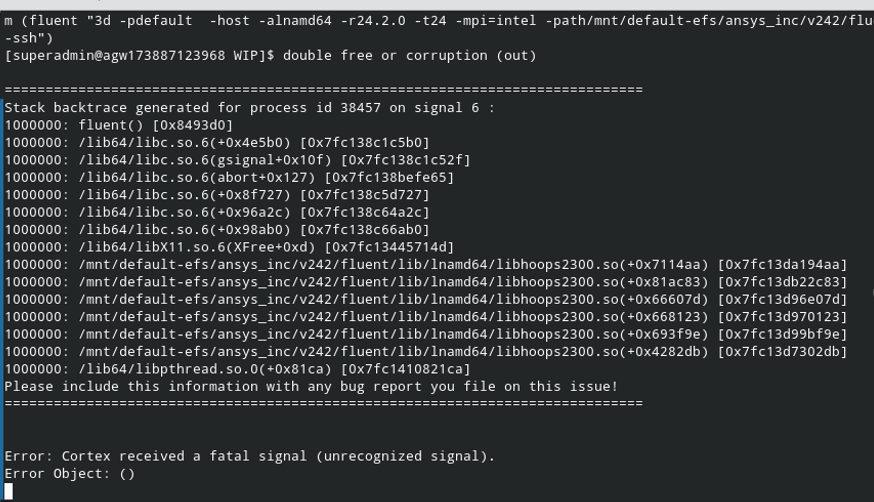
Error: An error or interrupt occurred in the previous operation.
Details have been printed to the text console transcript.
Error Object: #f...
...
=====
Any idea on how to further troubleshoot this?
Many thanks
Roberto
-
March 23, 2026 at 9:42 am
Rob
Forum ModeratorI assume you've got inifiband mpi? If you've got an interactive session, what did you set in parallel, and was there anything useful in the transcript (.trn file).
The chip exec means Fluent's looking for something UDF related "somewhere".
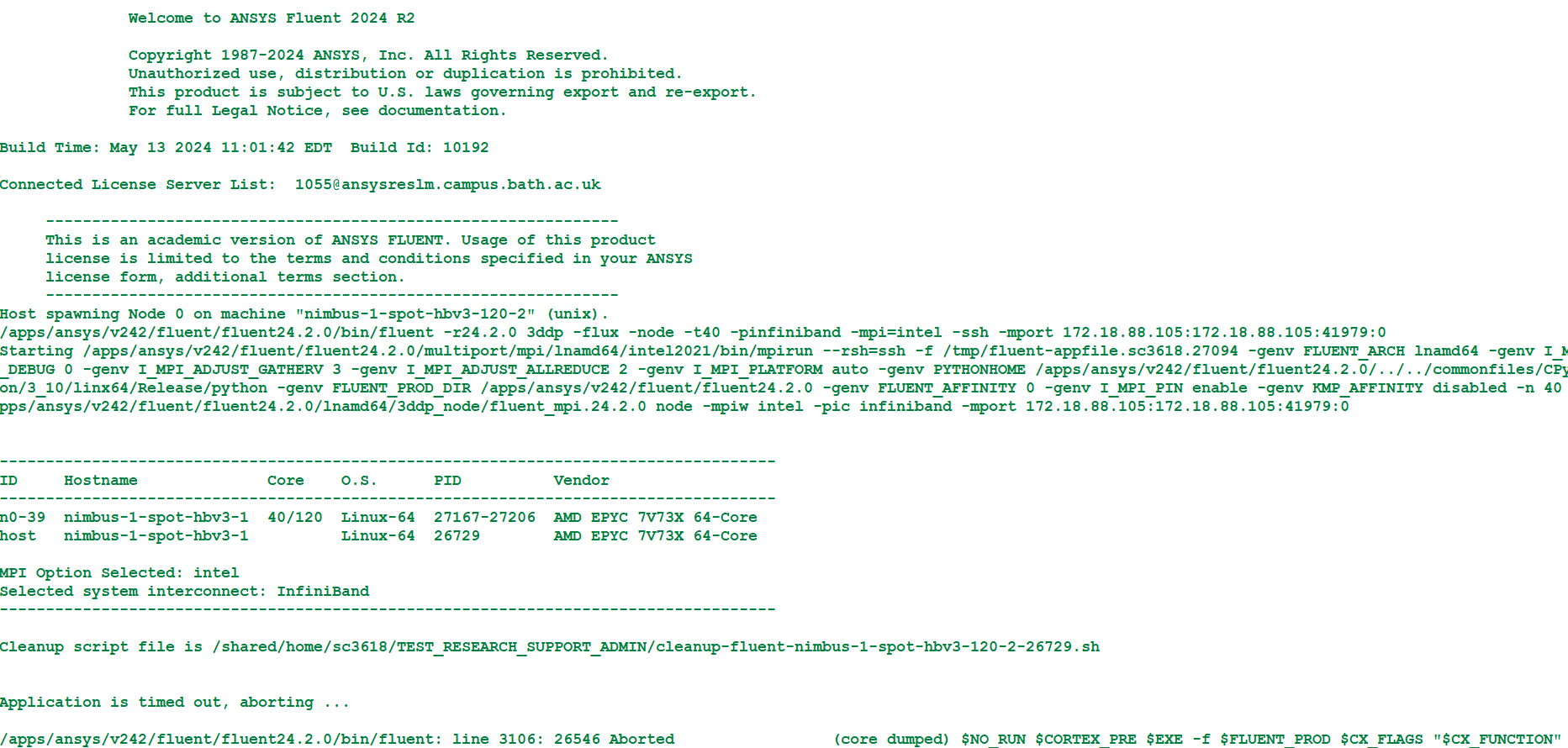
On launch I see this for interconnect
MPI Option Selected: intel
Selected system interconnect: default
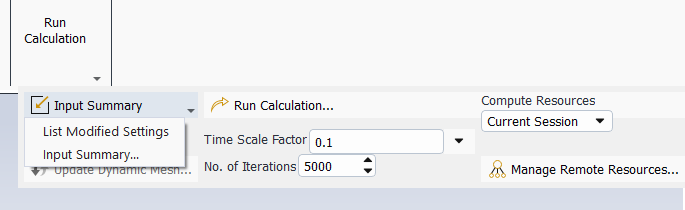
You might need someone who can use Fluent to troubleshoot the Fluent part. Under Solution tab, and possibly under Run Calculation (my screen resolution isn't good) look for "List Modified Settings". That should tell you everything that's been changed. You're looking for a UDF (libudf) or a blank line.
-
March 23, 2026 at 12:14 pm
roberto.scipioni
SubscriberHi,
Thanks.
1) As mentioned. As we are in an HPC environment (Linux) we do not use GUIs
2)I can use fluent as part of ansys (and I did) but I cannot use the GUI.
3)I have to confess I am not sure I fully understand this libudf thing! Is it a system library or a user compiled library (very weird in a unix environment!!!)
If it is a user compiled library do I need to retrieve the original .c file or?
Kind regards
Roberto
-
March 23, 2026 at 1:36 pm
Rob
Forum ModeratorLibudf is the compiled library, and you'll need either libudf compiled in parallel on the cluster OS or the .c file to compile once you've launched Fluent. If you compile from Fluent before reading the case it may resolve the chip-exec as the library will be available to load.
Is there a way to attach a viz node the cluster?
-
March 23, 2026 at 2:12 pm
-
March 23, 2026 at 2:23 pm
Rob
Forum ModeratorThe libudf folder is created by compiling a suitable .c file so that Fluent can work with the library. It's read by Fluent as part of the model set up.
-
March 23, 2026 at 2:59 pm
-
March 23, 2026 at 3:14 pm
Rob
Forum ModeratorYes. You'll need to compile some or all of the .c files. I'm fairly sure they can all be compiled at once into the one libudf, but you also need to check with the user as to what they set up.
-
March 23, 2026 at 4:16 pm
roberto.scipioni
SubscriberAnother question:
Where do you find these .c files does the user have to write them or?
R.
-
March 23, 2026 at 4:31 pm
Rob
Forum ModeratorThe user writes them. There have been a few Ansys provided modules but they're typically provided as "unsupported" in that the user is responsible for any problems. There are examples which (usually) work in the manual.
UDFs are a more advanced part of using Fluent and are used to add functions that aren't available in the core code: that could be as simple as a boundary profile, or as complex as a complete model for something. Hence the difference in support, a profile might be 10-15 lines but a full model could be 3-4000 lines of code.
-
March 23, 2026 at 5:14 pm
roberto.scipioni
Subscriberso the user should be able to create and/or use them then !
R.
-
March 23, 2026 at 5:28 pm
roberto.scipioni
SubscriberHow does fluent know that he "needs" to use these udfs?
A tag at the command line or?
-
March 23, 2026 at 5:34 pm
Rob
Forum Moderator -
March 23, 2026 at 7:37 pm
roberto.scipioni
SubscriberThanks.
So how does the command:
/solve/dual-time-iterate
know that has to use these UDFs ?
Is it not /solve/dual-time-iterate an internal command in fluent?
Thanks
Roberto
-
March 24, 2026 at 9:54 am
Rob
Forum ModeratorIt doesn't. The /solve/dual-time-iterate command triggers the Fluent solver to execute some iterations using the settings in the case file. That case file does know about the UDF along with the mesh, boundary settings etc.
-
March 24, 2026 at 11:29 am
roberto.scipioni
SubscriberSo either the user changes the case file or she has to set the proper .c files compiled the library etc. One last question, in a Linux environment would it suffice to specify LIBRARY_PATH to have fluent use/load the library or we need to set something somewhere else?
Thanks
Regards
Roberto
-
March 24, 2026 at 11:50 am
Rob
Forum ModeratorI'd just make the user put all of the files in the working folder and make sure they use local paths in the case file. Trying to pull data over the network just opens up potential for data access hiccups. Similarly, they need to write files to the local disc to avoid network latency problems. That's currently rare, but we have software-hardware speed cycles where data writing is faster than the system can handle every now and again: ie when people run older switches/RAM on clusters and we've just updated the MPI functions.
-
March 28, 2026 at 4:03 am
roberto.scipioni
Subscriber-
March 30, 2026 at 8:34 am
Rob
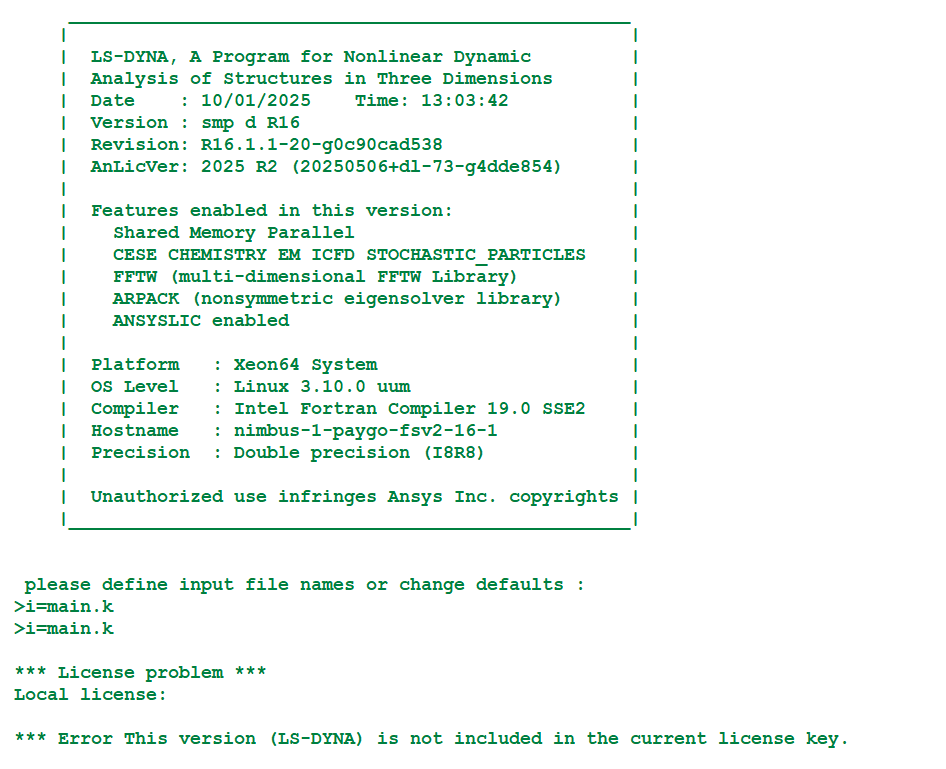
Forum ModeratorYou'll need to post into a new thread for this - I don't know anything about using Dyna.
-
-
March 30, 2026 at 9:51 am
roberto.scipioni
SubscriberOK thanks
-
April 9, 2026 at 3:19 pm
roberto.scipioni
SubscriberHi,
Going back to The Fluent error. The user confirmed that she took the simulation from a friend. She copied input etc but the case file is DIFFERENT could it be that in changing the case file
the simulation requires the libudf library?
I converted the .h5 file into a text file. Is it written anywhere the need to use the libudf.so ?
Many thanks
Kind regards
Roberto
-
April 9, 2026 at 3:40 pm
Rob
Forum ModeratorWhat exactly did she copy? If she took the setup FILE into a new mesh then that setup file might contain the UDF calls, but lacking a libudf things get interesting.
You don't need the libudf as such, it's the macro identity from the libudf. The problem being you're possibly looking for an absence of a setting.....
-
April 9, 2026 at 3:47 pm
roberto.scipioni
Subscriber...I asked the user to run exactly the same simulation of the other person who did not get the error. We will see what happens.
R.
-
April 14, 2026 at 2:39 pm
sc3618
SubscriberHi, I am Sylvia the user that got the original error. I need to figure out how to use the libudf with fluent. Can you please help me?
-
April 14, 2026 at 2:54 pm
Rob
Forum ModeratorOK. Have you got the .c file? If so, it needs to be compiled for the OS and parallel for the cluster AND the libudf needs to be in the working directory on the cluster.
-
April 14, 2026 at 2:57 pm
sc3618
SubscriberHi Rob, I have recently started working with it but sure what it means. Could you please provide me some sample files ?
-
- You must be logged in to reply to this topic.

-
6660
-
1906
-
1469
-
1313
-
1022
© 2026 Copyright ANSYS, Inc. All rights reserved.