Ansys Assistant will be unavailable on the Learning Forum starting January 30. An upgraded version is coming soon. We apologize for any inconvenience and appreciate your patience. Stay tuned for updates.
General Mechanical

General Mechanical

Topics related to Mechanical Enterprise, Motion, Additive Print and more.

Free vibration of sandwich plate.

    • Nurs134
      Subscriber

      Good morning,


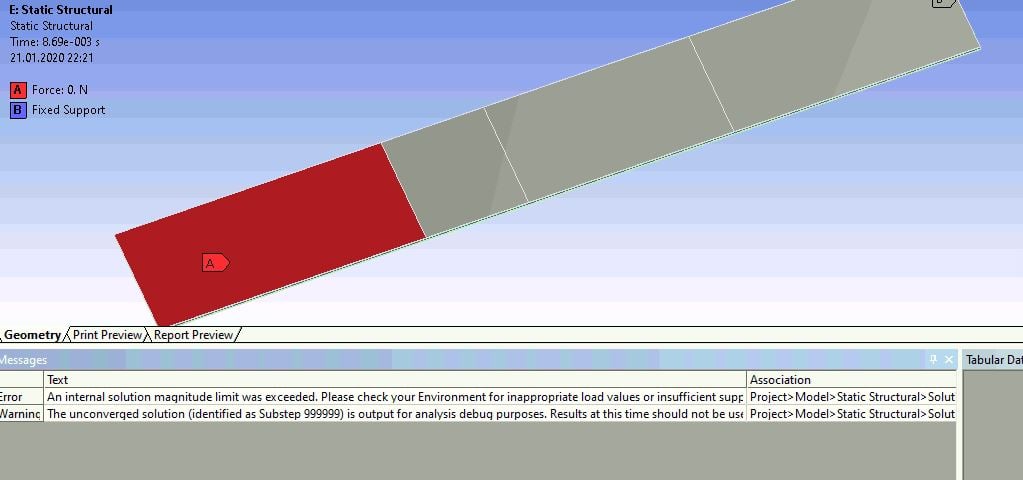
      I am working on a sandwich plate of bonded two materials Nitinol+aluminum+Nitinol. I have set up a Share Topology and it behaves like one single part. I have set fixed support to the plate from one side. A downward displacement acting on the other side of the plate. Below are the two error messages and the warning message I receive when trying to solve it. Any help would be greatly appreciated, thank you. 


      Solved with time integration 0.1 sec


      Face split on the side of a sandwich plate where is necessary to take results.


      Displacement is 5 mm for 1 sec. Duration of analysis 5 sec.


      Large deflections ON


      In damped controls, damping value was set up to 0, but alpha=7.8  and beta damping= 0.005128 values were inputted directly into material properties.


      Additionally, question, if the damping factors were inputted in material properties and in transient analysis of damping controls was the damping value is zero, is solver will ignore material damping over damping control values in settings of analysis or in reverse? Due to, there is no function to turn off damping in transient analysis, as it in modal analysis.


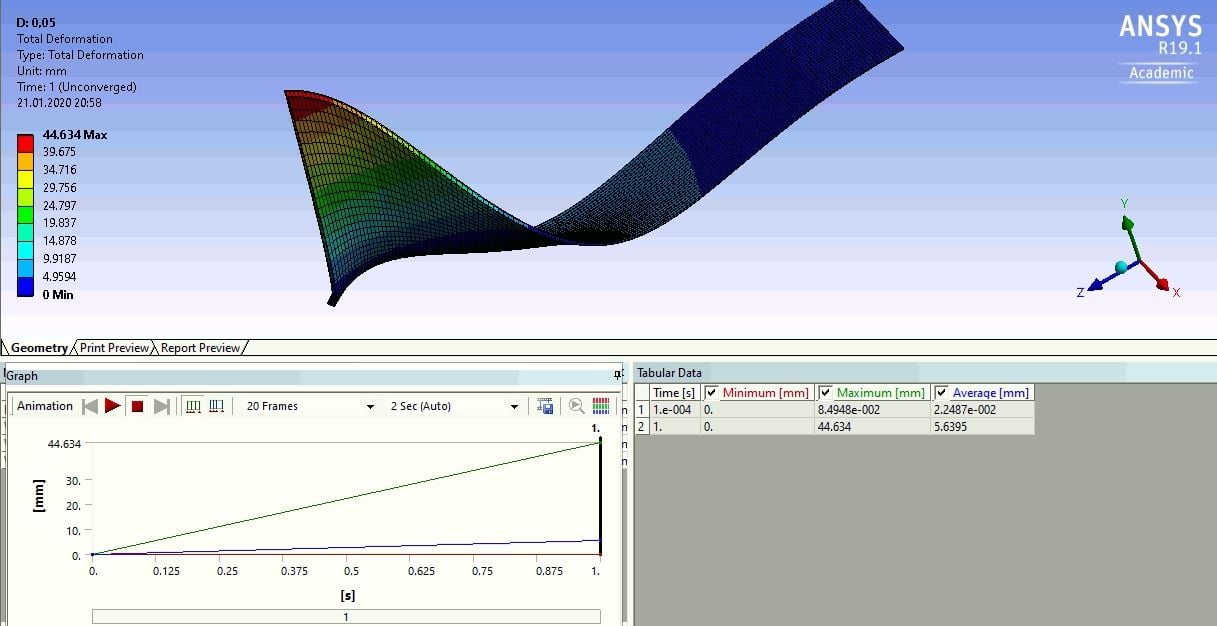
      ERROR: An internal solution magnitude limit was exceeded. Please check your Environment for inappropriate load values or insufficient supports.  You may select the offending object and/or geometry via RMB on this warning in the Message window.  Please see the Troubleshooting section of the Help System for more information.



    • peteroznewman
      Subscriber

      1. Turn on Auto Time Stepping.  That will help convergence as it will allow it to take smaller steps where needed and larger steps elsewhere.


      2. Damping is additive, so if you have it in the material definition and under Analysis Settings + Damping Controls, then those are both in the model, which you don't want.  Neither do you want no damping.


      3. Don't zero out Numerical Damping, leave it at the Program Controlled value of 0.1  It is there to help the solution cope with high frequency chatter and is not there to damp the structure in a significant way.


      4. I can't see the length of the entire object, so I can't tell if 5 mm is a small or large number.


      5. Moving 5 mm in 1 second doesn't seem like a vibration input, it seems like a static input.


      6. What is the undamped first natural frequency from the Modal analysis?


      7. If your integration time step is 0.1 seconds, that implies you are only interested in frequencies less than 1 Hz. Is that correct?


    • Nurs134
      Subscriber

      • The length of the entire object is 80mm, thickness = 0.05+0.2+0.05 mm and width = 30mm

      • The undamped first natural frequency from the Modal analysis = 39 Hz

      • The integration time step is 0.1 seconds taken randomly, which does not imply me in frequencies less than 1 Hz. Actually, I am interested in frequencies low vibration range which is above 1Hz until 1000Hz 

      • How to apply load as it seems to be as free vibration, for example as impact by the hammer?

      • I solved it with your recommendation, but it again shows ERROR. Error message attached

    • peteroznewman
      Subscriber

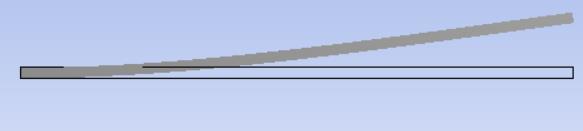
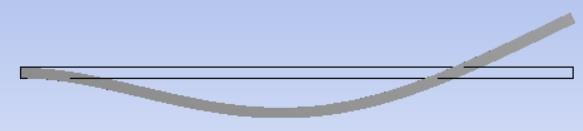
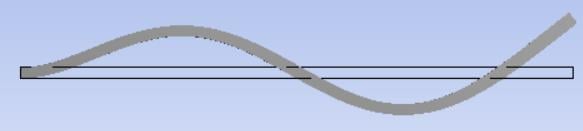
      A wide, thin cantilever beam has three mode shapes as shown below. I estimated the frequencies of mode 2 and 3.


       Mode 1, 39 Hz


       Mode 2, 244 Hz


       Mode 3, 690 Hz


      • To excite the first mode, apply a force to the tip for 1/(2*39) = 0.0128 seconds.

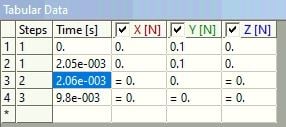
      • To excite the second mode, apply a force a bit less than half the length for 1/(2*244) = 0.00205 seconds.

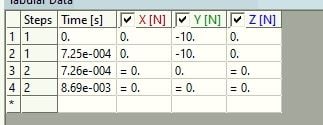
      • To excite the third mode, apply a force about 1/3 along the length for 1/(2*690) = 0.000725 seconds.


      How you do that is have a three-step solution. Step 1 end time is equal to the times listed above. Step 1 is when the force is non-zero. Use a force that causes a few millimeters of deflection in a Static Structural solution. Step 2 ends a millisecond after Step 1 and ramps the force down to zero. In Step 3, the force is zero and the response of the system can be observed for a few cycles of motion. So for 6 cycles of mode 1, the end time for step 2 would be 6/39 = 0.154 seconds.


      If you are interested in the transient motion of mode 3, then you should have the maximum time step be about 1/(20*690) = 7.25E-5 seconds so that you get 20 frames to animate the motion that cycles at 690 Hz.

    • Nurs134
      Subscriber

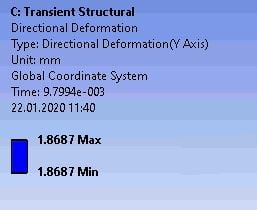
      Thanks for tips. I am interested in transient analysis. So I tried it, but there are again errors. I attached screenshots below. 

    • peteroznewman
      Subscriber

      What is the Static Structural deflection for that 10 N force (with Large Deflection On)?

    • Nurs134
      Subscriber

       Static analysis showed the error


    • peteroznewman
      Subscriber

      In Workbench, File, Archive to create a .wbpz file.  Attach that file to your post above.


      You should have a working Static Structural and Modal analysis before you spend time in Transient Structural.

    • Nurs134
      Subscriber

      This is a link to download the archive


      https://drive.google.com/file/d/1R8VSAyjcni5_rJIRGFDefDEs3ptMxt_C/view?usp=sharing

    • peteroznewman
      Subscriber

      The problem with static structural was poor quality elements in the mesh and a force that was 100 times too high.


      Attached is an ANSYS 19.1 archive. This only excites the first mode, so could increase the time step by 100.


      Check ANSYS Help if the material damping is applied in a MSUP Transient solution, I'm not sure, there is a complicated table of what gets used and what doesn't in different types of dynamic analysis.

    • Nurs134
      Subscriber

      Thanks for the right model. I did the analysis for the second mode.


      Actually, the research is effect of changing the thickness of damping material. At the end of transient analysis, I need the result of the attenuation of displacement as in the picture. Then I will compare the duration of damped vibration for each thickness of the material. How to make such an analysis in transient solver?


    • peteroznewman
      Subscriber

      Why mode 2? The graph you are showing looks like mode 1. Mode 2 is at 213 Hz while mode 1 is at 35 Hz so you will have to look for mode 2 within the oscillations of mode 1.


      Anytime you apply a hammer strike, it tends to excite all frequencies, so you will get mode 1 and mode 2 and higher modes all mixed together. It is difficult to excite only mode 2, you have to hit the beam with just the right combination of up and down force so as to cause it to deform into the mode 2 shape exactly.  It is easy to excite mode 1, because a tip load causes the beam to deform into the mode 1 shape.


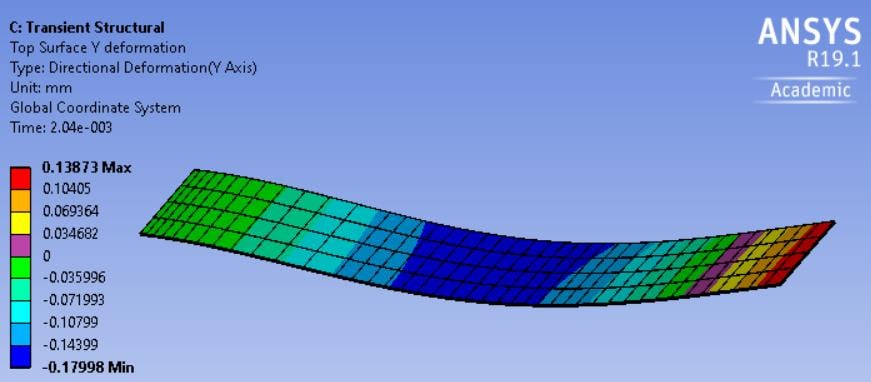
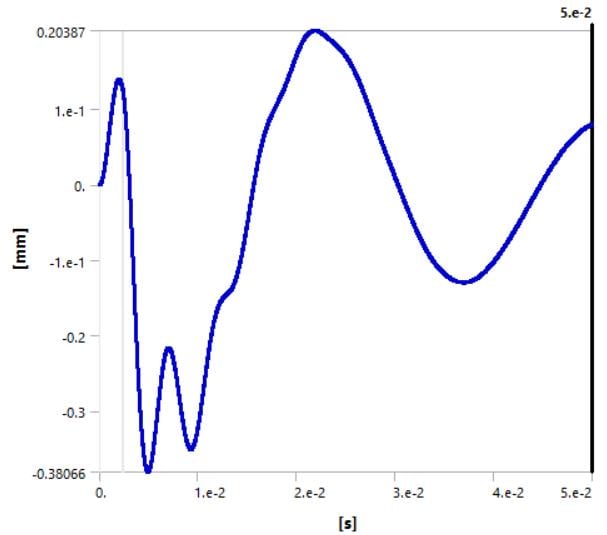
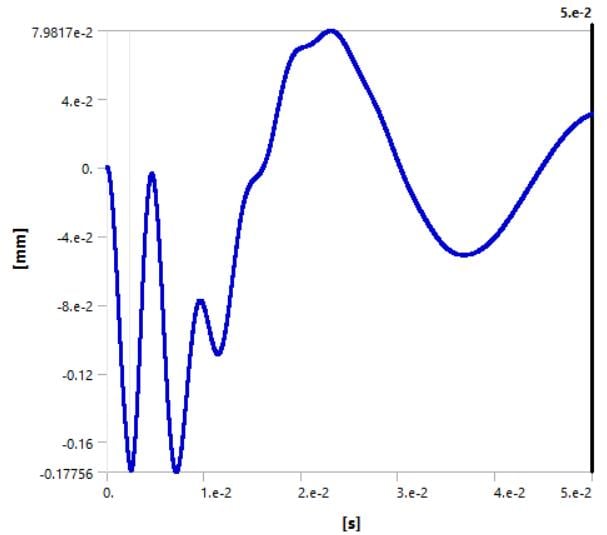
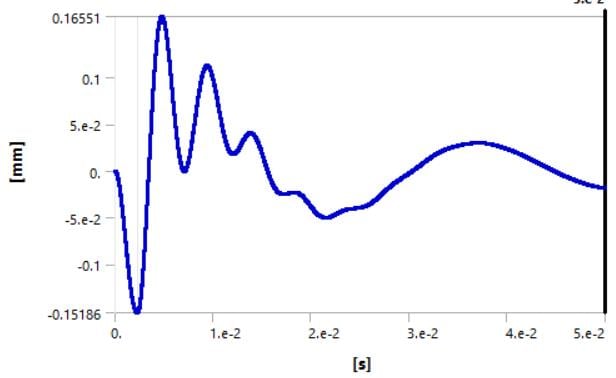
      In any case, I applied an up and down force at the middle and tip to get some mode 2 shape. The green/purple intersection is zero. I would use more tip force to get more of mode 2 in the response on the next try.


      Here is the graph of the tip Y deformation.


      Here is the graph of the center Y deformation.



      Notice that in the first few cycles, the tip goes up, while the center goes down (mode 2) but very quickly, mode 1 takes over and they start to go up and down together.

    • peteroznewman
      Subscriber

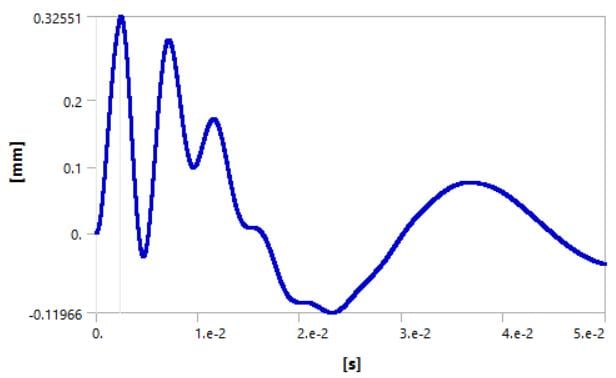
      I doubled the tip force and got much more of mode 2.


      Tip Displacement


      Center Displacement


    • Nurs134
      Subscriber

      Does it mean that I can see damped vibration after a hammer hit? I expected to see at the end of the graph the straight line which is at the calm condition. Or I should run simulation in a wider range of such as 3-5seconds?

    • peteroznewman
      Subscriber

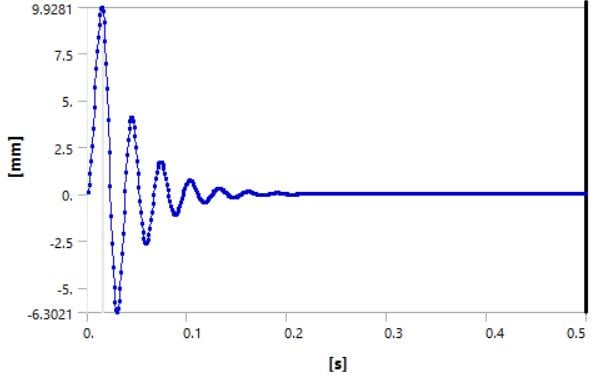
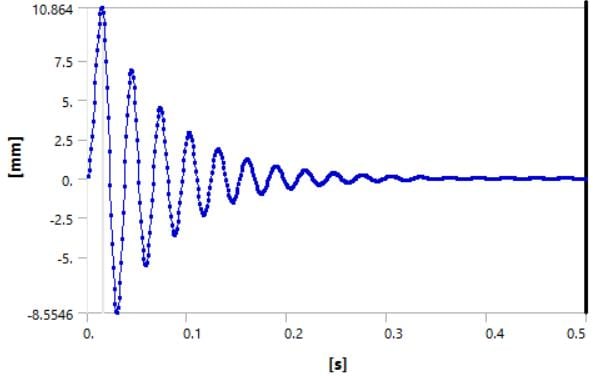
      Yes, you can see the calm condition if you simulate, but it will be mode 1 vibration that lasts more than a few cycles.


      This plot has a damping ratio of 0.2


      This plot has a damping ratio of 0.1


      You didn't say why you were interested in mode 2.


      If your question has been answered, please mark a post with Is Solution to mark the discussion as Solved, or ask a followup question.

    • Nurs134
      Subscriber

      I used mode 2 due to I mixed up the hummer hit with harmonic vibrations. It is obvious that with hammer hit we can only excite 1mode. When I try to do analysis by inserting damping ratio value, simulation crashes


      Can you please upload a file with 0.2 and 0.1 dampings on the 1mode?

    • peteroznewman
      Subscriber

      There is only one file, I changed the Damping Ratio in the Engineering Data and did an Update on the Project page to get a second graph.


      If your question has been answered, please mark a post with Is Solution to mark the discussion as Solved, or ask a followup question.

Viewing 16 reply threads
  • The topic ‘Free vibration of sandwich plate.’ is closed to new replies.
[bingo_chatbox]