-
-
May 2, 2020 at 12:01 am
xing
SubscriberWe are using VOF model to simulate a river water flow over the water bed and also with a small
pit (fish nest) in the middle of the no-slip bottom wall. Our flow domain has a very small tilt, with a
3rd or a 4th decimal numbered slope.
Â
The boundary conditions are as shown in the schematic. Mass flow inlet or velocity profile inlet pressure outlet (hydrostatic pressure profile), bottom No-slip wall and the top boundary is symmetry.
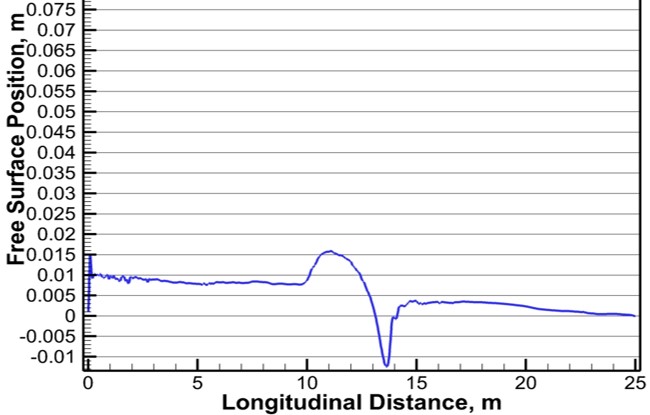
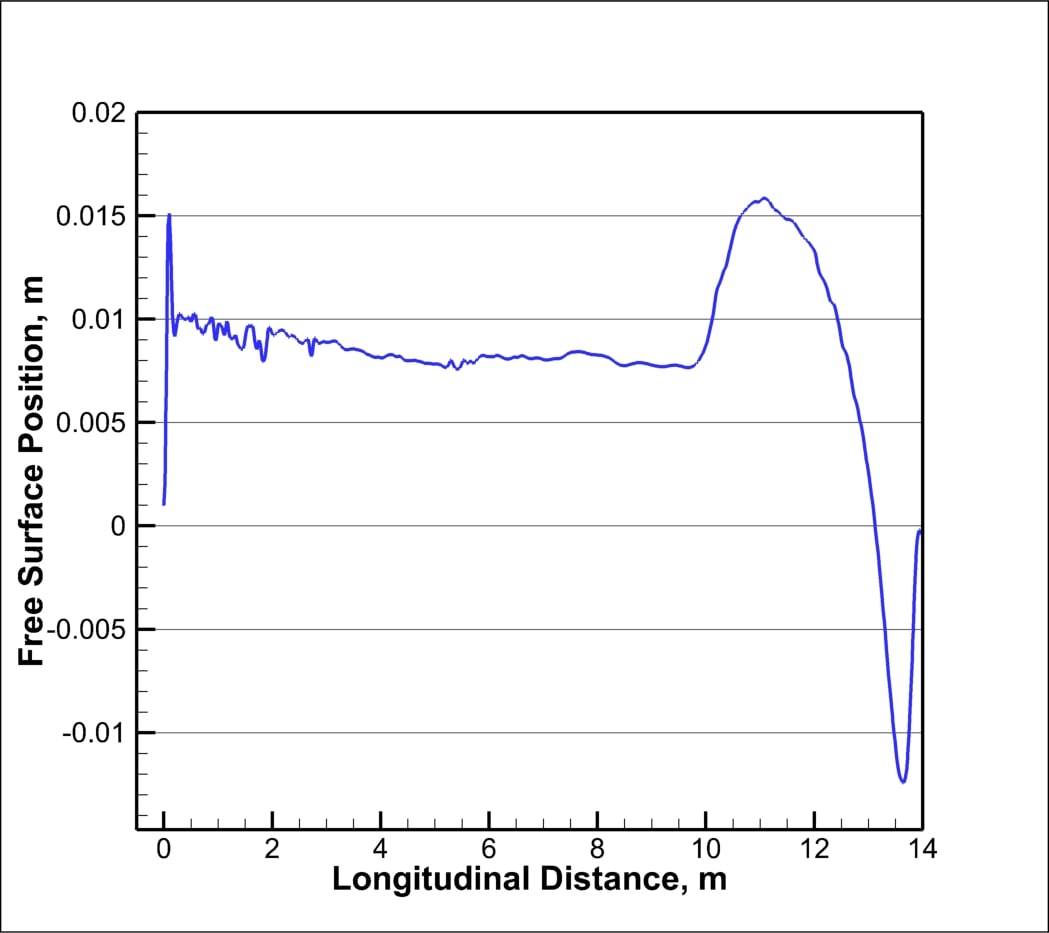
For such a simulation case, we are observing a few millimeters to centimeters unphysical jumps and
oscillations in the free surface near the inlet above the water depth we specified. These
jumps/oscillations gradually settle down further downstream. Below is a free surface plot, for a
domain with a pit on the water bed from 10 to 14 horizontal distance. This issue is there for either
mass flow inlet or velocity profile inlet boundary conditions. Note that the open channel flow
model doesn't work for our case as we are investigating the effect of slope and other parameters
effect but FLUENT open channel flow model enforces the gravity is always normal to the free
surface.

-
May 3, 2020 at 5:21 pm
Karthik Remella
AdministratorHello,
Are you running a transient simulation? If so, at what time is this free surface position result extracted?
What is your solution convergence like?
And what solver settings are you using for this problem?
Thanks.
Best,
karthik -
May 3, 2020 at 10:36 pm
xing
SubscriberHello Karthik:
Thanks for your prompt reply! We are running a transient simulation. The result shown is at about 180 seconds (the domain is 25 m long and velocity is about 0.6 m/s).
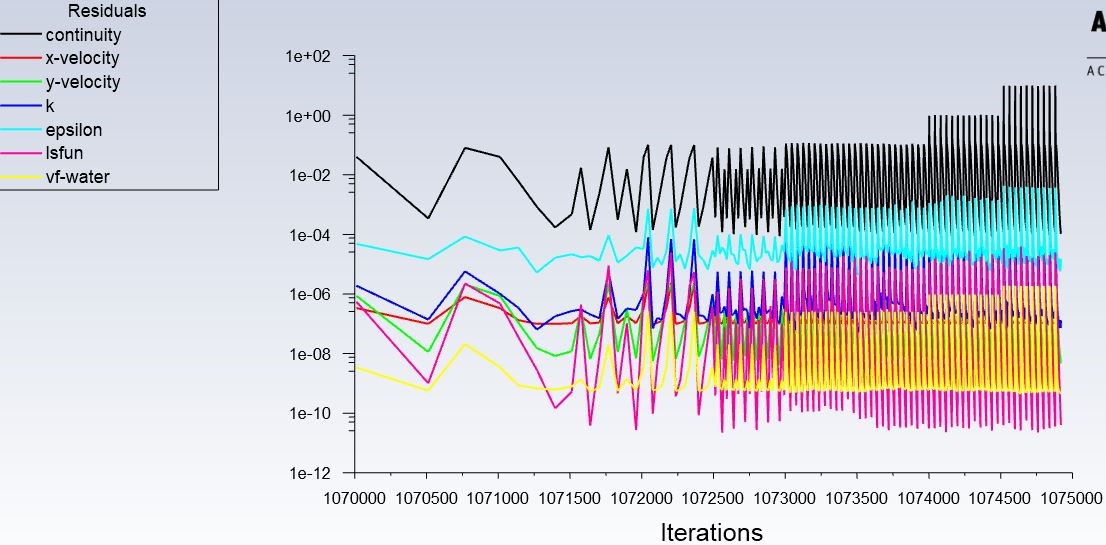
The final residuals are shown in the figure below.  As for solver settings: we are using VOF-2 phase (surface tension = 0.072 N/m); realizable k-epsilon, SIMPLE or SIMPLEC scheme, 2nd order upwind scheme.   -Best, Tao
-
May 4, 2020 at 9:24 pm
Karthik Remella
AdministratorHello,
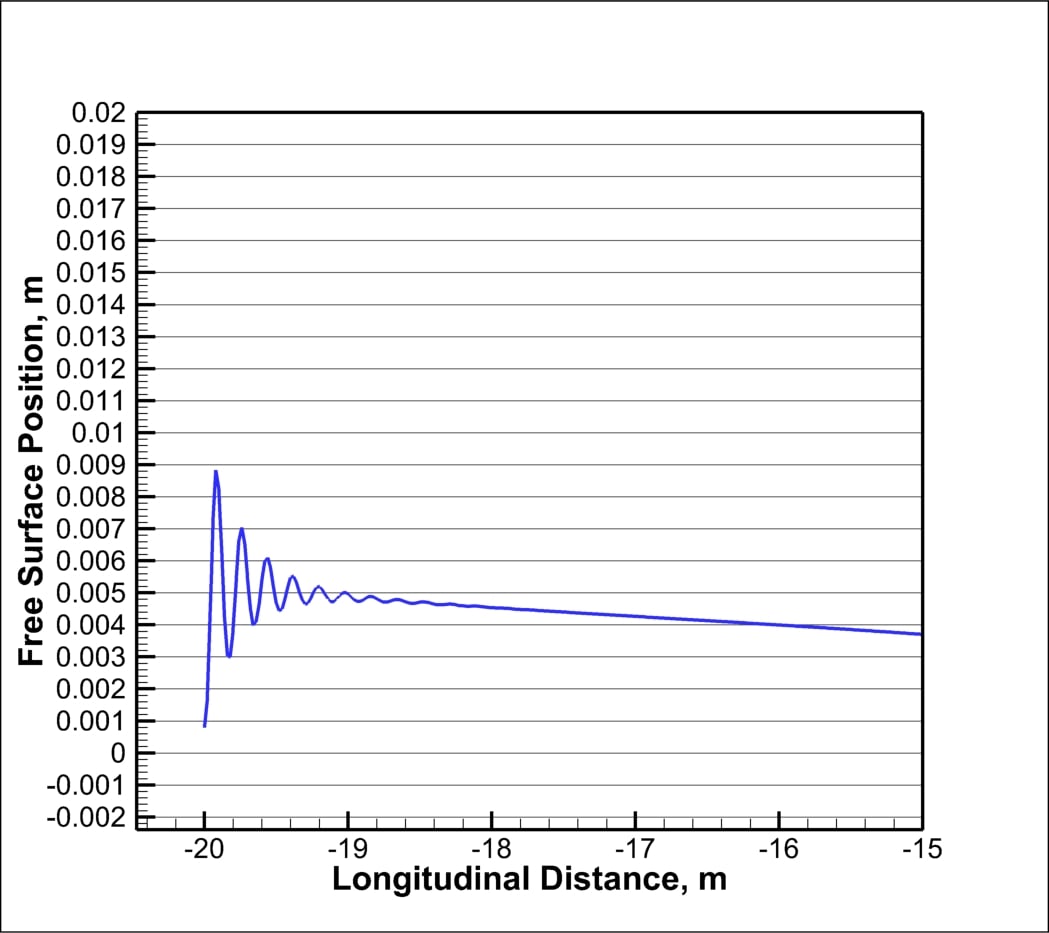
How much downstream does this effect propagate? Could you please zoom into the x-axis for me and send me a screenshot of the spike?
So, you have cycled the flow approximately 4 times through your computational domain. Interesting. And you simulation seems to be converging every time-step, which is good.
How do your monitors at the inlet boundary look? Do they show any irregular spikes? Perhaps, you could monitor average pressure at the inlet or something?
Are you able to collect the interfacial location periodically in your simulation and compare the values? Where you able to check if these oscillations are a transient phenomena and they damp with time?
What discretization are you using for the volume fraction equation?
Thanks.
Best,
Karthik
Â
-
May 7, 2020 at 5:37 am
xing
SubscriberÂ
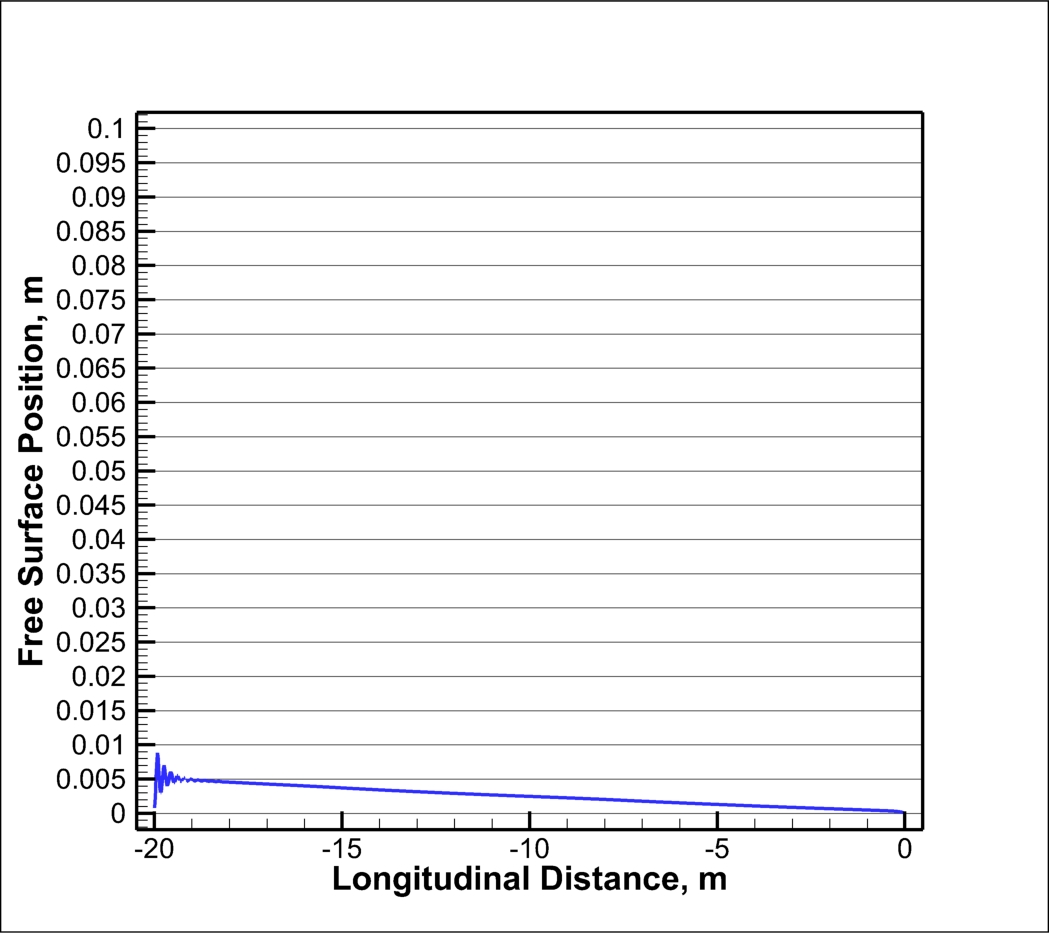
The wave propagation is seen upto a few meters away from the inlet. I am attaching both with Redd (OR with Pit) and without Redd simulation results. Without Redd results shows clearer propagation effects whereas with Redd shows free surface fluctuations. Our question here is, "why is there a free elevation seen near the inlet (for both simulations) when we specify the free surface to be at Y= 0 at the inlet boundary?" (Note that the domain is tilted with an small angle).
Â
- We are applying mass flow water inlet [density*velocity*(Area = depth (2-D case))]. Same is used for the air inlet above the free surface inlet boundary. There are irregular spikes for Redd case as seen in the free surface plot.
We are using Tecplot to obtain the free surface. In Tecplot, we can extract volume fraction = 0.5, that gives a periodic coordinates of the free surface across the length. Do they damp with time? - Like in the previous reply, this result is obtained from about 180 seconds of simulation time and the residuals looks like in the previous reply. The one without redd is from steady-state simulation after complete convergence.
-Implicit Volume Fraction discretization is used.
-
May 12, 2020 at 11:52 pm
Konstantin
Ansys EmployeeHello,
What are you using for pressure, PRESTO or body-force weighted? I'd suggest PRESTO if you are not using it already, it helps to eliminate spurious checker-boarding of the solution in multiphase problems. Another thought is the inlet is at a slight angle to the gravitational vector. Have you tried aligning it with g, i. e. if the inclination angle of the domain is zero, would you see the same spikes? If you let us know a representative velocity then it would be quick for us to check this in a 2D case.Â
-
- The topic ‘Free surface oscillation/jump near inlet using VOF’ is closed to new replies.
-
4818
-
1587
-
1386
-
1242
-
1021
© 2026 Copyright ANSYS, Inc. All rights reserved.