Ansys Assistant will be unavailable on the Learning Forum starting January 30. An upgraded version is coming soon. We apologize for any inconvenience and appreciate your patience. Stay tuned for updates.
Fluids

Fluids

Topics related to Fluent, CFX, Turbogrid and more.

Flamelet generated manifold – Issue with n and no

TAGGED: 

    • m.d.lasica
      Subscriber

      Dear all,

      After I generate or load a PDF table, I encounter the following messag

      -----------------------------------------------------------------------------------------------

      Material no:
      Changing method of "Thermal Conductivity" to "constant" -- data required.
      Changing method of "Viscosity" to "constant" -- data required.
       
      Material n:
      Changing method of "Thermal Conductivity" to "constant" -- data required.
      Changing method of "Viscosity" to "constant" -- data required.
      -----------------------------------------------------------------------------------------------

      Does anyone know what might be causing this? Why does it only happen for Material n and Material no?

      Thank you in advance for your help.

    • m.d.lasica
      Subscriber

      Hello again,

      I have a second question regarding the addition of FGM scalar transport. When I add the transport equations for NO, it appears in the residuals and preprocessing options, but the values remain at 0. Does anyone know the reason for this?

    • Ren
      Ansys Employee

      Hello,

      In additon to NO, did you include any other species for FGM scalar transport?

      Regarding the second question, did you check the mass fraction of NO? The residual is zero possibly because the NO mass fraction is zero.


    • m.d.lasica
      Subscriber

      Hello Ren, 

      Thanks for reply. 

      On my first attempt, I didn’t include them, only NO. However, in the second attempt, I added N and OH — species that take part in the reactions defined in the chemical mechanism contributing to NO formation. The calculations are still ongoing. Does your question suggest that the NO transport equation alone might not be sufficient?

      The NO mass fraction is not zero. In fact, it’s significantly higher compared to the results obtained from EDC. That’s why I decided to use additional transport equations in FGM to achieve more accurate results regarding NO.

      Please let me know if you have further suggestions or insights

    • Ren
      Ansys Employee

      Thank you for your answers.

      It looks that the messages about the thermal conductivity and viscosity are related to the addition of transport equations for NO and N as they are required transport properties. I don't think it's necessary to include transport scalars for other species (just need NO).

      It's strange that NO equation residuals remain to be zero. 

    • m.d.lasica
      Subscriber

      I have the results of simulations where I have included several transport equations, but just like for NO the results are 0. I don't understand why. When I check the PDF table the forward and backward reaction rates are non-zero value. Does anyone know how to solve this? 
      I'm using version 2024R1.

    • Ren
      Ansys Employee

      Hello,

      If you could send me the details of the model setup then I can do some investigation. Specifically, please provide:

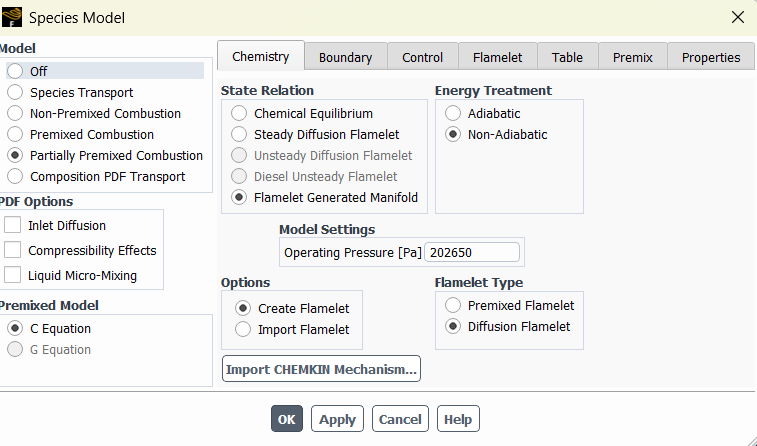
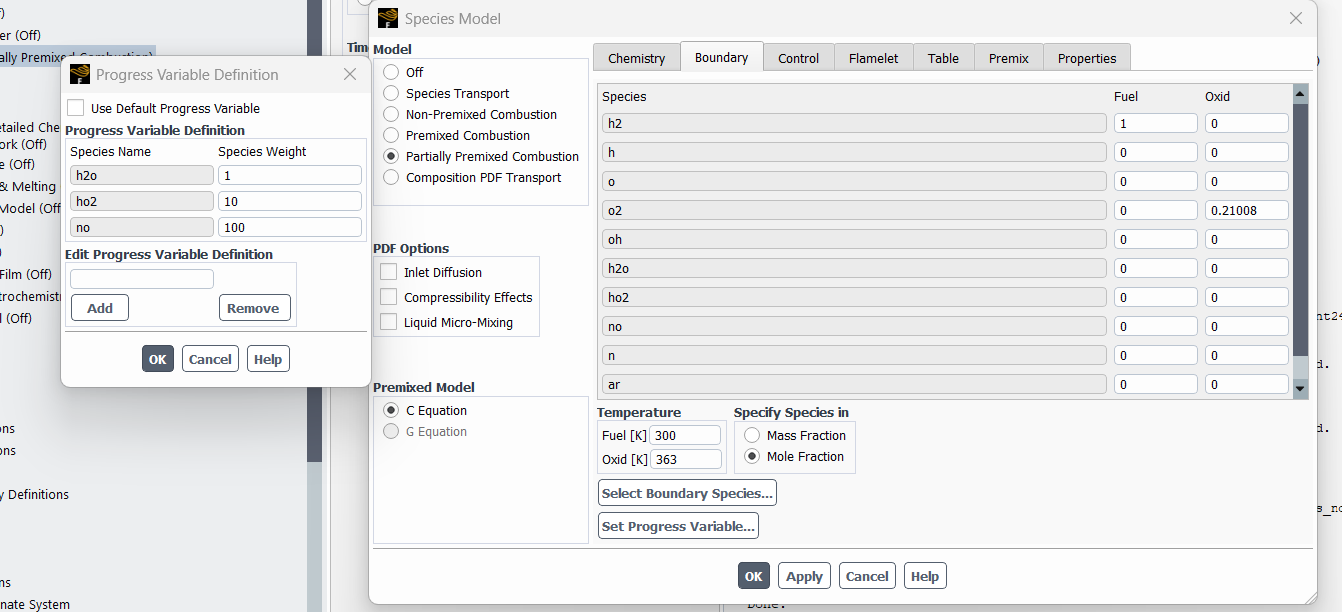
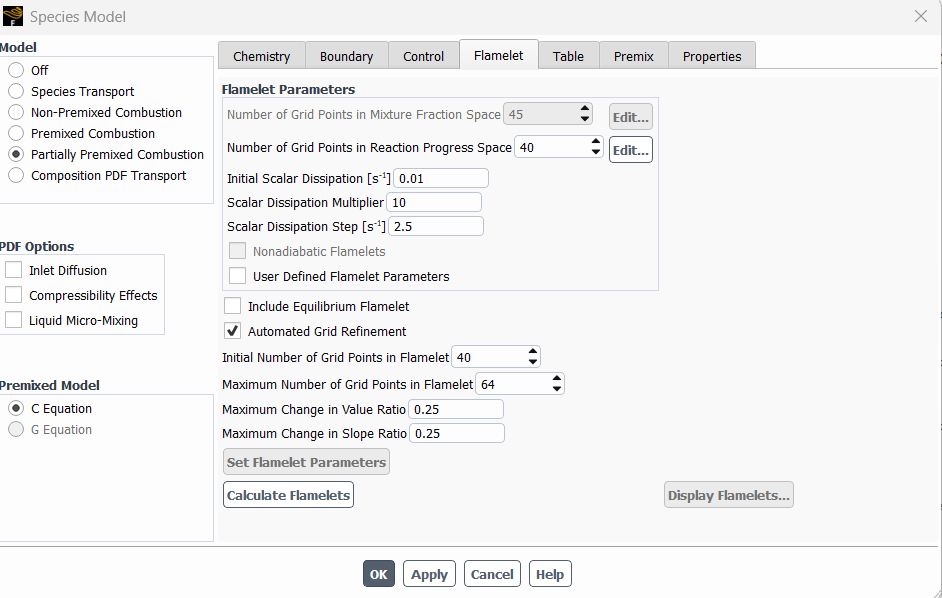
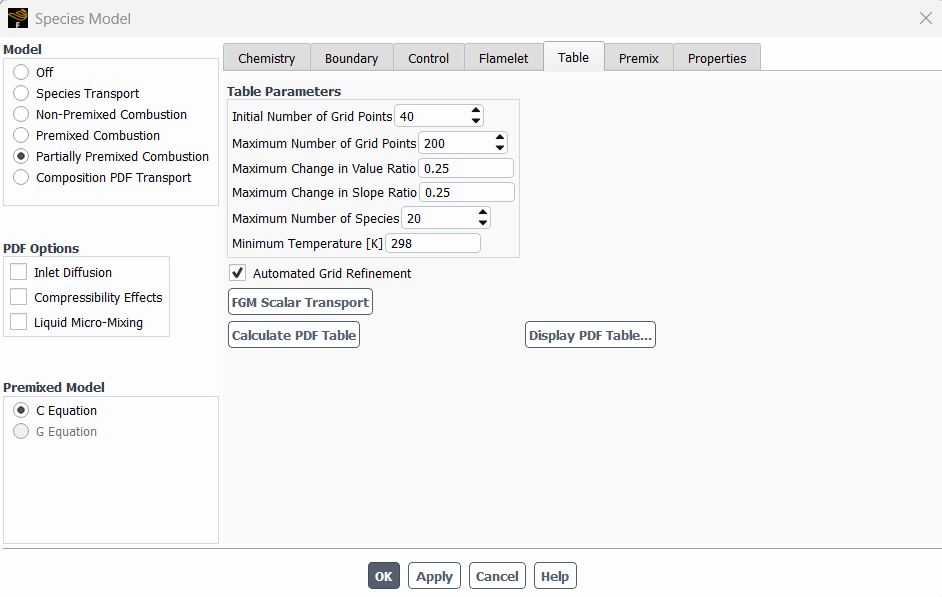
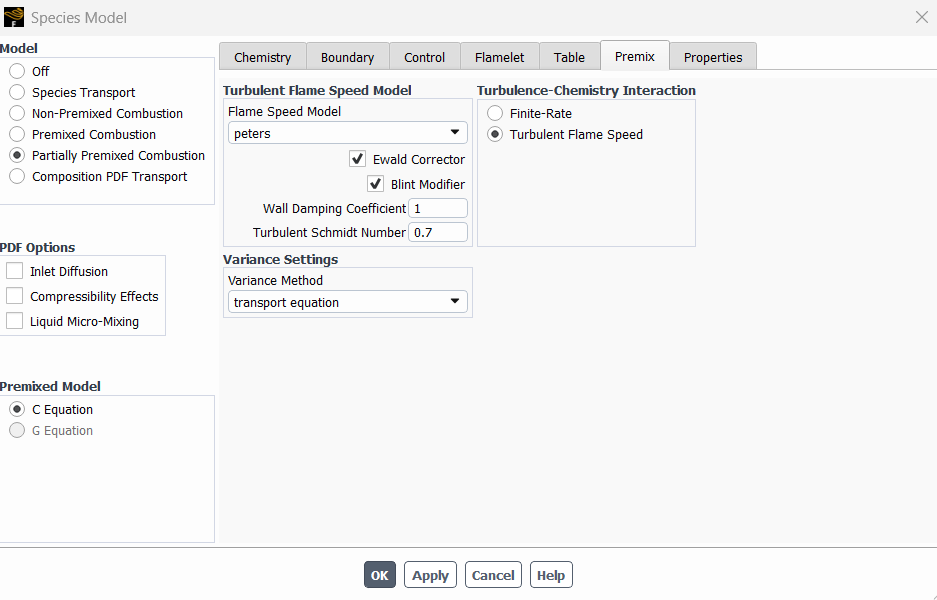
      Screenshots of all tabs of the "Species Model" dialog box.

      what are the fuel and oxidizer

      What chemical mechanism is used.


    • m.d.lasica
      Subscriber

      Thanks. 
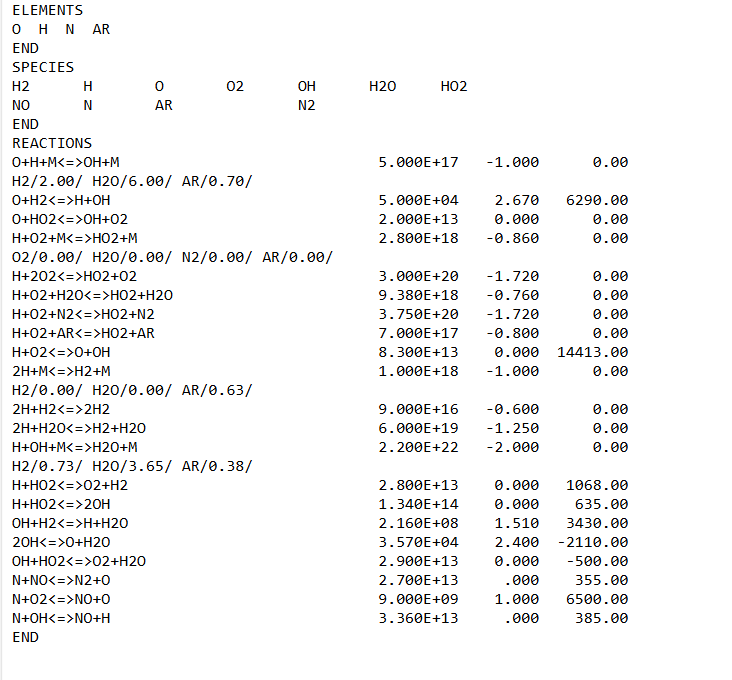
      These are screenshots: 


      Fuel is 100% Hydrogen, Oxidixer is air.


      Chemical mechanisms is DRM19 without hydrocarbons with added Zeldovich thermal NO equations. 

      Thermo and Transport data are from GRI3.0 


    • Ren
      Ansys Employee

      Hello,

      I've carried out some tests using a 2D and a 3D model with the same settings as yours except that I used gri3.0 mechanism (as I don't have a copy of DRM19 + thermal NOx mechanism). Both calculations showed non-zero residuals for the FGM scalars (I tested no and co). 

      Could you show me a temperature contour plot with global range on?


    • m.d.lasica
      Subscriber

      Yes, sure. This is temperature field:
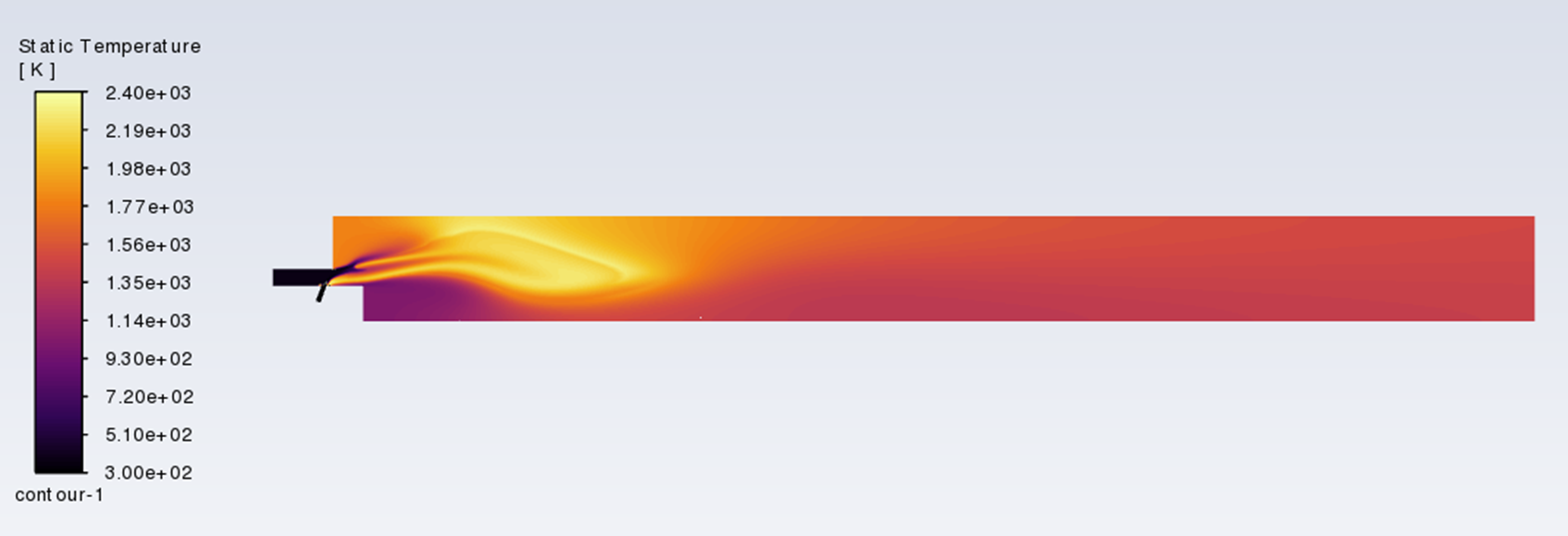
      It's quite similar to that I get from EDC. 

      Did you get the notifications below? 

      ---------------------------------------------------------------------------------------------------------

      Material no:
      Changing method of "Thermal Conductivity" to "constant" -- data required.
      Changing method of "Viscosity" to "constant" -- data required.
       
      Material n:
      Changing method of "Thermal Conductivity" to "constant" -- data required.
      Changing method of "Viscosity" to "constant" -- data required. 
      ---------------------------------------------------------------------------------------------------------
      If both scalars have non-zero residuals, then there must be something wrong with my kinetic scheme, since that's the only part that differs. 
      I will try to run my simulation with GRI3.0 

    • Ren
      Ansys Employee

      Yes, I got tne messages below after the PDF table has been generated:

      Material no:
        Changing method of "Thermal Conductivity" to "constant" -- data required.
        Changing method of "Viscosity" to "constant" -- data required.
       
      Material n:
        Changing method of "Thermal Conductivity" to "constant" -- data required.
        Changing method of "Viscosity" to "constant" -- data required.
       
      Material nh:
        Changing method of "Viscosity" to "constant" -- data required.

      ---

      If I read back the saved PDF file the messages did not appear.

      I think these messages are misleading and can be safely ignored. I'll check with the development team.


    • m.d.lasica
      Subscriber

      Just to clarify, have you run a simulation with the 2024R1 version? 

    • Ren
      Ansys Employee
      1. Yes, I used 2024R1
      2. Regarding the messages about thermal conductivity and viscosity, I've received a confirmation that the messages are redundant for FGM model and can be ignored.
    • m.d.lasica
      Subscriber

      Thank you.

      I am solving my case using GRI3.0 and will let you know once I obtain the results.

      I have one more question: When you included FGM scalar transport, did you do anything beyond adding them before generating the PDF table? Did you patch the initial values, or did you simply enable the option to include those species for separate transport equations in the Table tab?


    • m.d.lasica
      Subscriber

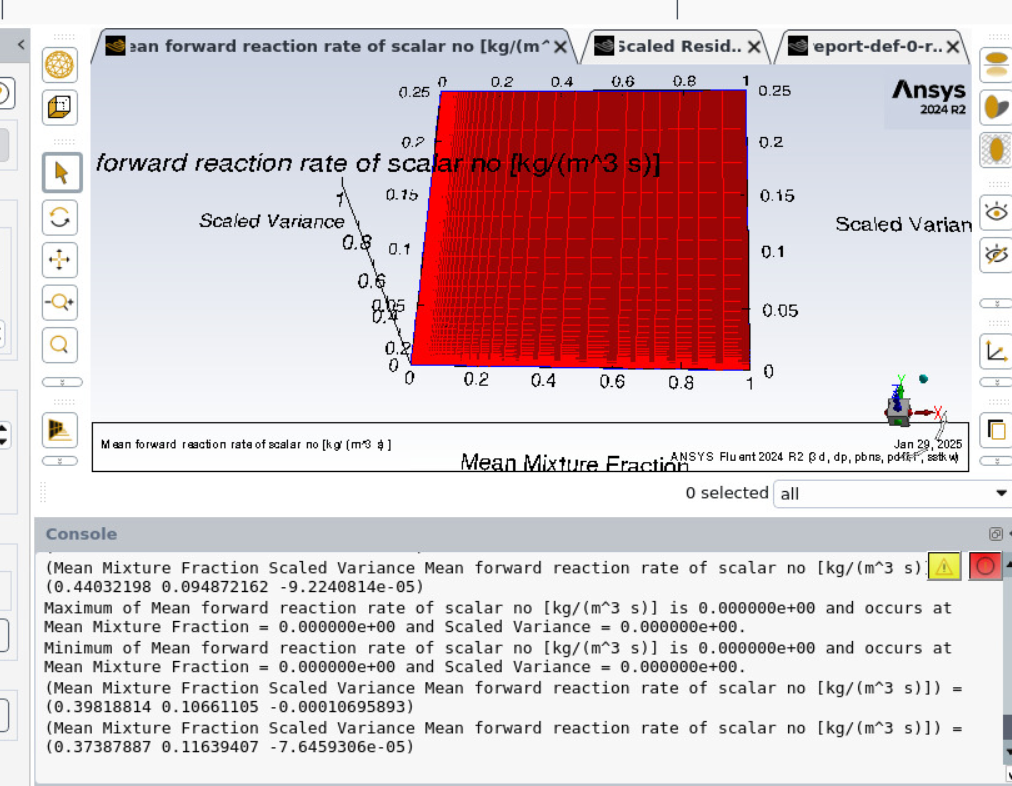
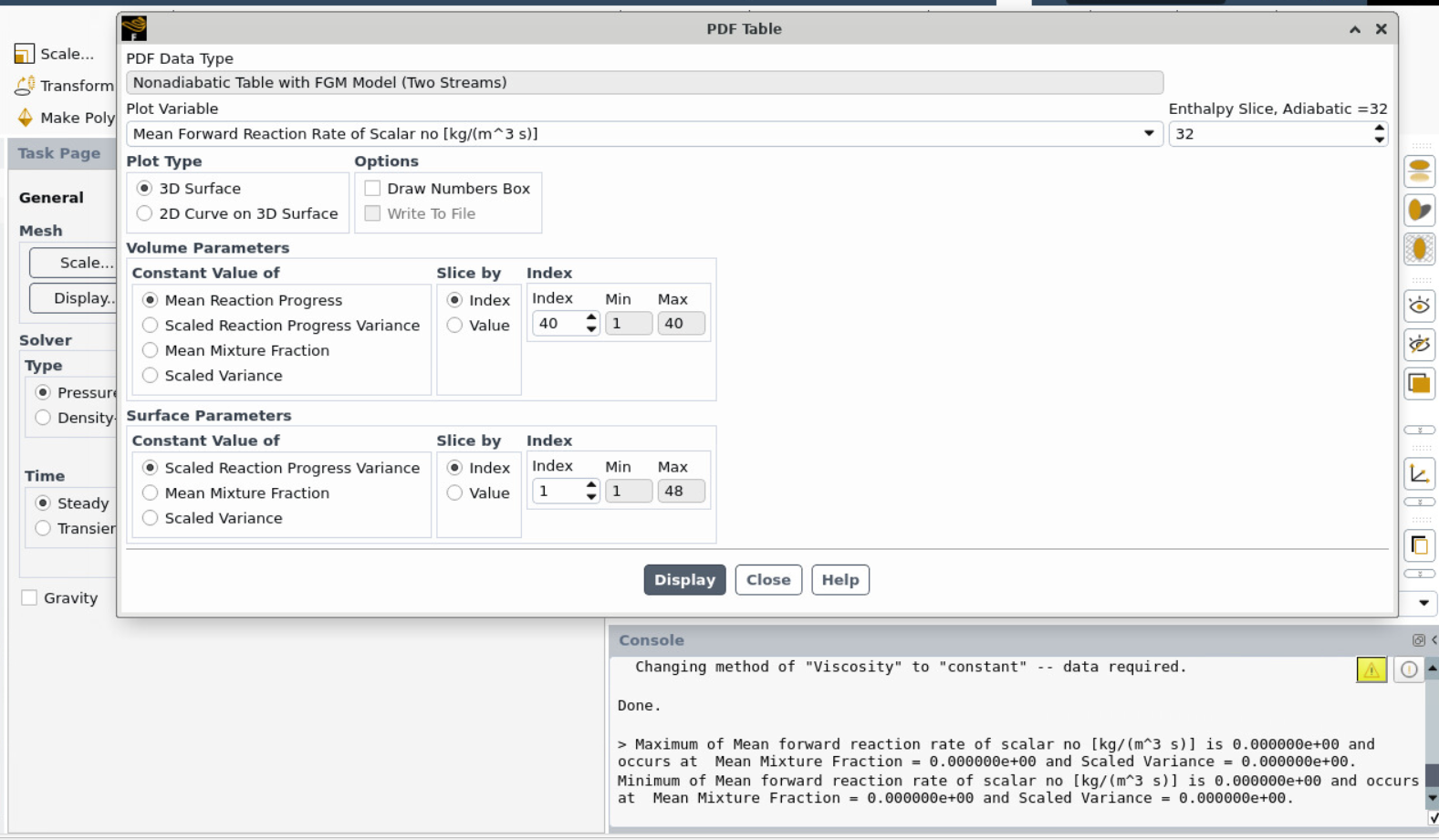
      There is one more thing I wanted to mention. I was reviewing the results again and noticed that both the forward and backward reaction rates of NO are zero.

      I went back to the PDF table, and when I attempted to display it for any combination of controlling parameters, the TUI output showed that the maximum and minimum reaction rates were both zero. However, when I clicked on the values displayed in the table, they appeared to be non-zero.

      Do you have any insights into why this might be happening?


    • m.d.lasica
      Subscriber

      I encountered the same issue in my case using GRI3.0. The values of the transported species are all zero. I also examined the PDF table, and both the forward and backward reaction rates are zero. This suggests that the issue lies within the PDF table, but I’m unsure why this happens only in my case. Could you share a screenshot of the reaction rates for NO from your PDF table?

      Thanks in advance!

    • Ren
      Ansys Employee

      I did not do anything extra other than activating the no and co FGM scalars.

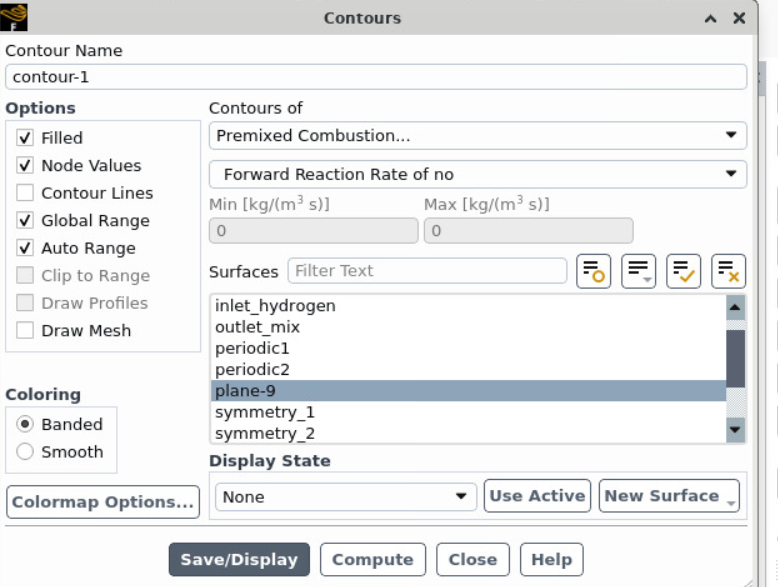
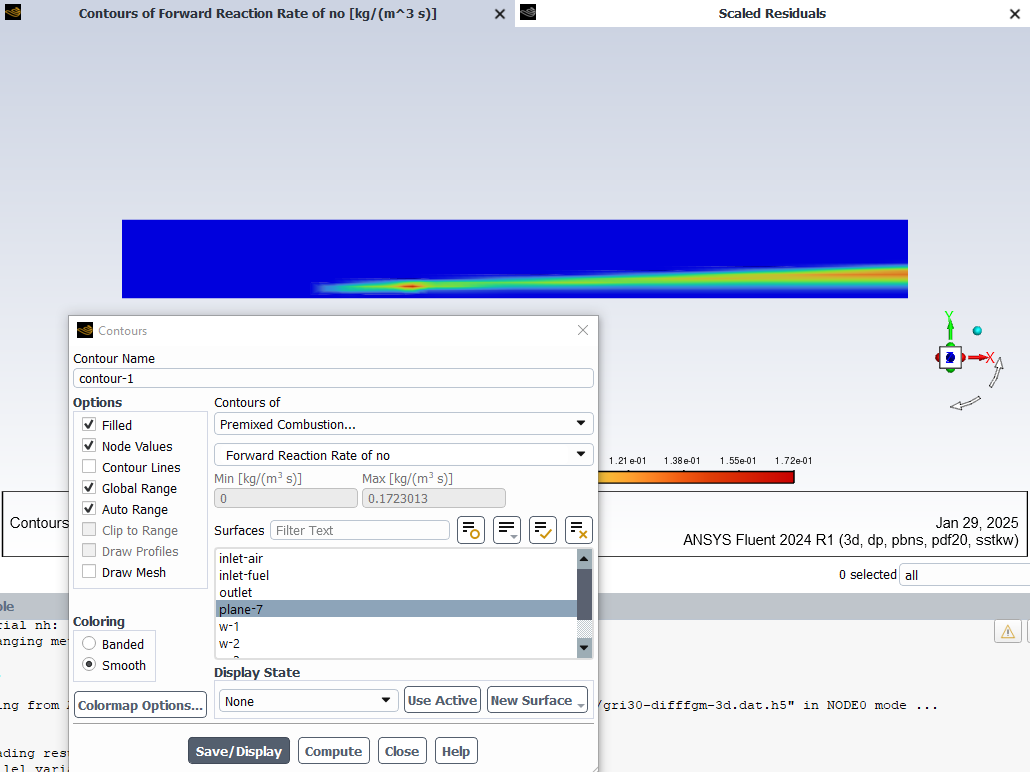
      This is a screenshot of the no forward rate contour plot:


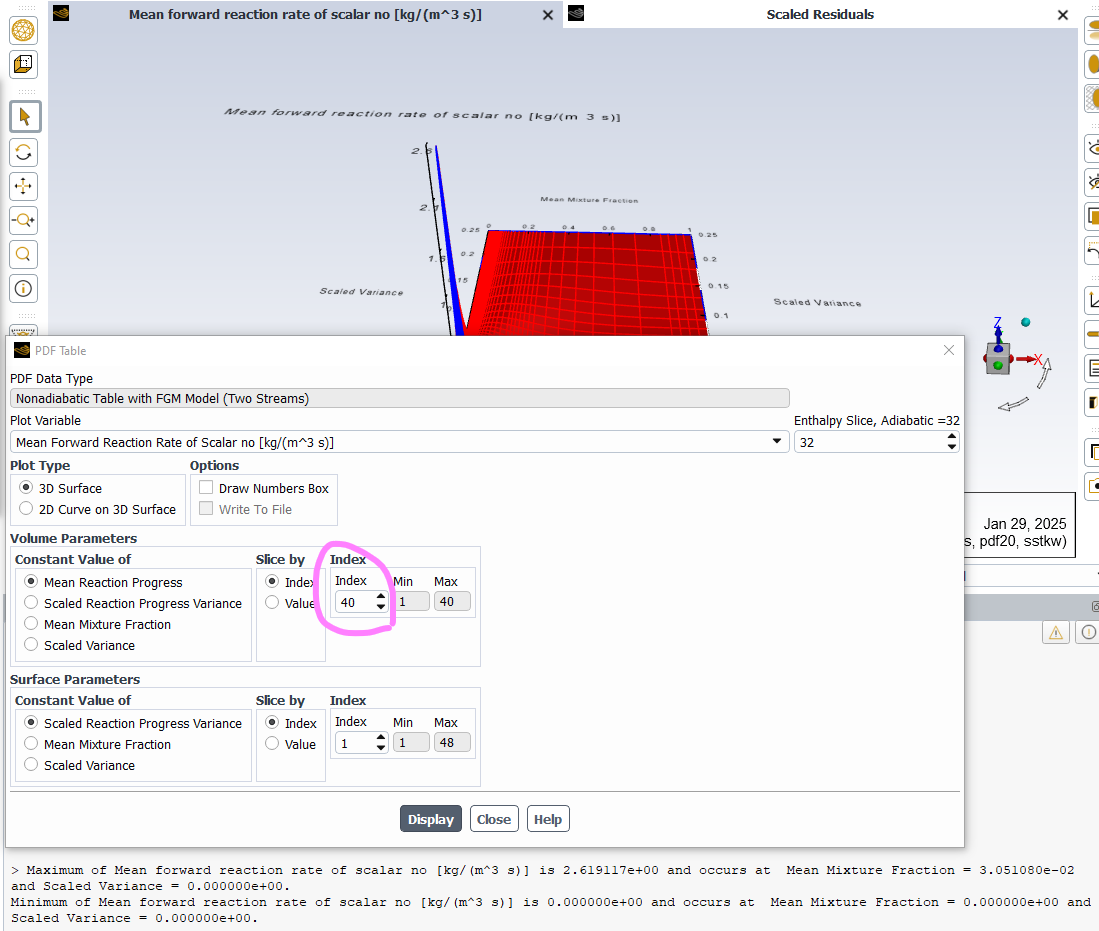
      This is a screenshot of the PDF plot and please note that I set the mean reaction progress index to the burnt state (40):


    • m.d.lasica
      Subscriber

      Thank you. 

      I checked the same slice of the PDF table that you uploaded, but unfortunately, the reaction rate is still 0 in my case.

      Do you have any idea how I can fix this? What can I do? I would greatly appreciate any suggestions.

    • Ren
      Ansys Employee

      Hi, I can't think of anything that might be the cause. Could you try again from scratch (using a mesh file) using the gri3.0 mechanism?  


    • m.d.lasica
      Subscriber

      Hello, 

      I set up the simulation from scratch using only the mesh file. First, I used GRI3.0 and obtained satisfying results. Then, I switched to my mechanism and also achieved positive outcomes. The simplest method turned out to be the most effective. Apparently, the issue occurred when I switched from volumetric to partially premixed combustion while working on the previous case file. Thank you for your help! 


    • m.d.lasica
      Subscriber

      Hello,

      I have one more question related to flamelet generation and the progress variable. Ultimately, I plan to compute flamelets using external software and upload them to Ansys Fluent with an optimized progress variable. In the Boundary tab, there is an option to define the progress variable. I generated flamelets for three different progress variables and examined the saved files. While the flamelet data changes as expected, the "reaction progress" remains unaffected.

      Could you clarify what reaction progress represents and how it is calculated? It does not seem to respond to modifications in the progress variable.

      Thank you in advance!


    • Ren
      Ansys Employee

      The reaction progress is the normalized progress variable as defined in Eqn (8-107) of the theory guide. It has values between 0 and 1 regardless of the definition of the progress variable.

      For postprocessing, both the normalized and the un-normanlized progress variable are available.


Viewing 21 reply threads
  • You must be logged in to reply to this topic.
[bingo_chatbox]