TAGGED: cfd-combustion, fgm, flamelet, les
-
-
July 17, 2026 at 1:43 pm
can.sumeyye
SubscriberHello,
I am setting up a transient LES combustion simulation in Ansys Fluent 2021 R2 and would appreciate clarification regarding the two nonadiabatic FGM options.
My current setup is:
- Partially Premixed Combustion
- C-Equation
- Flamelet Generated Manifold
- Premixed Flamelet
- CHEMKIN Physical Space
- LES with WALE
- Natural gas–air mixture at ϕ=0.8\phi=0.8ϕ=0.8
- Fuel and oxidizer reference temperatures: 300 K
- Pressure: 1 atm
- Open-atmosphere Bunsen-type flame
- Radiation disabled
- Conjugate heat transfer disabled
- Solid walls treated as adiabatic
The production mesh contains approximately 5–8 million cells. Flamelet and PDF-table generation is performed separately on a small test mesh.
My primary interest is the accuracy of the transient temperature field, particularly the temporal evolution of temperature at selected monitoring locations. Emissions prediction is not part of the present study.
I am trying to understand the practical difference between the following three configurations:
1. Energy Treatment: Adiabatic 2. Energy Treatment: Non-Adiabatic Nonadiabatic Flamelets: OFF 3. Energy Treatment: Non-Adiabatic Nonadiabatic Flamelets: ON
My understanding is that in the second configuration, Fluent solves enthalpy transport and includes enthalpy as a PDF-table coordinate, but the nonadiabatic PDF is constructed from adiabatic flamelets under the assumption that species composition is independent of heat loss.
When
Nonadiabatic Flameletsis enabled, flamelets are additionally solved for different fuel and oxidizer enthalpy levels, so species composition, reaction-progress source terms and laminar flame properties may also depend on enthalpy.I would particularly appreciate clarification on the following points:
- For a case with no radiation, no CHT, adiabatic walls and equal 300 K inlet temperatures, how much difference should normally be expected between a fully adiabatic FGM calculation and a nonadiabatic calculation with
Nonadiabatic Flameletsdisabled? - Does entrainment and mixing with 300 K ambient air provide any physical reason to use the nonadiabatic formulation, or is this cooling already represented through mixture-fraction and progress-variable variation in the adiabatic FGM table?
- For accurate time-resolved temperature histories and flame-crossing durations, can
Nonadiabatic Flamelets = ONmaterially improve the result when there is no significant external heat-loss mechanism? - Is the main benefit of enabling nonadiabatic flamelets limited to cases involving large wall heat losses, radiation, quenching, different inlet temperatures or temperature-sensitive species?
- What is the approximate computational impact of enabling
Nonadiabatic Flamelets?- Increase in flamelet-generation time
- Increase in PDF-table generation time
- Increase in PDF/table memory
- Increase in RAM usage during the main LES
- Increase in wall-clock time per timestep after the table has already been generated
I understand that the exact cost depends on the grid dimensions and number of stored species, but even a qualitative estimate or typical range would be helpful. In particular, does enabling this option mainly affect preprocessing, or can it noticeably increase the runtime of a 5–8 million-cell LES?
In later stages, I also plan to repeat the analysis with approximately 10% and 20% hydrogen addition. Would hydrogen addition by itself make nonadiabatic flamelet generation more important for accurate temperature and flame-crossing predictions, even when radiation, CHT and nonadiabatic wall conditions remain disabled?
My current concern is choosing the least expensive model that still provides reliable instantaneous temperature evolution rather than emissions such as NOx.
Its a little bit long but I hope you can help.
-
July 22, 2026 at 3:14 pm
judy.cooper
Ansys EmployeeHi:
Your understanding of option 2 is correct. Option 3 is only available for the physical space flamelets. The physical space non-adiabatic flamelet option lets Chemkin flamelet generator transition between a 1d premix freely propagating flame and a premixed burner stabilized flame solution method based on the inlet species composition and enthalpy at the inlets. (This is what the ON switch does.) Using the non-adiabatic option therefore allows larger enthalpy ranges to be treated correctly.
Below are your questions, with answers:
For a case with no radiation, no CHT, adiabatic walls and equal 300 K inlet temperatures, how much difference should normally be expected between a fully adiabatic FGM calculation and a nonadiabatic calculation with
Nonadiabatic Flameletsdisabled?This would be difficult to quantify, as it would probably vary from case to case. The flamelet solution methods are completely different. The physical space flamelet solution carries the advantage that the scalar dissipation is solved directly rather than having an assumed shape. This could create quite a difference in the solutions or be negligible, depending on how close to equilibrium the solution is.
Does entrainment and mixing with 300 K ambient air provide any physical reason to use the nonadiabatic formulation, or is this cooling already represented through mixture-fraction and progress-variable variation in the adiabatic FGM table?
A non-adiabatic formulation is needed any time the energy content of the system cannot be fully described by the temperatures used at the fuel and oxidizer boundary conditions of the flamelet solution. Examples of this are: non-adiabatic walls, heat sources, or multiple fuel or air inlet temperatures. The Mixture fraction space solution (adiabatic flamelets) will be ok for small enthalpy variations (so long as you activate the switches shown below to capture density variations due to pressure and temperature). For larger enthalpy variations, the Mixture fraction space solution will miss the effect of temperature on reaction rate, which could be quite significant. These larger enthalpy variations will require non-adiabatic flamelets as well as the general treatment for density.
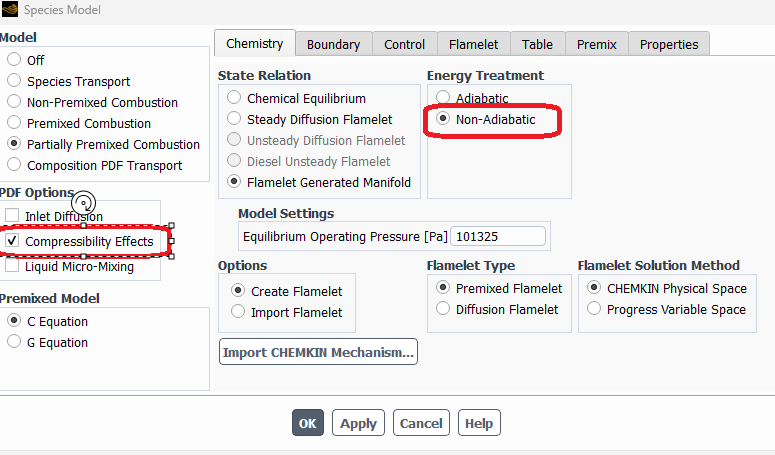
For accurate time-resolved temperature histories and flame-crossing durations, can
Nonadiabatic Flamelets = ONmaterially improve the result when there is no significant external heat-loss mechanism?This is again hard to quantify, but the nature of the physical space flamelet solution suggests that it might be more accurate because of the scalar dissipation assumption used in the mixture fraction space solution.
Is the main benefit of enabling nonadiabatic flamelets limited to cases involving large wall heat losses, radiation, quenching, different inlet temperatures or temperature-sensitive species?
Yes, the extra enthalpy dimension is the main advatage of using non-adiabatic flamelets. The secondary impact of the solved scalar dissipation might be quite significant in some cases, however.
What is the approximate computational impact of enabling
Nonadiabatic Flamelets?Using the Chemkin‑based physical‑space flamelet generator increases the preprocessing cost (flamelet generation) as well as CFD iteration cost. The extra iteration cost comes from interpolating an the extra enthalpy dimension in the tables, and also the lower robustness of the non-adiabatic solution. The impact of this ranges from quite small for fully premixed cases where there is a single mixture fraction value, to more significant for long transient cases that also require very large PDF tables. I would prepare for a slowdown from 10% to as high as 30%

-
- You must be logged in to reply to this topic.
-
6880
-
1906
-
1544
-
1344
-
1217
© 2026 Copyright ANSYS, Inc. All rights reserved.








