Ansys Assistant will be unavailable on the Learning Forum starting January 30. An upgraded version is coming soon. We apologize for any inconvenience and appreciate your patience. Stay tuned for updates.
LS Dyna

LS Dyna

Topics related to LS-DYNA, Autodyn, Explicit STR and more.

Explicit Dynamics – Insertion of the needle. Stresses in the needle

    • Tom
      Subscriber

      Explicit Dynamics - Insertion of the needle. Stresses in the needle

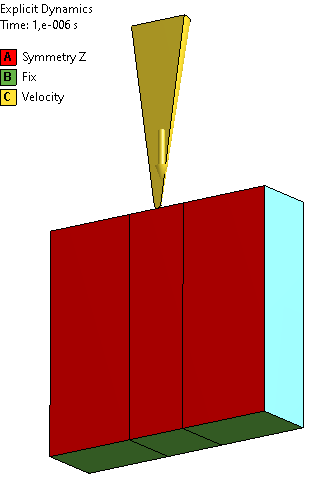
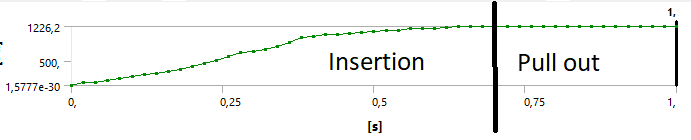
      Hi. I am doing a simple needle insertion simulation in Explicit Dynamics software. I have tissue and needle - both linear material (tissue has a failure). The needle has an assigned velocity (I also tried with displacement), the tissue is fixed at the bottom. In the first step I insert the needle, in the second step I pull it out. After pull out, there is still stress in the needle (similar or the same as at the end of the insertion). Why are there the stresses after the needle is pulled out?
      The analysis is without mass scaling (I also tried with scaling). I have tested different default settings (Low and high speed, quasi static, drop test), different needle velocities and there are always stresses in the needle at the end of the analysis.

      Boundary conditions

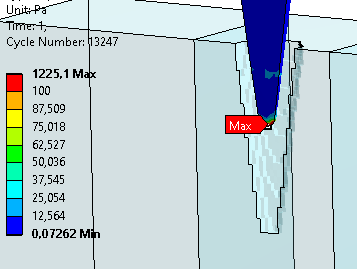
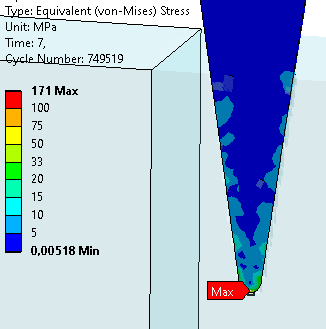
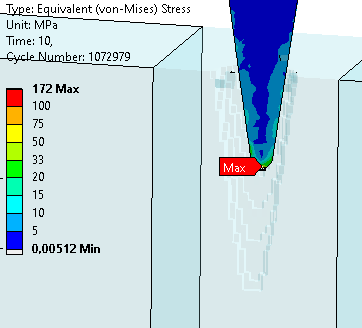
      Insertion and pull-out. von Mises stress map in the needle
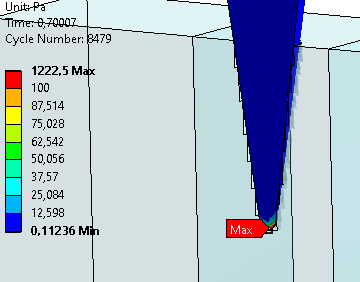
      Chart of maximum needle von Mises stress in the needle

    • Ashish Khemka
      Forum Moderator

      Hi,

      After the needle is pulled out of the tissue, there can be residual stresses remaining in the tissue due to the deformation and damage caused by the insertion process.

      Regards,

      Ashish Khemka

    • Tom
      Subscriber


      In linear material without damage? I mean the stresses in the needle, not the tissue.
      I have experience in Static Structural Analysis. In this analysis, when the needle is removed from the tissue, the stresses in the needle should be zero (if the material is linear) Is it different in the Explicit analysis?


    • Chris Quan
      Ansys Employee


      The magnitude of stress is very small, <100 Pa. It can be ignored.

      When the needle was pulled out, which boundary condition was used, Displacement or Velocity? Was the Boundary Condition applied to the entire body or on a selected face? If it was on a face, the BC introduced stress wave from the face and then the wave propagated into the body of the needle. This resulted in the stress you observed.

      If the BC is applied to the entire body, you will observe very small or even zero stress in the needle.


    • Tom
      Subscriber

      Thank you for your answer :)

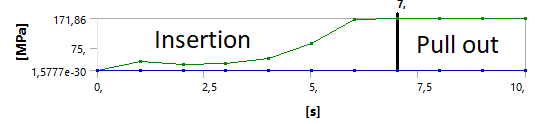
      1. Yes, the stresses are small but the model was scaled (Pa = MPa.).
      2. velocity boundary condition to the body. I also tried node displacement to the entire needle body. 

      The model without scaling the units behaves like this:
      1. Full insertion

      2. Pull-out

      3.  Chart of von Mises stress in the needle
       

Viewing 4 reply threads
  • The topic ‘Explicit Dynamics – Insertion of the needle. Stresses in the needle’ is closed to new replies.
[bingo_chatbox]