

TAGGED: drag-coefficient, fluent, pressure-outlet, udf, velocity-inlet
-
-
July 19, 2021 at 11:52 am
up201506004
SubscriberHello, I am doing blood flow transient simulation in an artery and I used a UDF for inlet velocity and another for outlet pressure (fig. 1). I want to obtain Cd over time.
July 19, 2021 at 12:33 pmKarthik Remella
AdministratorHello The drag coefficient uses the values of reference density, area, and velocity under 'reference values'. Where are you estimating these coefficients?
Karthik
July 19, 2021 at 12:40 pmSubscriberHello Kremella
I left the reference values as the default ones, but I don't see how these affect the profile of Cd over time. Could you please explain?
July 19, 2021 at 1:03 pmAdministratorHello I agree - it would change the profile. It might only change the numerical values.
Again - where are you computing this drag? Artery walls?
What is your mesh resolution at the wall? What models are you using?
Karthik
July 19, 2021 at 1:06 pmSubscriberHello again
I am sorry for not having left much information about the simulations, I thought it wouldn't be important.
I am computing the drag in the walls through a monitor.
The mesh is a uniform tetrahedron patch independent mesh (i did not improve the quality of the mesh near the walls to not exceed the limit of the student version).
The model comes from solidworks, which was created from stl files from MIMICS, a program that detects the geometry of the artery of CT scan images.
July 19, 2021 at 1:44 pmRob
Forum ModeratorI've not used MIMICS or MAGICS in years.
If you give the solver a back pressure the inlet pressure must increase to force the correct amount of flow into the system. Are you comparing dP for the system with flow, inlet pressure with flow or a surface monitor with flow?
July 19, 2021 at 1:47 pmSubscriberHello Rob
I didn't pick any pressure for the inlet, but I did plot the inlet pressure over time and the distribution was almost identical to the outlet pressure, which is in accordance to what you say.
I do not understand the second part of your answer, could you please rephrase it?
Thank you for your answer.
July 19, 2021 at 1:50 pmForum ModeratorI was wondering where the pressure value was coming from for the drag calculation.
July 19, 2021 at 1:54 pmAdministratorJust to add - you might also want to add sufficient inflation layers to your geometry especially since you are looking at the drag values. Obtaining the correct pressure drop is important.
Karthik
July 19, 2021 at 1:54 pmSubscriberWell, the only pressure data comes from the outlet pressure I defined, the reference value of pressure was left as default. In the simulations in which I remove the outlet pressure UDF, I think the outlet pressure is constant and equal to 0.
I plotted Cd over time and obtained completely different cuves depending on the existence of the pressure UDF in the outlets...
Why do you think this is the case? Why does Cd apparently depends so much on the outlet pressure?
I am sorry if I still haven't answered your question!
July 19, 2021 at 2:01 pmSubscriberI understand this, but I believe that increasing the quality of the mesh is not going to have a significant impact on the shape of Cd.
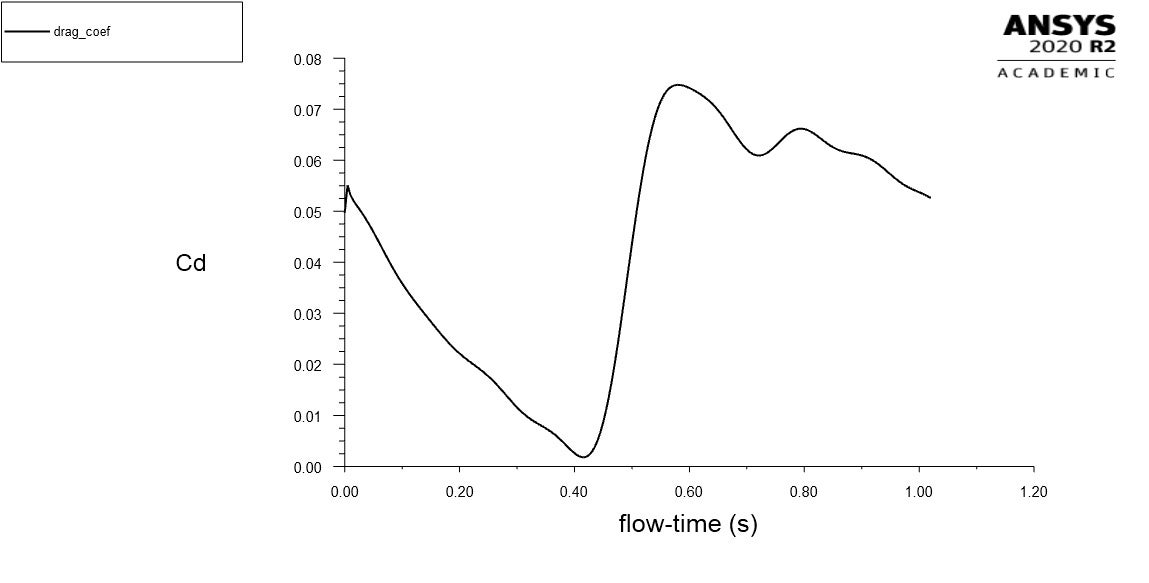 Fig 2. Cd WITH pressure outlet UDF
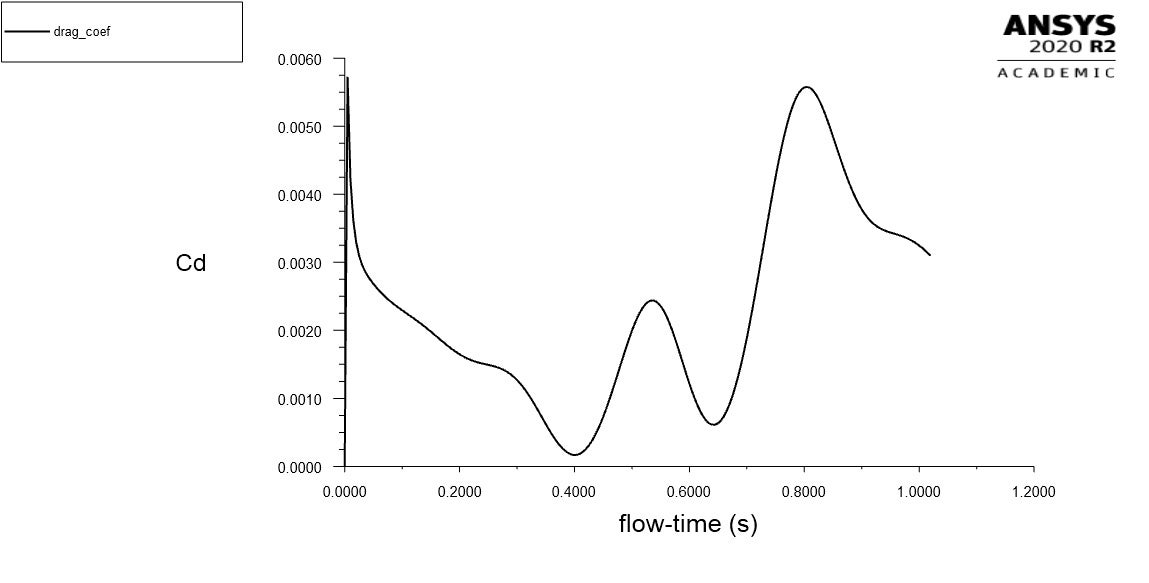 Fig. 3 Cd WITHOUT pressure outlet UDF
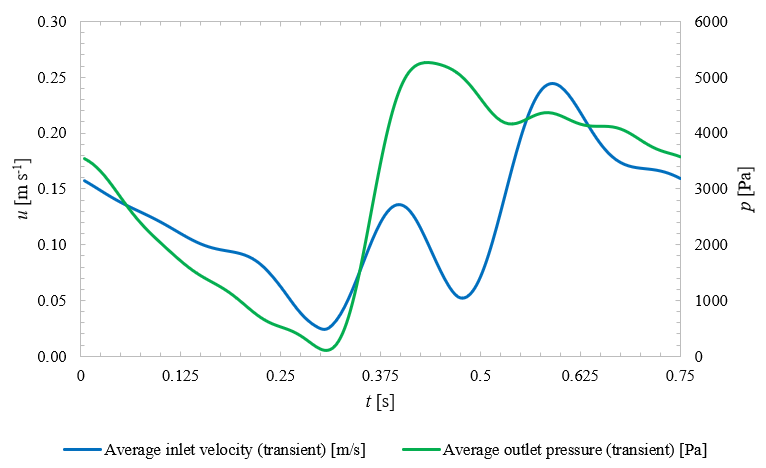
July 19, 2021 at 2:11 pmSubscriberI noticed I sent a wrong v and p graph, I resend it here for a better comparison with the Cd curves (the t axis is corrected in fig. 4.).
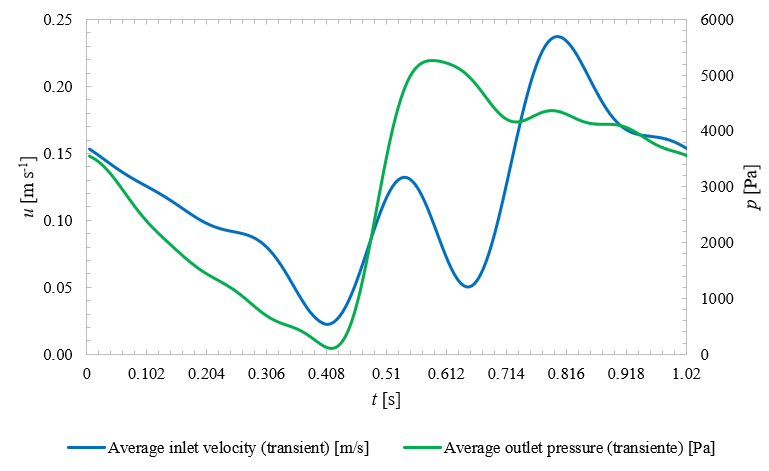 fig. 4 CORRECTED v and p graph.
July 19, 2021 at 2:17 pmForum ModeratorYou set the outlet pressure, Fluent calculates the inlet pressure (and pressure field) to deliver the flow rate you define.
Read https://ansyshelp.ansys.com/account/Secured?returnurl=/Views/Secured/corp/v212/en/flu_th/flu_th_sec_report_force_moment.html as I think the solver pressure you're using for the force is where it's giving the differences. Plot the inlet pressure for both cases on the same graph as the outlet pressure.
July 19, 2021 at 2:19 pmSubscriberthank you for your answer. Do you believe that the Cd curve will become more similar to the pressure or the velocity one?
July 19, 2021 at 2:30 pmSubscriberI am sorry to bother you again, but how can I input the velocity and pressure in the inlet simultaneously?
July 19, 2021 at 3:34 pmForum ModeratorI don't know which value the curve will take - I rarely use coefficients.
You don't input velocity and pressure. You input velocity and measure pressure.
July 19, 2021 at 3:45 pmSubscriberThat was what I had already done when I obtained the results in the original question.
I used a pressure based solver, transient with absolute velocity formulation.
My goal with measuring Cd was understanding the drag inside the artery, as that may be an indicator that the person is more prone in developing healthy problems.
I take the opportunity to also ask you about the wall shear stress. I also created a monitor to measure this property in the wall of the artery and the profile was shaped like the velocity.
I was hoping Cd and WSS would provide me with the same evolution in the cardiac cycle, but it doesn't occur. If you don't mind answering, I do not understand how Cd, which depends on the velocity in the formula, is clearly more dependent on pressure, while the wall shear stress, which depends on pressure, clearly only depends on the velocity.
July 21, 2021 at 11:05 amForum ModeratorWall shear is a function of the flow speed adjacent to the wall, and parallel to the facet so is linked to flow rate.
Drag is a force, so is linked to pressure (force/unit area).
In your case you'd look at the pressure loss in the system, and also wall shear. The former may imply a restriction (constriction) in the vessel and the latter may suggest a greater risk of an aneurysm. There are references to this somewhere as I've read (and helped with) projects of this type.
Viewing 17 reply threads- The topic ‘Drag coefficient (Cd) calculation’ is closed to new replies.
Innovation Space Trending discussions
 Top Contributors
-
peteroznewman
 6450
6450 -
scabo
 1906
1906 -
Dennis Chen
 1457
1457 -
javat33489
 1308
1308 -
Shyam Prasad V Atri
1022
Top Rated Tags
© 2026 Copyright ANSYS, Inc. All rights reserved.
Ansys does not support the usage of unauthorized Ansys software. Please visit www.ansys.com to obtain an official distribution.
-


The Ansys Learning Forum is a public forum. You are prohibited from providing (i) information that is confidential to You, your employer, or any third party, (ii) Personal Data or individually identifiable health information, (iii) any information that is U.S. Government Classified, Controlled Unclassified Information, International Traffic in Arms Regulators (ITAR) or Export Administration Regulators (EAR) controlled or otherwise have been determined by the United States Government or by a foreign government to require protection against unauthorized disclosure for reasons of national security, or (iv) topics or information restricted by the People's Republic of China data protection and privacy laws.

 You are navigating away from the AIS Discovery experience