-
-
June 8, 2020 at 12:10 pm
Cayle
SubscriberI'm a final year Mechanical engineering student. I am currently busy with my final year design project.
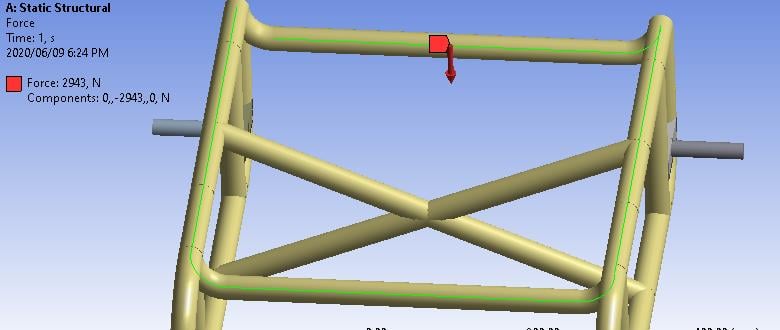
I am designing a lever chain driven wheelchair. I have developed a line model in spaceclaim that incorporates the essential frame of the wheelchair, I then added circular and square beam elements to represent the cross sections of the wheelchair geometry.Â
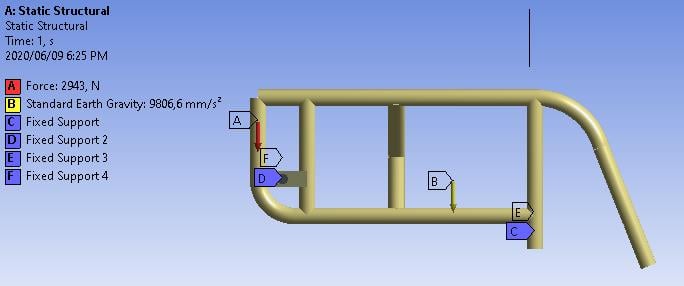
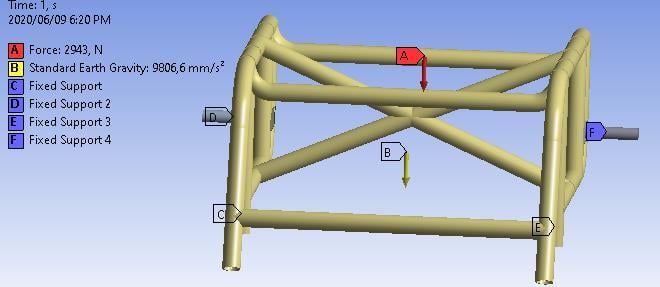
 The beam model was then exported to the ansys mechanical to be simulated. I applied a fixed boundary condition, with an edge designation, at the rear axles of the wheelchair and then applied a fixed boundary condition, point designation, at the front tubing where the caster wheels would attach to the frame of the wheelchair. I then applied a force where the user will sit on the wheelchair.  Now, the results of this static analysis were negated by my internal examiner, stating that " This completely deletes the possibility of there being different forces at the wheels or relative displacement between the wheels, like when the brakes are applied on an incline. It also means that moments can be resisted at the wheel locations, which is not necessarily true."  Please could you help me in assessing the correct boundary conditions to apply to account for the loads as stipulated in the statement above. Or, guide me to a solution which would offer a truer representation of the loads encompassed in a wheelchair.
 I've attached my files for the spaceclaim geometry if needed.  Any feedback would be greatly appreciated.
Â
-
June 9, 2020 at 12:20 pm
Aniket Chavan
Forum ModeratorAnsys staff can not download images on the student portal, so if you want to reach a larger audience to get answers from, please insert the images inline.
Thanks!
-Aniket
How to access Ansys Online Help Document
How to show full resolution image
Guidelines on the Student Community
How to use Google to search within Ansys Student Community
Â
-
June 9, 2020 at 4:19 pm
peteroznewman
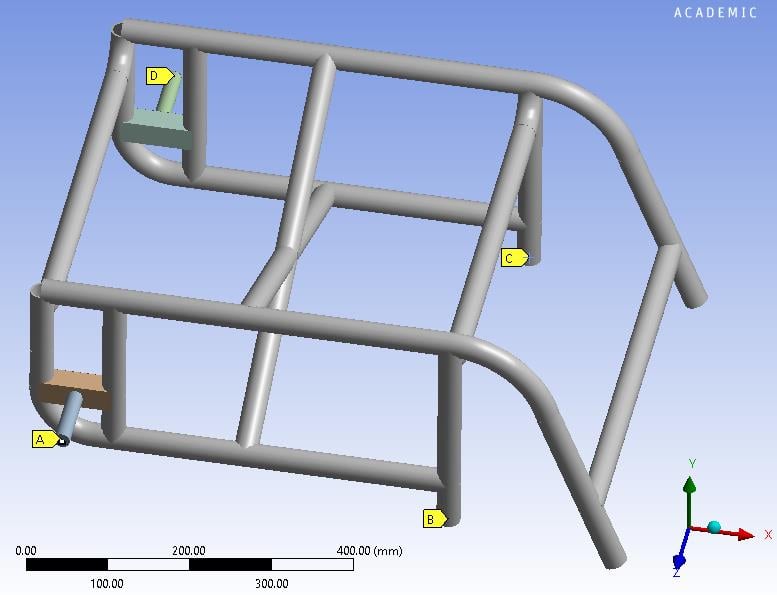
SubscriberA "kinematic" connection to ground is one which provides no additional stiffness to the structure. That works perfectly when there are 3 points touching the ground. A body has exactly 6 degrees of freedom in space, so you need to create exactly 6 constraints. With three points, you can do that by fixing one point (A) in XYZ a second point (D) in XY and a third point (C) in Y leaving all rotations free. That is exactly 6 constraints. If you have 4 wheels in contact with the ground, then the ground is effectively contributing to the stiffness of the frame. If you support a fourth point (
in Y, that is one extra constraint for a total of 7.
When you applied Fixed Support to four points, that controls both translation (XYZ) and rotation (RxRyRz) and is 24 constraints, which is way too many.
-
June 9, 2020 at 4:36 pm
Cayle
SubscriberThat explanation makes so much more sense, Thank you so much.
So in effect, I was over constraining my frame which would then portray an inaccurate solution to the static structural simulation?
Â
-
June 9, 2020 at 4:39 pm
Cayle
SubscriberI would like to sincerely thank you for your proposed solution. I better understand where I was wrong in overconstraining the frame.
-
- The topic ‘Discerning which boundary conditions are most accurate in modeling a wheelchair frame’ is closed to new replies.
-
6465
-
1906
-
1458
-
1308
-
1022
© 2026 Copyright ANSYS, Inc. All rights reserved.