-
-
July 26, 2018 at 4:30 pm
roy.macgregor
SubscriberHow do you increase the number of degrees of freedom of a component? I keep getting an error in a rotation I am trying to do. The error says that the components selected do not have enough degrees of freedom.
-
July 26, 2018 at 9:50 pm
peteroznewman
SubscriberRoy,
A rigid body in 3D space has exactly six degrees of freedom. Different boundary conditions or joints take away different degrees of freedom. Are you doing Rigid Dynamics or Static Structural or some other analysis?
Please reply with a screen snapshot or some kind of illustration of the component, the rotation you are trying to do and the supports that are currently defined on the component.Â
Regards,
Peter -
July 26, 2018 at 10:14 pm
roy.macgregor
SubscriberHey Peter,
Thank you for your response. I am doing a steady/static analysis in aim.
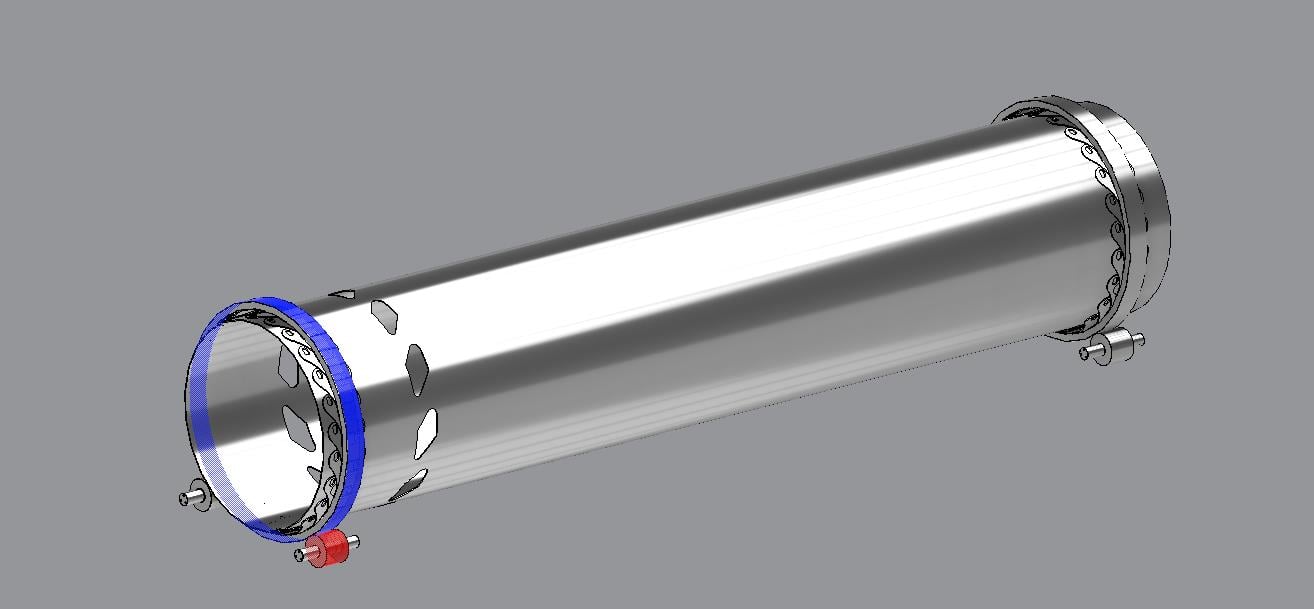
The supports are highlighted:
All 4 contacts like this are "No separation" so that that large cylinder can roll on the 4 smaller cylinders.
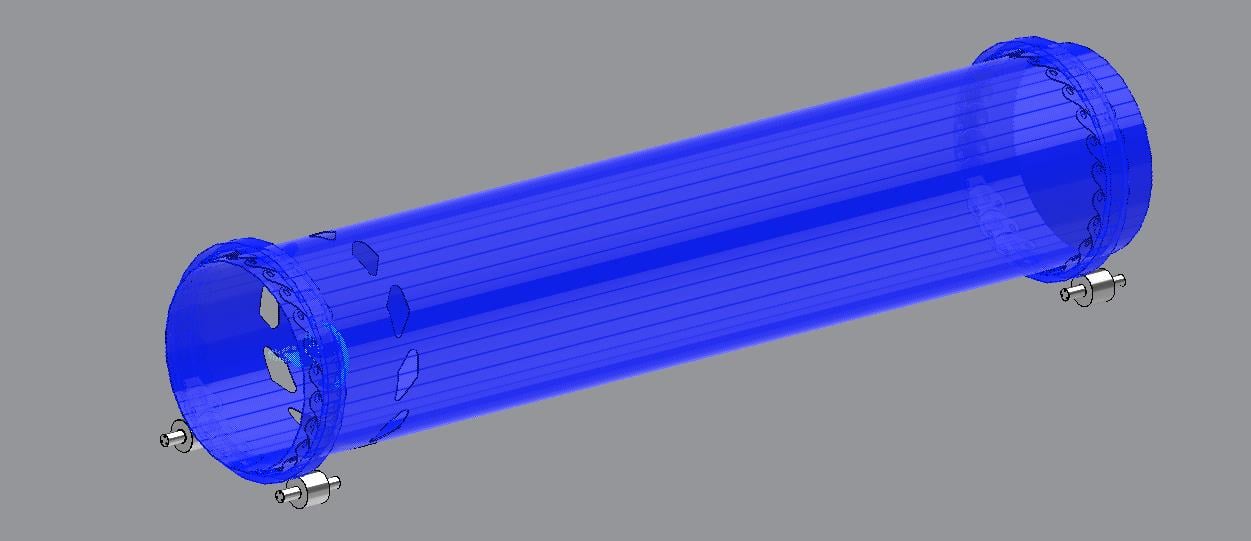
I am trying to make the below selection rotate about its center.

Here is the error
Â
Â
Â
-
July 27, 2018 at 1:24 am
peteroznewman
SubscriberHey Roy,
No Separation contact with the four small rollers take away four degrees of freedom from the large roller.
To do a static analysis, you actually need to take away two more degrees of freedom: rotation about the cylinder axis and translation along the cylindrical axis, otherwise there is no solution to the matrix inversion (except when weak springs are used).
A no separation contact of a small cylindrical roller on a large cylindrical surface prevents the cylindrical surface from tilting up on one edge when the center of the tube between the span sags under gravity, and the prevention of a lift-off creates an artificial stiffness.
I would change the four small rollers to be frictional contact with the two large rings. That way the large ring can tilt a little if it wants to due to bending of the center of the tube. You can put a revolute joint on all four small rollers. Then on one of the four small rollers, you can put a joint load on the revolute, which would be a rotational displacement. You can ramp that displacement up in angle and friction will cause the large tube to rotate on the four small rollers. The friction also prevents the translation along the axis. Then you can get a series of static equilibrium at different angles of the large drum.
Regards,
Peter -

July 28, 2018 at 9:08 pm
roy.macgregor
SubscriberHey Peter,
Thanks for your help on this! Your advice makes sense. I changed the roller contacts to frictional but revolute joint does not appear under joints in aim. My options for joint behavior are: Fixed, Hinge, Slot, Cylindrical, Universal, Spherical, Planar, and general. Should I select Hinge?Â
Also I Have been getting some odd displacement results. I "turned on gravity" by creating an inertial load on in the negative y direction but I am get displacements in the positive y and the side of the barrel are being crumpled in. I this the correct way to turn gravity on in Aim? I'll send a picture in a bit.
Thank you,
Roy
-
July 28, 2018 at 9:27 pm
peteroznewman
SubscriberHey Roy,
Yes, Hinge = Revolute.
Yes, gravity is an inertial load with a specific acceleration of 9.8 m/s/s but in Mechanical (and I assume AIM), you accelerate upward in the positive Y direction to apply a downward (negative Y) force on a mass.
Regards,
Peter
-
July 28, 2018 at 9:30 pm
roy.macgregor
SubscriberHey Peter
That is very helpful to know. I really appreciate you taking the time to help me.
Best Regards,
Â
-
November 20, 2018 at 3:17 am
waqaskhan.92
Subscriberhi
 I want to static structural analysis on ECAP system but i am not able to give a system proper dof can some help me to do it or guide meÂ
i am sending screen shot
-
November 20, 2018 at 3:19 am
waqaskhan.92
Subscriber this is my system i want work piece to flow through the tube i applied pressure on the top face but i am not able to define dof conditions
Â
-
November 20, 2018 at 3:19 am
Sandeep Medikonda
Ansys EmployeeWaqas, Open a new discussion and explain your problem in detail using pictures as Roy did in this discussion.
-
- The topic ‘Degrees of freedom’ is closed to new replies.
-
6660
-
1906
-
1469
-
1313
-
1022
© 2026 Copyright ANSYS, Inc. All rights reserved.