Ansys Assistant will be unavailable on the Learning Forum starting January 30. An upgraded version is coming soon. We apologize for any inconvenience and appreciate your patience. Stay tuned for updates.
General Mechanical

General Mechanical

Topics related to Mechanical Enterprise, Motion, Additive Print and more.

Deformation and Stress Analysis on a Screw and Two Plates Assembly

    • Khaled Al Halabi
      Subscriber

      Hello,

      So, I am trying to run a simulation on a screw that is connecting two plates together with a small distance in between. There are two things i am trying to achieve: first, to determine whether or not the plate itself will break and second, whether or not the screw itself would break. 

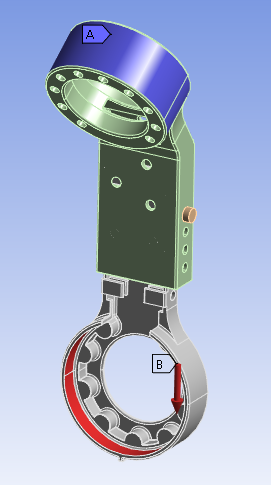
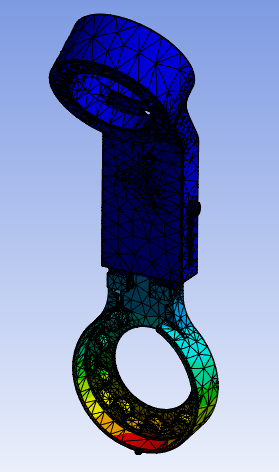
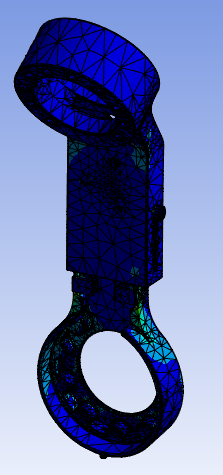
      Looking at the picture attached, I am struggling with identifying what boundary conditions to apply on my part. In its real application, this part is fixed from the upper link, while the lower link inside of it is connected to a part from which force is exerted downward. So, with this in mind I applied all the required contact with the screw and the parts and have applied a fixed boundary on top and then on the bottom of the second link i applied a force downward. However, this does not seem to accurately mirror the real application as i cannot see any much of a stress concentration around the screw area, and if any deformation should ocurr it should be in that area. Is there anyone that has experience or knowledge in this area that could clarify what I could be missing? Should I be simulating each component separately instead?

      I would appreciate any help.

      Boudnaries:
      Deformation:
      Stress:
       

    • Armin
      Ansys Employee

      Hi Khaled,

      For the stress contours you displayed (assuming it is equivalent stress), could you please show stress distribution in the screw only (not the whole assembly)? Since the screw is hidden under the other components, it is difficult to see what stress level it is experiencing. 

    • Matthew Middleton
      Ansys Employee

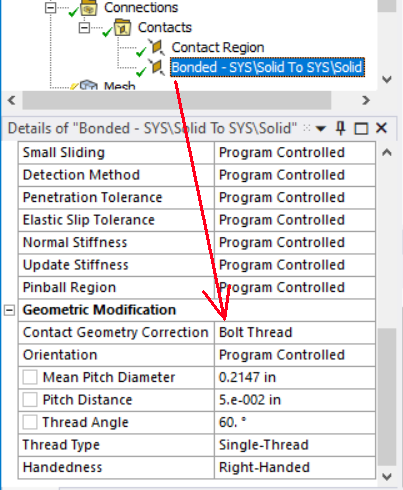
      If failure occurs at the screw and/or screw hole it will be important to model that accurately enough. Did you model as a straight cylinder, or did you incude threads in the geometry? Are the threads small compared to the bolt diameter? If so, you may not need to model the threads. Do you know how failure occurs at the bolt from a physical test? Does the bolt shear? In the contact settings, at the bottom, there is a setting for bolt threads. This allows you to model with a straight cylinder and have Ansys simulate bolt threads. It's accuracy will be better than modeling and solving as straight cylinder, but not as good as actually modeling the threads in the geometry with appropriately small mesh sizes.

      Did you use bonded contact between the entire bolt shank and hole? If so, it all acts as a solid mass through the hole/screw and will be pretty strong. Does the bolt have a threaded and shank portion where you can just just use bonded contact at the threads? You can use frictional contact if you set the "contact geometry correction" to "bolt thread" or geometrically model the threads or even if you use a straight cylinder as long as you set some constraint to keep the bolt from moving in the axial direction. What about the effects of bolt pretension?

Viewing 2 reply threads
  • The topic ‘Deformation and Stress Analysis on a Screw and Two Plates Assembly’ is closed to new replies.
[bingo_chatbox]