Hello everyone,
I am currently working on simulating the critical heat flux phenomena in FLUENT and am using experimental data from Celata et al. The geometry is a 2.5 mm ID pipe with 100 mm of pipe followed by 100 mm of heated pipe. I'm modeling a case run at 2.5 MPa pressure using the 2D axisymmetric condition with a rectangular geometry of 1.25 mm in width and 200 mm in length. The mesh has 20 radial divisions and 500 axial divisions.

For the FLUENT conditions, I am using:
Gravity On in the -x direction
Multiphase -> Eulerian -> Boiling Model -> Critical Heat Flux
Energy On
Realizable k-epsilon model with standard wall functions and Mixture turbulence multiphase model
Phase Interactions:
Virtual mass -> constant -> 0.5
Drag model -> Ishii
Lift model -> Moraga
Wall lubrication model -> Antal et al.
Turbulent dispersion force -> lopez-de-bertodano
Turbulence interaction -> Troshko-Hassan
Heat transfer -> Ranz-Marshall
Mass transfer -> Boiling from Liquid to Vapor at 497.1 K saturated temperature
Bubble departure diameter -> Tolubinski-Kostanchuk
Frequency of bubble departure -> Cole
Nucleation site density -> Lemmert-Chawla
Area influence coefficient -> Delvalle-Kenning
Surface tension -> Constant -> 0.032148 N/m
Interfacial area -> particle
To get inlet velocity, k, and epsilon profiles, I first ran the model with no heating and vapor generation and exported the outlet profiles to be read for the inlet profiles. The outlet profile was specified using 1% turbulent intensity and 0.0025 hydraulic diameter. In addition, the backflow temperatures of the liquid and vapor were set to the saturation temperature.
For a solver, a Coupled -> Pseudo-transient set up was used. The explicit relaxation factors were not adjusted while the timescale factor was adjusted to 0.1.
As a model for departure from nucleate boiling, I increased the heated wall heat flux from a heat flux where convergence was achieved up to the critical heat flux, which is about 27 MW/m^2 in this case. I think that to see if CHF has occurred, a large jump in maximum wall temperature (which I recorded in the model as the vertex maximum liquid static temperature at the wall) should be seen after applying a higher heat flux value. However, I've seen in previous work that the model achieves convergence after this jump in wall temperature and I am not getting the same type of convergence at higher temperatures when a very high heat flux has been applied.
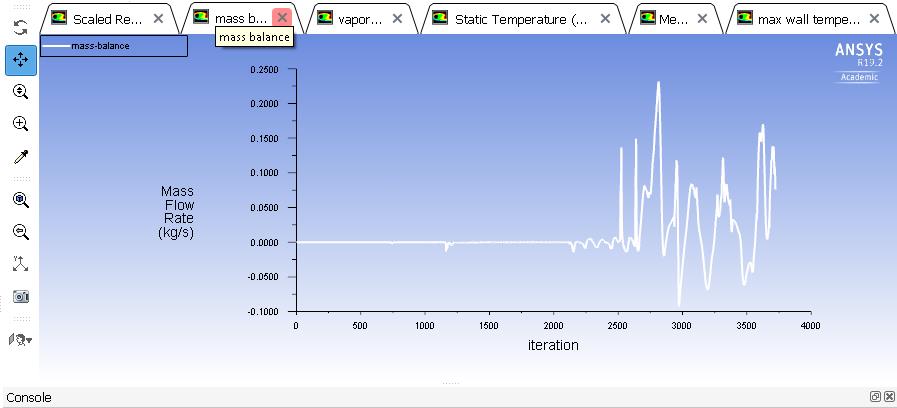

Does anybody know how to achieve convergence for this CHF modeling?
Any help that can be provided is very much appreciated!


















 You are navigating away from the AIS Discovery experience