TAGGED: mechanical
-
-
July 21, 2026 at 9:53 pm
matt
SubscriberIn Mechanical, I'm running a modal analysis followed by a spectrum analysis. With command snippets, I'm doing a manual comparison of FSUM data at a location on a model. I'm manually extracting FSUM data from the modal analysis for every mode at a location. I then manually extract the modal coefficients from the spectrum analysis using *GET. With some basic APDL math scripting, I manually multiply the modal FSUM data of each mode, by its corresponding modal coefficient. Then in the last step, I SRSS all of those values to get the actual FSUM data for the location. It matches what I get if I just issue FSUM from the spectrum analysis. In this scenario, the spectrum analysis uses the SRSS method.
Next, I want to redo the manual verification of the FSUM data using CQC method instead. But coding the basic math of CQC is more complicated. I would like to know if anyone has coded the CQC math before.

-
July 23, 2026 at 3:25 pm
Dlooman
SubscriberI doubt it, partly because there doesn't seem to be any reason to. If you are trying to create a verification test, just base it on two modes so the combination of the fsum values will be easy to do with a hand calc.
-
July 23, 2026 at 3:30 pm
matt
SubscriberThere is, in fact, a reason to do the CQC calculation in the current project that I'm into. I didn't want to go into all of those details here though since it would confuse the reader(s) more. Â
-
July 23, 2026 at 3:38 pm
Dlooman
SubscriberOK. It's going to be hard to automate because the cross-terms aren't "*gettable". Â
-
July 23, 2026 at 3:44 pm
matt
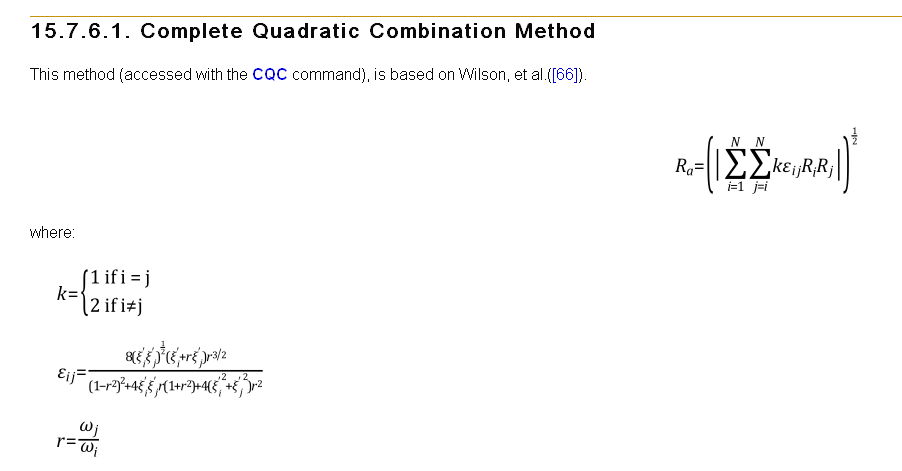
SubscriberI can retrieve the mode coefficients with *GET in the spectrum solution. That allows me to compute R for every mode. Are you saying that I cannot compute epsilon (image below)? I assumed if Xi (damping) was known and constant and the lowercase r values were known (i.e., the mode frequencies), a hand calc would be possible.
-
- You must be logged in to reply to this topic.
-
6880
-
1906
-
1543
-
1344
-
1217
© 2026 Copyright ANSYS, Inc. All rights reserved.