Ansys Assistant will be unavailable on the Learning Forum starting January 30. An upgraded version is coming soon. We apologize for any inconvenience and appreciate your patience. Stay tuned for updates.
Fluids

Fluids

Topics related to Fluent, CFX, Turbogrid and more.

Convergence problem in simulation on Ansys Fluent – Solar chimney

    • sandrazc
      Subscriber

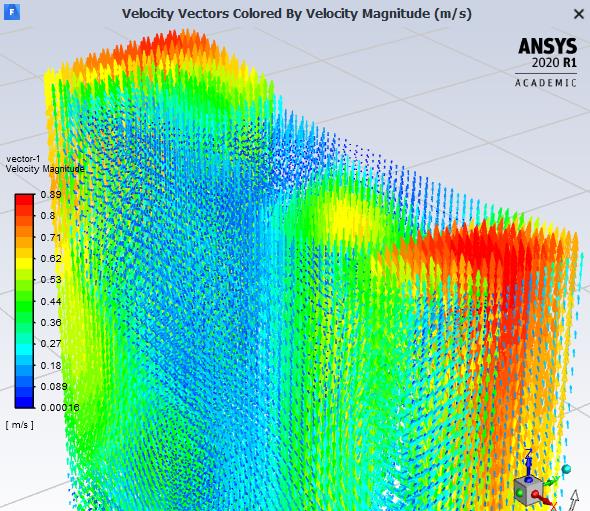
      Hi, I'm simulating a solar chimney attached to a cubic chamber, is a steady state simulation, i'm using the k-e RNG model, with full buyoancy effects and standard wall treatment, and the DO radiation model. The walls of the chamber are considered as adiabatic, the glass cover is semi-transparent, and the absorber plate is aluminium. The air inlet of the chamber is set as velocity inlet, normal to boundary and constant temperature, the top of the chimney is set as pressure outlet, the air is considered an ideal gas. Is a simple geometry, an hexa mesh, the quality is good. Since i'm working with student version the mesh is aprox 472000 elements.


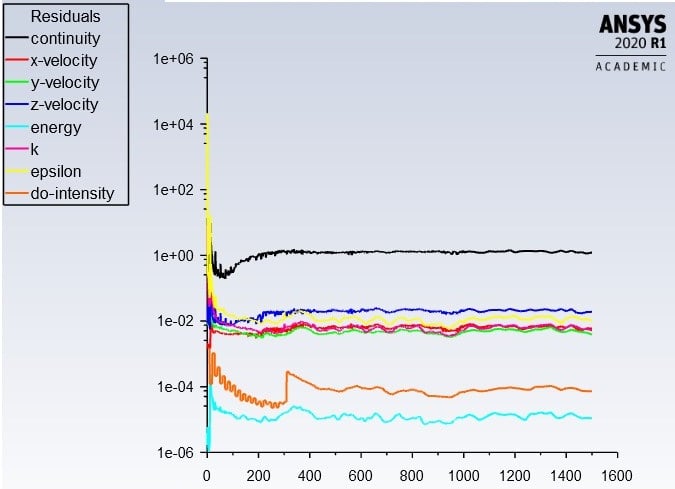
      How to know the calculation as convergerd? The residuals do not decrease.


    • Karthik Remella
      Administrator

      Hello,


      Could you please create a report: Average velocity at the outlet and Average pressure at the inlet, and monitor them during your simulation run?


       I'd also check the final mass and energy balance between your inlet and outlet boundaries.


      What is your flow Reynolds number? Please use the effective hydraulic diameter to calculate the Reynolds number. 


      Also, what are your solver settings (and solution methods)? Are you using the 'Coupled Psuedo-Transient' model?


      How is your inflation layer mesh in the computational domain? What is the y+ value in the first layer? 


      Thanks.


      Karthik

    • sandrazc
      Subscriber

      Hi, Reynolds number is 5.1e+3


      The solver is Pressure based, I’m using the SIMPLE algorithm, Least Square Cell-based, Body Force Weighted, and second order upwind for the rest of equations. The under-relaxation factors and convergence criteria are the default values.


      For Inflation i´m using the First Layer Thickness = 0.007 m, at inlet, outlet, glass and absorber plate. The maximum cell size in domain is 0.02 m.


    • Karthik Remella
      Administrator

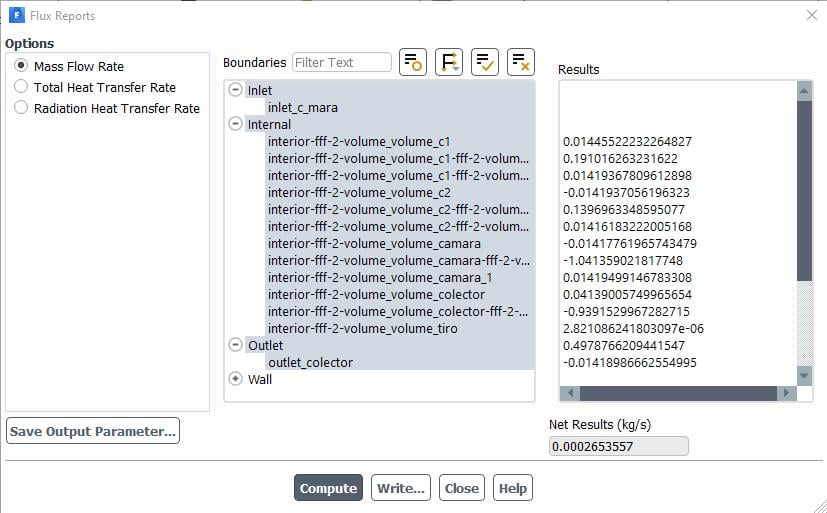
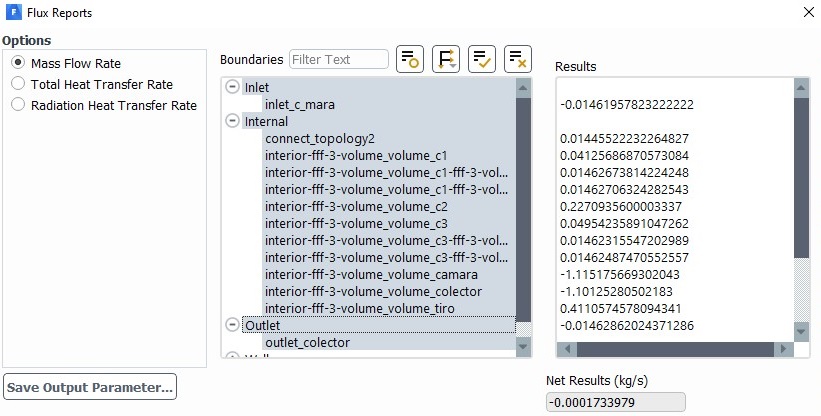
      The net mass flow rate is 1.8 % of the smallest mass flux in your simulation. If your mass flow rate has become steady (please check if this is the case), it tells me that your mass balance is conserved. 


      How does your energy balance look?


      Thanks.


      Karthik

    • sandrazc
      Subscriber


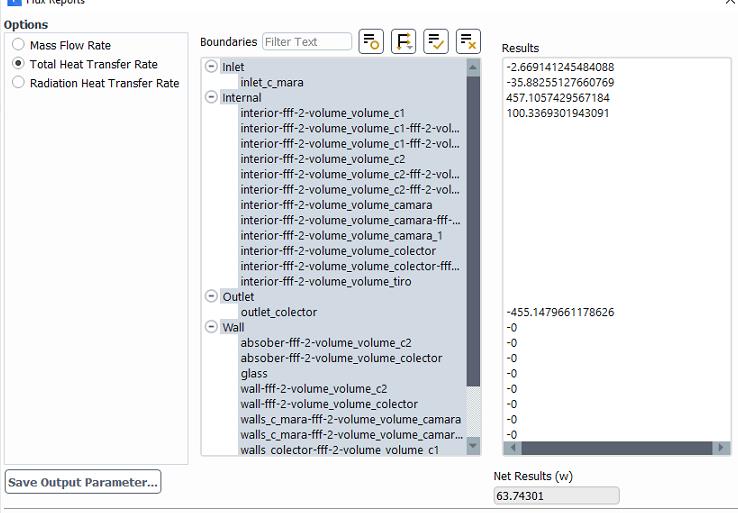
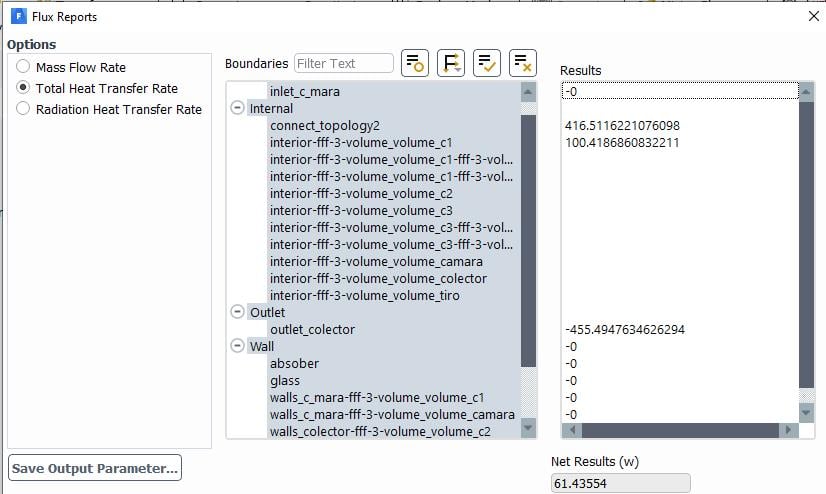
      Hi, this is the Total heat transfer rate.


      I also compare the simulation results with experimental data (absorber plate and internal temperature in the chimney), and they are very close. I hope the simulation is on the right way.


      Thanks.


      Sandra

    • Karthik Remella
      Administrator

      If you look at your net result, it is still appreciable compared to the smallest flux on one of your face zones (-2.66). If you are running a steady model, I'd say that your solution is not yet reached a steady state. It might be on track to getting to a steady state though. 


      What do your solution monitors look like? And how are your residuals, especially the energy equation?


      Thanks


      Karthik

    • sandrazc
      Subscriber

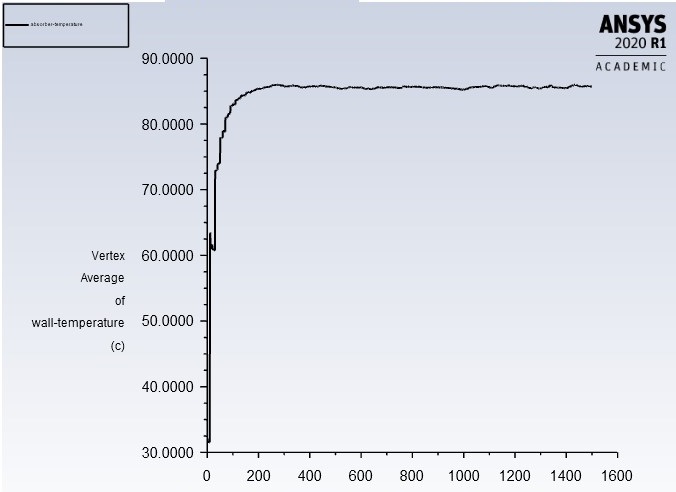
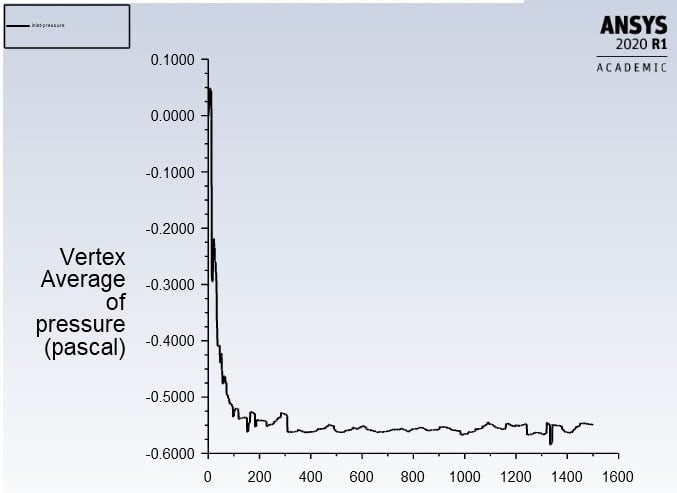
      Hi, I already made another simulation, residuals in energy equation do not decreases below 1e-5. i´m monitorig the absorber plate temperature and it's stablized after 300 interations, but outlet velocity and inlet pressure are not. I'm not sure what it should look like, i generated vertex average reports.


      I think mass flow rate is fine, but i´m not sure about total heat transfer rate, i attach images.


      Thank you very much, i´m a begginer.


      Sandra


Viewing 6 reply threads
  • The topic ‘Convergence problem in simulation on Ansys Fluent – Solar chimney’ is closed to new replies.

[bingo_chatbox]