-
-
June 4, 2020 at 2:11 pm
alessandro.vaghi
SubscriberHello everyone !
Â
My name is Alessandro and from few month I have starting to learn how to use ANSYS Mechanical to do somes simulations.
I am some problem with a simulation and I would like to kindly ask you somes helps.Â
I would like to simulate the following system:
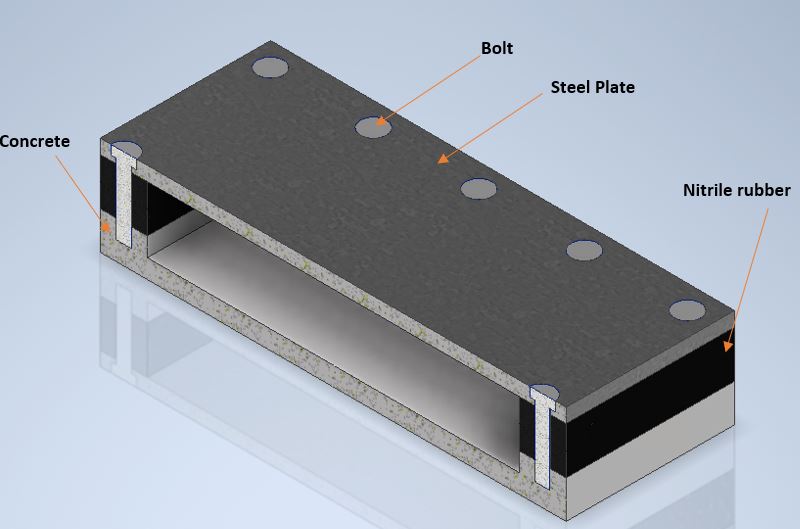
There is a concrete base where it is fixed through 12 bolt a steel plate. Between the steel plate and the concrete there is a nitrile rubber to isolate the vibration.
The plate can be hit with different object or an object can remain on the plate. The weight of the objects can be up to 1-2t.
The idea is, first do a structural simulation to see if the support can resist at the load, then do a modal simulation to see the resonance modes of the plate.
In the following pictures is visible the exploded model in ANSYS.
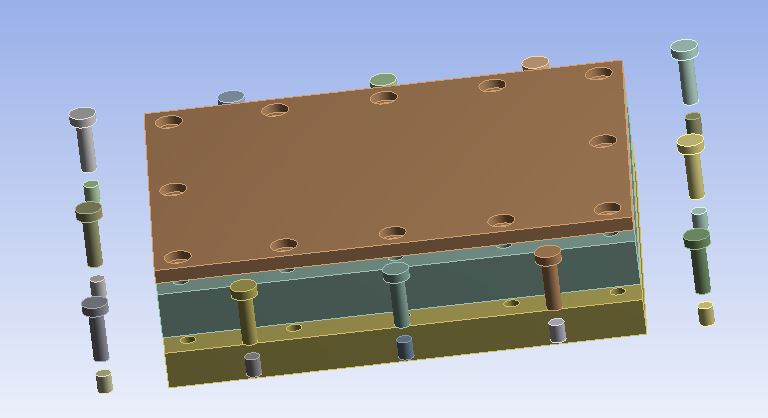
I have set this contact:
 - Plate-Rubber: Frictional Contact
 - Rubber-Concrete: Frictionless Contact
  - Bolt side surface - Rubber: Frictional Contact and disable small sliding
 - Bolt side surface (down part) - Concrete: Bonded Contact
 - Bolt head downside surface - Plate: Frictional Contact
The initial contact information say that there aren't open contact.
At the down side of the concrete I have applyed a fixed support.
The bolt pretension is 2500N for each bolt.
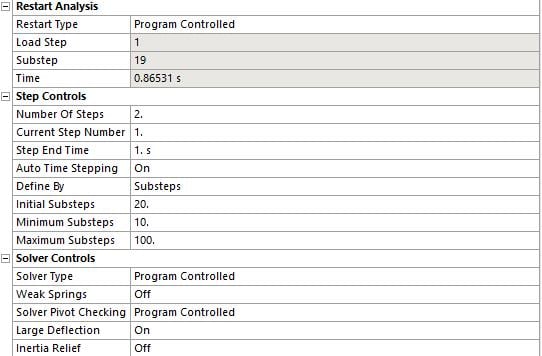
In the analysis setting I have turn on large deflection.
In the first step of the simulation I apply the pretension and then I lock it, in the second step I apply a force in one node (near the plate center) with components (20'000N,-20000N,20000N).
The problem is that the simulation converge for the first time step (Bolt pre-tension), but the second step, when I apply the force, doesn't converge.
When the external force is applayed at the plate the bolt head will be not in contact with the plate, I think that this situation cause the convergence problem.
How I can solve this problem?
Attached you could find the archive of my simulation model.
Excuse me for my english and thank you very much in advance for your time and help.
Alessandro

Â
-
June 5, 2020 at 7:26 am
alessandro.vaghi
SubscriberI have made many other test but the behavior is the same, converge for pre-tension step but when I apply an external force doesn't converge.
Someone can help me?
Thank you very much! -
June 5, 2020 at 8:24 pm
Sai Deogekar
Ansys EmployeeHi,
Due to company policies, Ansys employees cannot download any attachments. Could you attach an image showing the deformed configuration and how the bolt head is not in contact with the plate any more (when external load is applied)? Could you also attach an image showing where the bolt is cut in half to apply bolt pretension? I just want to make sure that the cutting plane doesn't pass through the region where bonded contact is defined.
Sai
Â
-
June 8, 2020 at 8:38 am
alessandro.vaghi
SubscriberHi sdeogeka,
Thank you very much for your help!
I have modified the structure to avoid the problem that we an external force is applyed the vibration material will be compressed and then the head of the bolt loss the contact with the plate. I think that this behavior can damage the bolts or unscrew it.
However I have convergence problem also with this model, maybe I do somethings wrong.
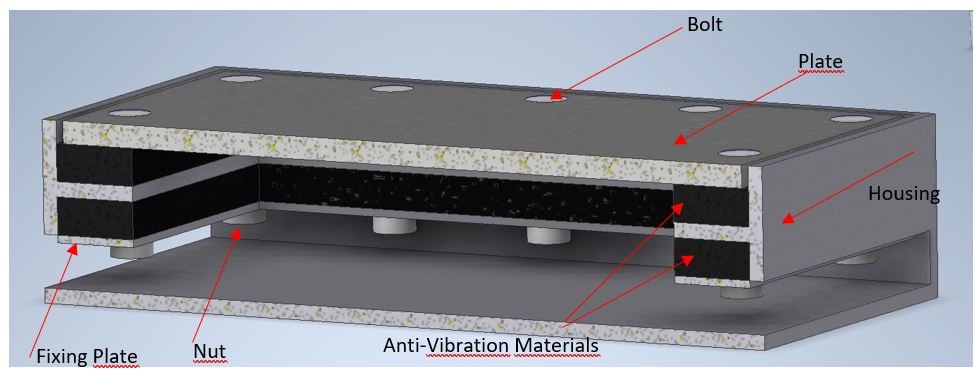
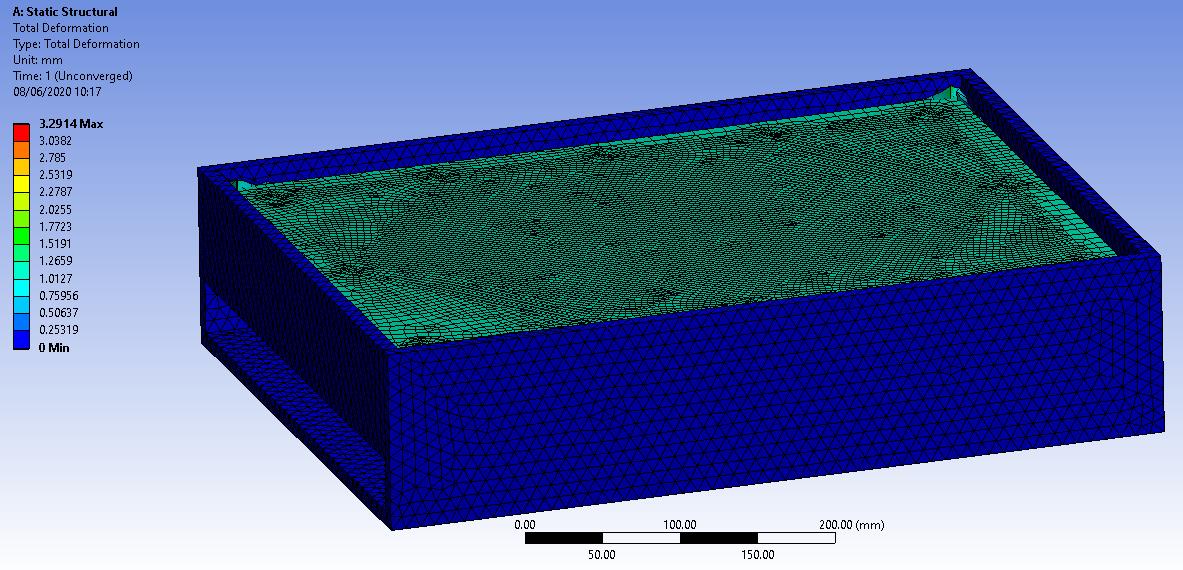
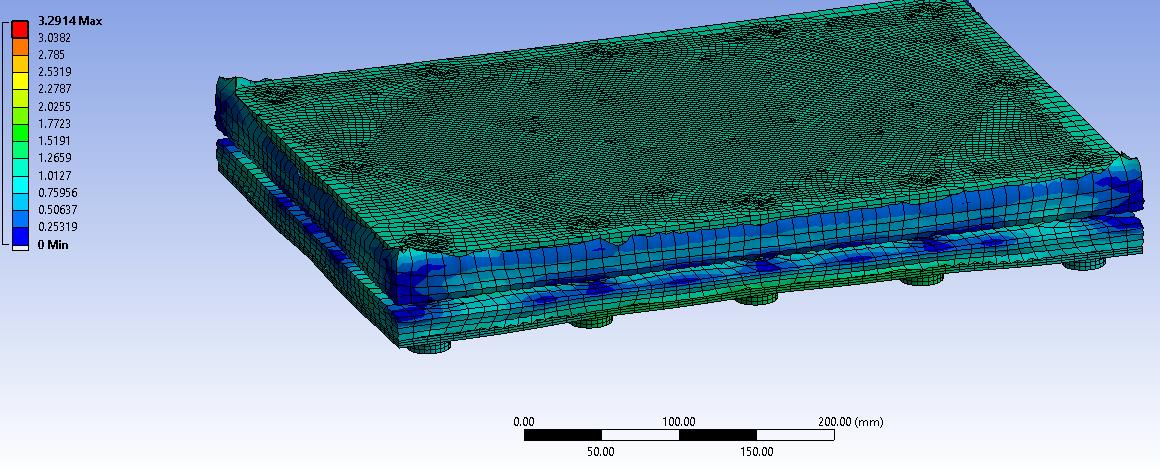
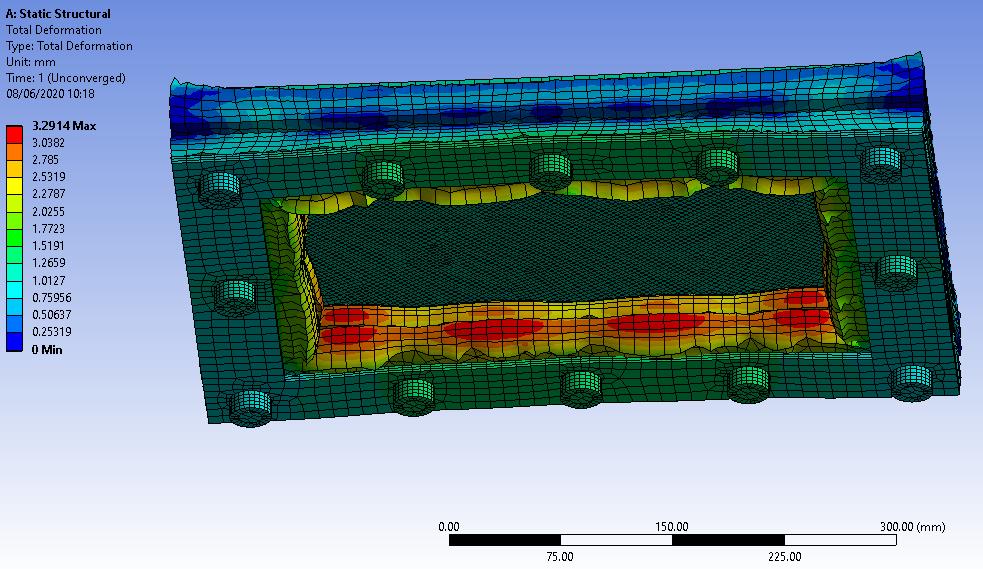
The new model is visible in the following pictures
The anti vibration materials is splitted in two parts and fixed at the housing trought 12 bolts and nuts. The pourpuse of the Fixing metal plate is to distributed the pre-tension forces to avoid a high local deformation of the anti-vibration materials.
In this way the bolts will be always in contact with the plate, because if an external force is applayed that pull down the plate the high-side anti-vibration material will be compressed but the down-side antivibration material will expand maintaining the pre-load of the nuts.
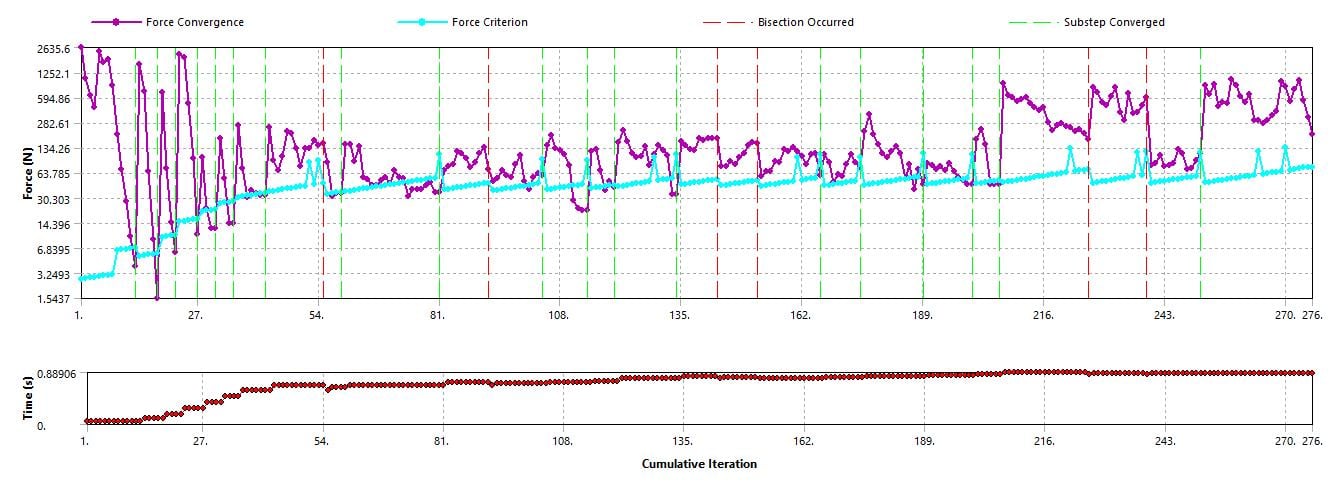
The simulation take a lot lot of time 22h and arrive only al 0.8896s instead of 2s.
The error is the following:
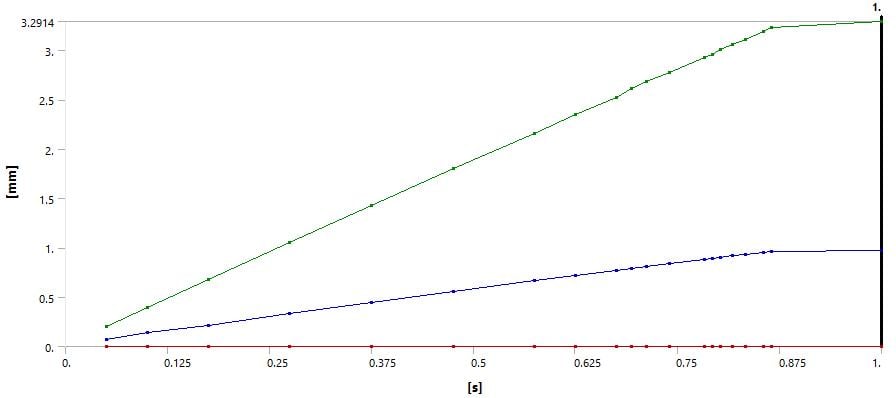
This is the Force Convergence
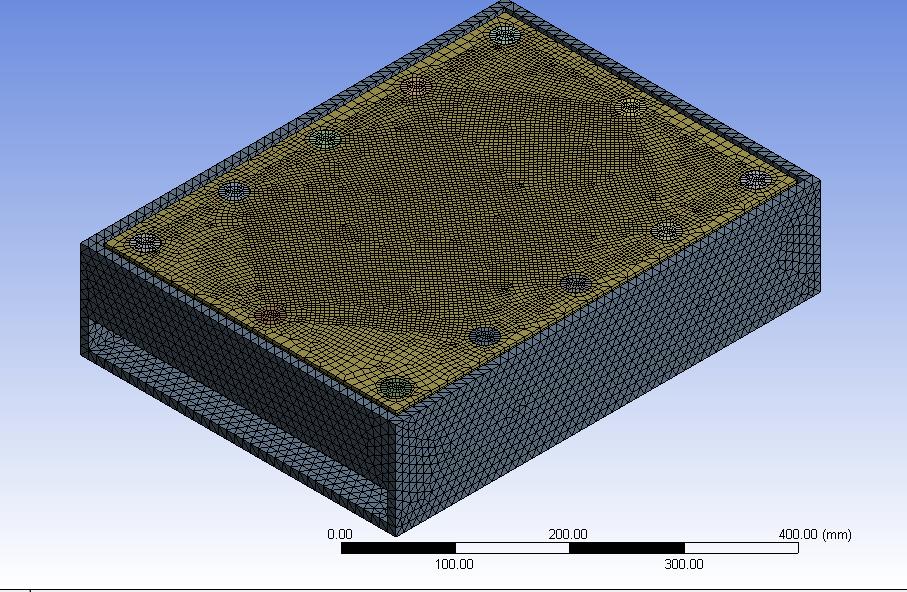
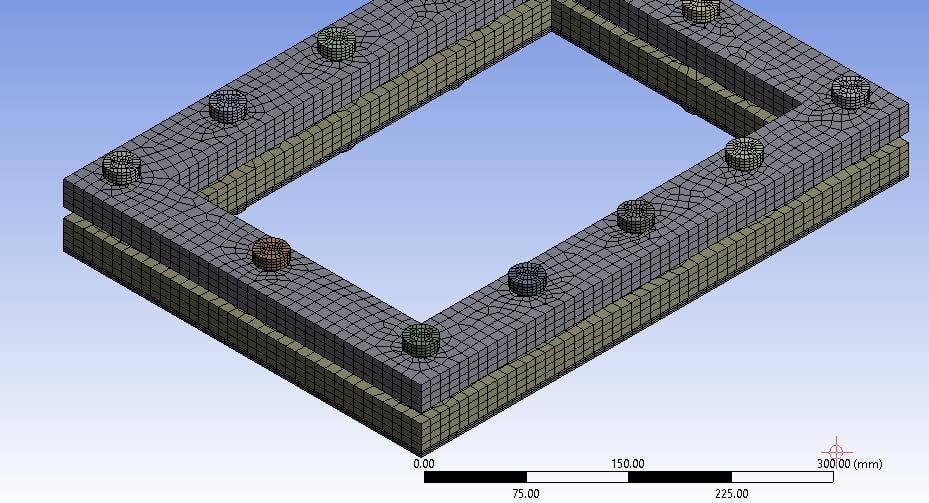
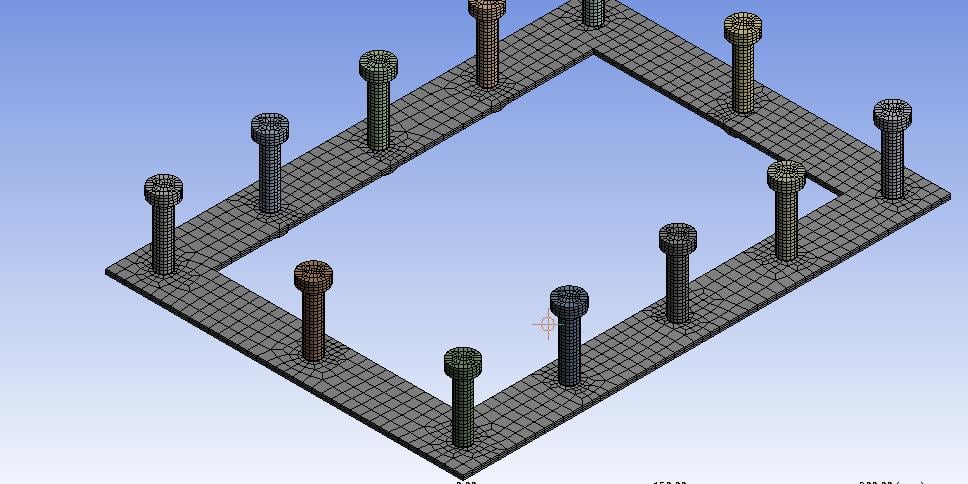
The mesh is the following
Â
Â
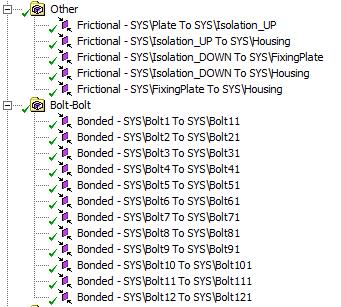
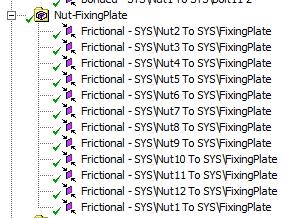
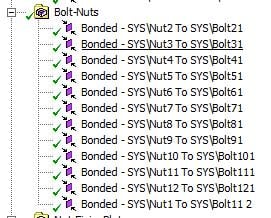
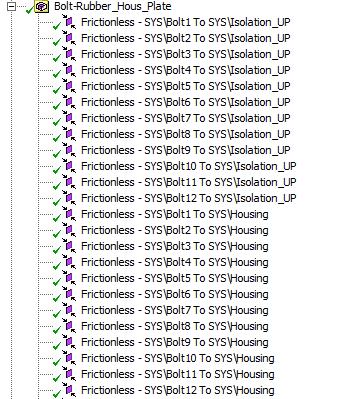
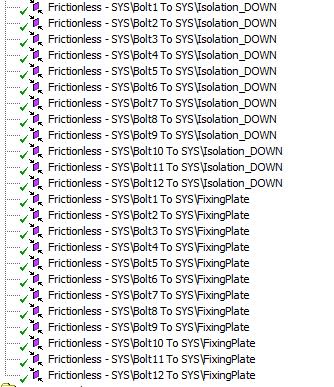
For the contact I have the following contacts near open and I not understand why:
Partial results with scale 10x
Â
How I can increase the speed of simulation? Which contact I can remove to simplify the problem? The mesh is correct or not?
Let me know if you need other information
Thank you very much for your time and help.
Â
-
June 15, 2020 at 3:22 pm
Sai Deogekar
Ansys EmployeeHi,Â
You mentioned that the simulation runs till 0.8896 s. I see that your first step is till 1 s. So even the first step does not converge completely. Could you insert a snapshot showing how the Bolt Pretension has been applied?
A possible way to make it faster would be to make the mesh coarse. This would reduce the accuracy, but you can run faster simulations till you have debugged it. Once you fix all the issues and know that the simulation runs completely, you can refine the mesh to get accurate results.
Â
Sai
-
June 16, 2020 at 12:20 am
peteroznewman
SubscriberAlessandro,
You have not provided your new geometry, so I opened your original geometry.
In Engineering Data, you have Nitril Rubber with linear elastic properties where Young's Modulus is 4 MPa and Poisson's Ratio is 0.49.
It would be better to use a Hyperelastic material model instead of what you have above.
When you have nearly incompressible or hyperelastic materials, there are special setting that are required in the elements to help them converge, such as mixed u-P formulation and Reduced Integration for quadratic elements. These settings are turned on by Keyops. I recommend you find a Hyperelastic Material model that represents your rubber, and use the Keyops on the elements.
Regards,
Peter
Â
-
June 24, 2020 at 6:44 am
alessandro.vaghi
SubscriberThank you very much for your information.Â
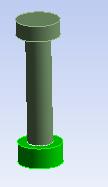
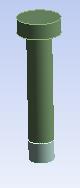
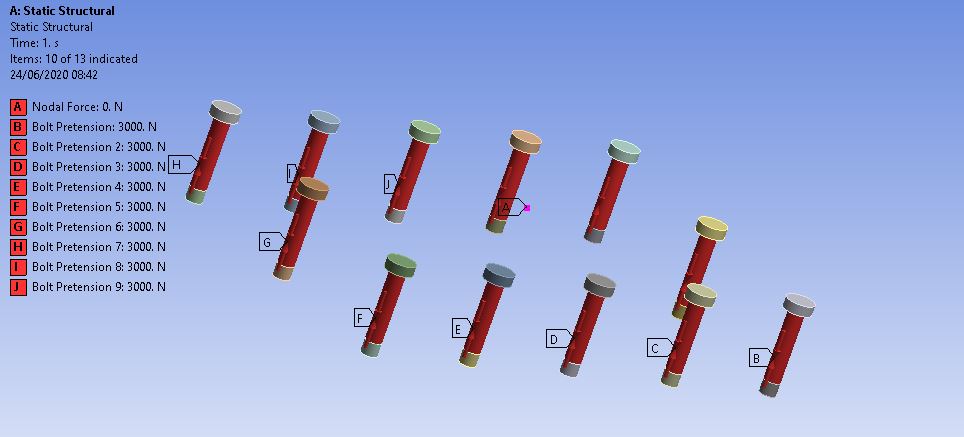
This is the bolt pretension:
If I reduce the mesh is not more difficult for the solver to converge at one solution?
I know that if I use elastic property the simulation is not so real, but if I use hyperelastic material is not more difficult to converge at one solution?
Thank you very much!
Â
-
- The topic ‘Convergence problem’ is closed to new replies.
-
6625
-
1906
-
1469
-
1311
-
1022
© 2026 Copyright ANSYS, Inc. All rights reserved.