Ansys Assistant will be unavailable on the Learning Forum starting January 30. An upgraded version is coming soon. We apologize for any inconvenience and appreciate your patience. Stay tuned for updates.
Preprocessing

Preprocessing

Topics related to geometry, meshing, and CAD.

Convergence of results in the study of mesh independence

    • hugo CFD
      Subscriber

      I am simulating a duct with rectangular section without heat transfer and laminar flow. All of all are abdiabatic.


      I m doing a study of indenpende of mesh but the results not converge. What can I be doing wrong? The problem is very simple.

    • Karthik Remella
      Administrator

      Hello hugo CFD,

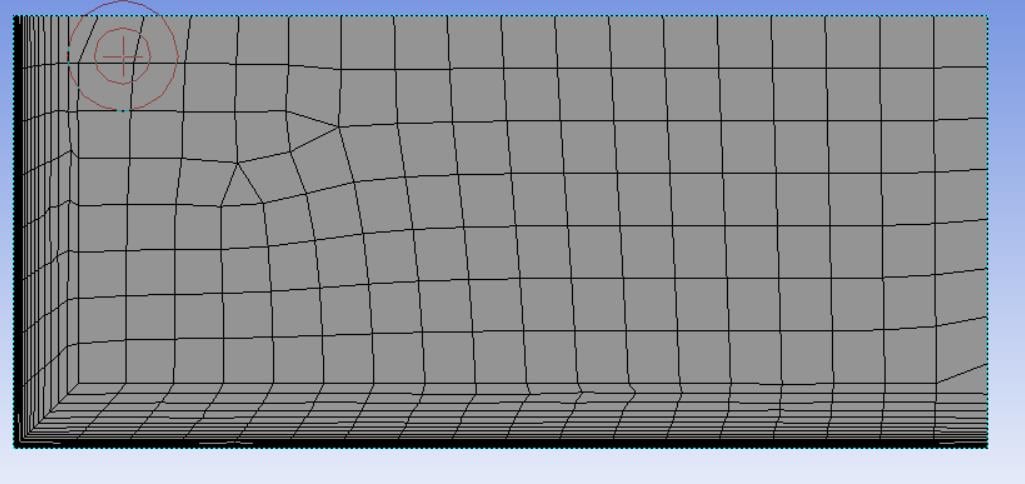
      Are you saying your results are not grid independent? If so, could you please post some snapshots of the grid? Also, please elaborate on how you are conducting this study.

      Thank you.

      Best Regards,

      Karthik

    • hugo CFD
      Subscriber

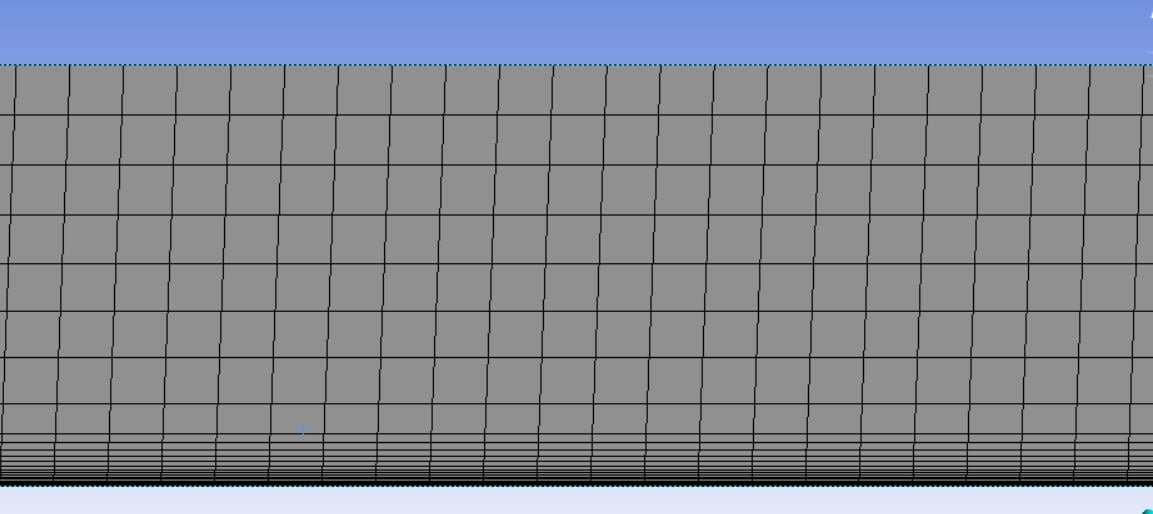
      yes.  I used the grid that you can see in the pictures. This mesh represents the most refined mesh.


      I am analyzing a duct with the following dimensions.

      Cross section : length- 9mm; witdh- 4mm

      and length total 500 mm.

       The skewness is less than 0,65 for all of grids.


      I am analyzing a quarter of the duct.

      The first mesh I used has the following characteristics: 

      size element: 0,7 mm, 

      Inflation: layer 7; total thickness: 0,3 mm

      Then I studied the 3 most refined meshes with a ratio of 1.4 relative to the element size and number of layers used in the inflation. I got the following results for the average pressure throughout the duct.

      0,7 mm; 7 layers - 4,539;   0,5 mm; 10 layers - 4,603;    0,357 mm; 14 layers - 4,638;    0,255 mm; 19 layers - 4,664; 


      thank you

      hugo


    • raul.raghav
      Subscriber

      Hugo, you're doing a laminar flow problem. There is no point in increasing the number of inflation layers beyond a certain point. Just focus on increasing the element size. I'd recommend a ratio of 2 for the element size. Say, for e.g., 1mm, 0.5mm, 0.25mm, 0.125mm...

      And you are achieving convergence from your study if you notice it. I hope you're reporting the pressure drop across the duct. Based on those values, you're error is down to less than 0.5%. That's good for grid convergence study.

    • hugo CFD
      Subscriber

      Oi.

      Why did you recommend ratio 2?


      Hugo

    • raul.raghav
      Subscriber

      The mesh refinement depends on the geometry and the physics of the problem. So a standard ratio for grid independence doesn't have to be a certain number. The whole idea is to have a coarse, fine and finer mesh, and you compare the variables of interest between the different meshes, like Pressure in your case. I would usually go with a ratio of 1.5 to 2.

    • hugo CFD
      Subscriber

      Another question.

      why should I not increase the refinement of inflation, only the dimensions of the element?


      Hugo

    • Karthik Remella
      Administrator

      Since you are solving a laminar flow, refining your inflation layers might not matter 'beyond a certain point' (as pointed out by Rahul). As long as you have a 'sufficiently' fine inflation grid to resolve your boundary layer gradients, you should be set. Now, what is sufficiently 'fine' is something you will have to experiment with and figure out for yourself. This exercise again is similar to your initial grid refinement question.

    • raul.raghav
      Subscriber

      As Karthik mentioned, sufficiently 'fine' is based on your judgement. You define the total thickness of your inflation layers to be 0.3mm and adding 15 or 20 inflation layers is not going to make a huge difference particularly for low Re flows. What you're doing is absolutely right and that is the correct way of doing grid convergence study, however, depending on the physics of your problem, you would want to change your approach.

      For e.g., consider two of your cases:

      Case (i) Element size: 0.7mm, Inflation layer total thickness: 0.3mm, Number of inflation layers: 7

      Case (ii) Element size: 0.255mm, Inflation layer total thickness: 0.3mm, Number of inflation layers: 19

      Compare the number of elements in the inflation layer and the rest of the geometry:

      Case (i) Inflation region: 89,964 + Rest of the geometry: 24,276 = Total: 114,240 elements

      Case (ii) Inflation region: 1,937,468 + Rest of the geometry: 523,587 = Total: 2,461,055 elements

      Since its laminar flow, the total number of elements can be marginally reduced by decreasing the number of inflation layers but still performing an efficient convergence study.

    • hugo CFD
      Subscriber

      Hi

      According to the explained I did a study for the meshes 1, 0.5, 0.25, 0.125 mm. I hit a 0.424% error for the 0.125 mesh. For the 0.25 mesh I reached a 1% error.

      However, for further study, the more refined simulation takes a long time. I can use the 0.25 mesh, right?

      Hugo 

    • Karthik Remella
      Administrator
      Hugo, Yes! 1% error is excellent. Grid independence is always a choice between maximizing accuracy and maintaining reasonable computational time. Good luck with your modeling! Best, Karthik
    • dippa399
      Subscriber
      .

      Quite insightful!!

      .
Viewing 11 reply threads
  • The topic ‘Convergence of results in the study of mesh independence’ is closed to new replies.
[bingo_chatbox]