-
-
October 6, 2019 at 11:23 pm
-
October 7, 2019 at 1:53 am
peteroznewman
Subscriber1) Where did that equation come from?
2) What did you put in your model?
I am more familiar with Hertz contact stress equation. Why don't you use that as a test case?
-
October 7, 2019 at 2:31 am
Autonewbie
SubscriberHi Peter,
This should be non-Hertzian equation as Hertz formula is about curved surface. Correct me if I am wrong. The formula is actually from Roark’s Formulas for Stress and Strain. Â
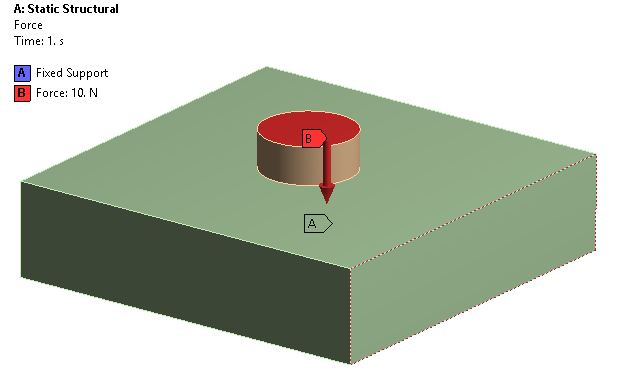
The setup is as below. I am doing this because it is the nearer scenario to my actual contact case as I want to verify the stress obtained from contact analysis.
Note: I updated the picture in the first post which there was a mistake in Unit. The magnitude is correct now and I think using normal stress formula can get fairly accurate stress except the peak stress at the edge which shall be ignored.
I just wanted to see if the calculated contact stress at the flat surface close to the contact pressure obtained.Â
Â
-
October 7, 2019 at 1:01 pm
peteroznewman
SubscriberDid you make the cylinder a Rigid body? You could also make the cylinder's Young's modulus 1000 times larger as a good approximation of a rigid body. Try using smaller elements and also reduce the Penetration tolerance on the Contact details to get closer to the theoretical result.
-
October 7, 2019 at 3:56 pm
Autonewbie
SubscriberHi Peter,Â
Thanks for the reminder. I got the result quite close to simulation result. In other words, if the cylinder is same material to the target or not rigid body, the equation is not applicable anymore, is that right?
-
October 7, 2019 at 6:24 pm
peteroznewman
SubscriberThe equation is for a rigid cylinder.
-
- The topic ‘Contact Stress Verification with Hand Calculation’ is closed to new replies.

-
5879
-
1906
-
1420
-
1306
-
1021
© 2026 Copyright ANSYS, Inc. All rights reserved.