

-
-
March 12, 2021 at 6:31 pm
Ryan_Mitchell
SubscriberHi,
I am trying to compare the outlet temperature achieved by using different fluids in a pipe that is subject to cooling airflow.
I have set the mass flow rate of the fluid and the air as well as the temp at the inlets and to my knowledge everything else has been set up according to a tutorial that i have watched.
Please could someone a
dvise that when i change the material properties of the fluid the outlet temp does not change.
For info each time i run the simulation I just change the material properties of water liquid in fluent. I have used surface integrals and average static temp at fluid outlet to get the outlet temp.
I have tried to attach the file but it's too large. I have attached a photo where the boundary conditons import in a strange way from the meshing.
March 15, 2021 at 4:45 amKeyur Kanade
Ansys EmployeeYou may be having multi body part. For that you will need to use share topology. nPlease check following videosnnDM Share topology:nhttps://www.youtube.com/watch?v=IO4ZtwZdD2InnSpaceClaim Share topology:nhttps://www.youtube.com/watch?v=h43E1YO1LiMnAlso make sure that you have changed material of fluid in cell zone condition panel. By default it is air. nRegards,nKeyurnHow to access Ansys Online Help DocumentnHow to show full resolution imagenGuidelines on the Student CommunitynHow to use Google to search within Ansys Student CommunitynMarch 15, 2021 at 7:20 amSubscriberHi,nThanks for the reccomendations. The time to run iterations for this model was very long, perhaps this is a result of the topology? So I changed to a 2d asymetric model as created in this video, in which outlet temperatures of nanofluid are compared (these are the fluids I am comparing). I get the same issue. Very minimal teperature change. I have ehthylene gylcol and water as a base fluid and when comparing the results from that with the same fluid plus 2.0% copper nanopartciles the increase in delta t is very small in a turbulent flow condition. I have calculated the reynolds number and change the velocity of the different fluids as a function of this due to the varying density and viscocity. Any thoughts as to the small change? nMarch 15, 2021 at 7:20 amSubscriberhttps://www.youtube.com/watch?v=X6JWlz1vcEYnMarch 15, 2021 at 4:02 pmRob
Forum ModeratorWas the DPM run coupled, ie interacting with the flow? Is that 2% copper by mass or volume? nMarch 15, 2021 at 4:05 pmSubscriberSorry rob I am new to the software as you can probably tell. You?ll have to elaborate on the DPM run? The 2% copper is by volume. I use a set of equations to calculate the nano fluid properties of density, thermal conductivity, specific heat capacity and viscosity. These are then entered into the material data base when creating the new fluid. nMarch 15, 2021 at 4:06 pmForum ModeratorDid you include the copper particles or just change the fluid properties? nMarch 15, 2021 at 4:08 pmSubscriberI just change the fluid properties as per my calculations for each different nano fluid I am using nMarch 15, 2021 at 5:24 pmForum ModeratorCan you confirm you've got the correct fluid (check Cell zones for fluid label). How much of a difference does the change make to the specific heat capacity? nMarch 15, 2021 at 5:30 pmSubscriberHi Rob, nYep I always check the cell zone to make sure it updates once I have updated the materials. Below is a summary of my Specific heat capacities. I will double check my calculations on excel. Formula below.n n
n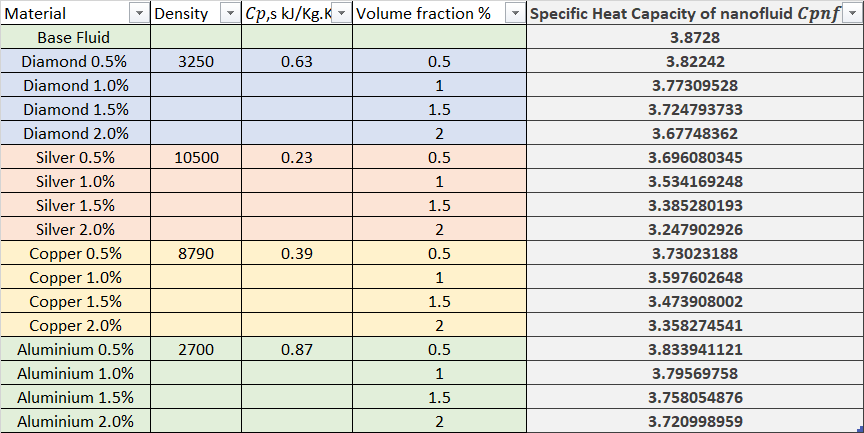 n
March 15, 2021 at 5:35 pmSubscriberI have checked my results for the table above and they appear to be correct. nMarch 16, 2021 at 1:37 pmSubscriberJust to update this post I have increased the volume % of nanoparticles to 5% and acheived a 0.79 degree kelvin difference in temp with copper as the particle material. Using q = mcdelta t this leads to a 15% increase in heat transfer over that which is achieved by the pure Ethylene glycol fluid in the same pipe with a constant wall temperature applied. This is more in line with what I would expect. nMarch 16, 2021 at 2:59 pmForum ModeratorWith value changes like that make sure the mesh is refined and you're converging below the default criterion. nAlso check the temperature profile on the outlet: is heat transfer rate or cp what determines the outlet temperature? nViewing 12 reply threads
n
March 15, 2021 at 5:35 pmSubscriberI have checked my results for the table above and they appear to be correct. nMarch 16, 2021 at 1:37 pmSubscriberJust to update this post I have increased the volume % of nanoparticles to 5% and acheived a 0.79 degree kelvin difference in temp with copper as the particle material. Using q = mcdelta t this leads to a 15% increase in heat transfer over that which is achieved by the pure Ethylene glycol fluid in the same pipe with a constant wall temperature applied. This is more in line with what I would expect. nMarch 16, 2021 at 2:59 pmForum ModeratorWith value changes like that make sure the mesh is refined and you're converging below the default criterion. nAlso check the temperature profile on the outlet: is heat transfer rate or cp what determines the outlet temperature? nViewing 12 reply threads- The topic ‘Changing material in fluent has no effect on results’ is closed to new replies.
Innovation Space Trending discussions
 Top Contributors
-
peteroznewman
 5884
5884 -
scabo
 1906
1906 -
Dennis Chen
 1420
1420 -
javat33489
 1306
1306 -
Shyam Prasad V Atri
1021
Top Rated Tags
© 2026 Copyright ANSYS, Inc. All rights reserved.
Ansys does not support the usage of unauthorized Ansys software. Please visit www.ansys.com to obtain an official distribution.
-
Ansys Assistant will be unavailable on the Learning Forum starting January 30. An upgraded version is coming soon. We apologize for any inconvenience and appreciate your patience. Stay tuned for updates.


 You are navigating away from the AIS Discovery experience