

TAGGED: bisection
-
-
June 25, 2021 at 1:28 pm
Rameez_ul_Haq
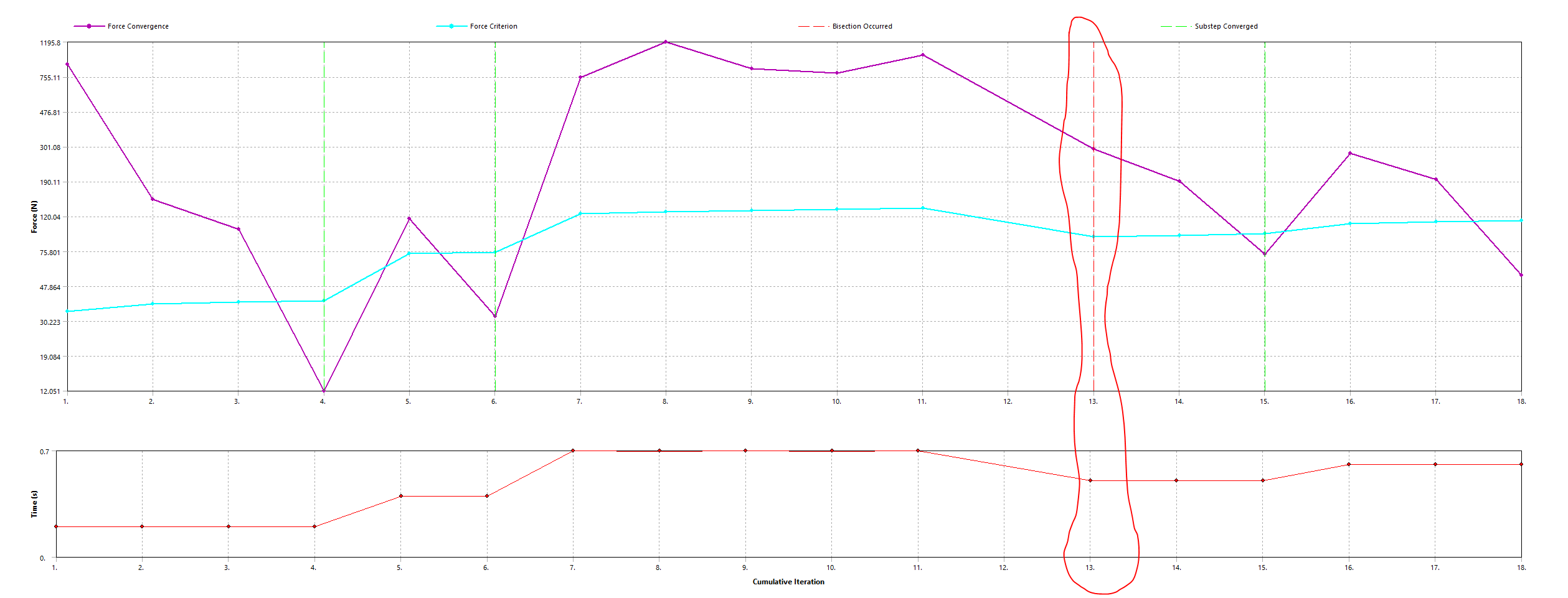
SubscriberHello everyone. Please have a look at the figure below.
June 25, 2021 at 4:30 pmAkshay Maniyar
Ansys Employee
I just wanted to know why you are saying that bisection should occur at 26 step?
Recall that, in the Newton-Raphson method, force equilibrium is sought. If the out-of-balance (residual) force drops below the force criterion, the substep is assumed to be converged. Here, the Force Convergence graph shows that a bisection occurred. This means that a smaller load increment needed to be applied to achieve convergence.As you can see, solver was trying to converge 3rd substep, but it was getting difficult, so solver bisected it, and now trying to converge for smaller load increment.
regards amaniyar
June 25, 2021 at 6:33 pmSubscriber,I mean yes you are right. I shouldn't have said that the bisection should occur at the 26th (default) load step because that is not what happens in the ANSYS solver. The solver automatically stops, showing that the convergence couldn't happen. But it raises a question that will bisection at that time period (i.e. at load step 26) to a lower time step could make the solver converge or not? What I am trying to say is that if I increase the load even more gradually, then are there chances for convergence to happen (for the same model which was not converging at a higher time step and stopped after making 26 iterations)?
And also, I couldn't understand that why does the bisection happen? Why was it getting difficult for the solver to converge at the 3rd substep? I have seen the magenta line have maximum values reach thousands of times the value given at the cyan line for that specific substep, but still the solver continues iterating to see if it will converge or not. So the difference between the magenta line value and cyan line value is not the problem here for bisection to occur. Maybe the elements are distorting alot, thats why bisection should happen. But if that is the case, then high element distortion is a hard error; meaning the solver should abruptly stop giving me an error. But I saw bisection kept on happening. Maybe I was using default program controlled time steps, thats why the solver had the say to actually decrease the time step by its own decision. Maybe thats why I was seeing a bisection to happen.
What else can be the reasons for bisection to occur, if you know any?
Thank you.
June 27, 2021 at 8:06 amAnsys Employee
Yes, if we apply load gradually, it is possible that convergence can happen and for that bisection happens.
Yes, you are also right about element distortion. Element distortion messages are usually indicative of significant problems due to excessive loading or over-constraint. Solver initially tries to apply load gradually and try to eliminate the distortion. Bisection of the solution is performed automatically, but sometimes additional corrective measures will need to be taken to fix this problem.
Also, there is one more common situation when contact status changes abruptly. ÔÇ£Contact status changes abruptlyÔÇØ means that some contact elements unexpectedly changed from status ÔÇ£closedÔÇØ to status ÔÇ£far openÔÇØ (or vice versa). This may be due to large sliding or bodies contacting/separating suddenly. Mechanical will automatically bisect the solution if necessary.
Refer to below link for some other common issues when bisection can happen.
https://ansyshelp.ansys.com/account/secured?returnurl=/Views/Secured/corp/v194/ans_thry/thy_tool6.html?q=bisection
regards amaniyar
June 27, 2021 at 10:11 pmSubscriber,well thank you for your reply.
I think I was not able to comprehend if you answered my question or not. What I was asking is that we know that bisection can happen automatically by the solver if element distortion occurs. (and you also mentioned that bisection can also take place if there is an abrupt change in contact, thank you for that). But if element distortion is not the problem, but infact the element quality is somehow causing the convergence to not occur (even after surpassing the 26th iteration), so will decreasing the load more slowly could help in convergence or not. (and I think you are already aware that element distortion and solution not converging even after 26th time step are two different things, I am asking if the latter problem could be solved by bisection or not?).
Viewing 4 reply threads- The topic ‘Bisection occurred problem.’ is closed to new replies.
Innovation Space Trending discussions
 Top Contributors
-
peteroznewman
 6379
6379 -
scabo
 1906
1906 -
Dennis Chen
 1457
1457 -
javat33489
 1308
1308 -
Shyam Prasad V Atri
1022
Top Rated Tags
© 2026 Copyright ANSYS, Inc. All rights reserved.
Ansys does not support the usage of unauthorized Ansys software. Please visit www.ansys.com to obtain an official distribution.
-


The Ansys Learning Forum is a public forum. You are prohibited from providing (i) information that is confidential to You, your employer, or any third party, (ii) Personal Data or individually identifiable health information, (iii) any information that is U.S. Government Classified, Controlled Unclassified Information, International Traffic in Arms Regulators (ITAR) or Export Administration Regulators (EAR) controlled or otherwise have been determined by the United States Government or by a foreign government to require protection against unauthorized disclosure for reasons of national security, or (iv) topics or information restricted by the People's Republic of China data protection and privacy laws.

 You are navigating away from the AIS Discovery experience