Ansys Assistant will be unavailable on the Learning Forum starting January 30. An upgraded version is coming soon. We apologize for any inconvenience and appreciate your patience. Stay tuned for updates.
General Mechanical

General Mechanical

Topics related to Mechanical Enterprise, Motion, Additive Print and more.

Assesing a acceleration on a single area

    • FlorianHenscheid1
      Subscriber

      Hello, 


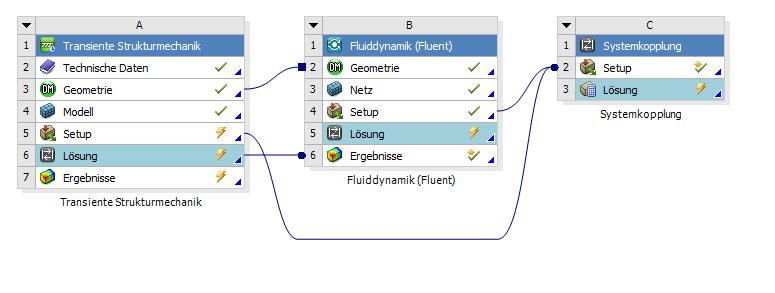
      I try to simulate a tank filled with water under an earthquake, for which I use ansys Workbench. That's why I chose a coupled analysis. I use transient structural mechanics and fluid dynamics (fluent) as analysis settings and system coupling for the interaction part (the tank wall should be assumed to be elastic). Now I try to apply the replacement load for the earthquake to the bottom of the tank and wonder how I can put an acceleration only on a surface of the tank volume. I am also open to other solutions or suggestions for solutions.


      thank you for your help

    • peteroznewman
      Subscriber

      Does the earthquake data have three components?


      What kind of foundation is in the ground supporting the tank?


    • FlorianHenscheid1
      Subscriber

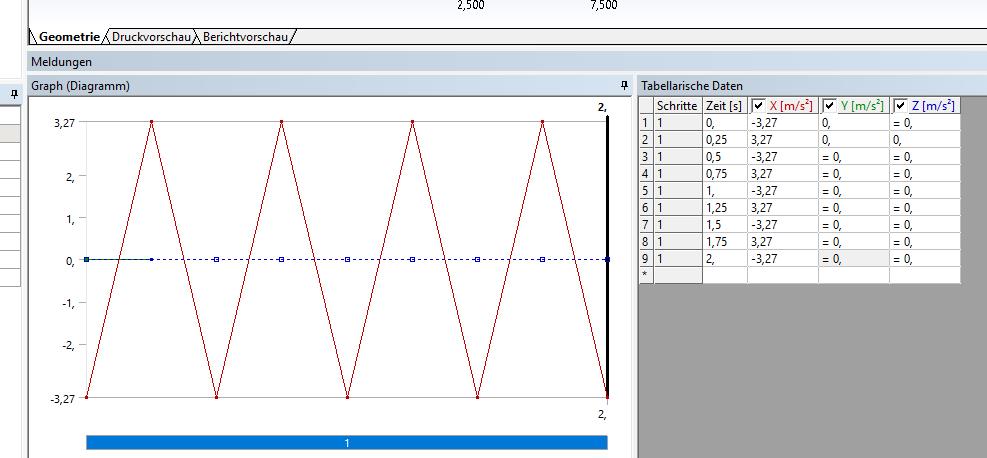
      The vector for acceleration is only containing data for the x-component. Since I do not know an exact frequency for earthquake simulation, I set the acceleration every 0.5 seconds. The inner surface of the tank is declared as Fluid Solid Interface boundary conditions and the underside of the tank is fixed (no displacement or rotation).


      As results I look for the natural frequency of the water-filled tank and the maximum vertical displacement of the water.

    • FlorianHenscheid1
      Subscriber


      the tank is eight meters high and up to 6 meters filled with water. the tank wall thickness is 20 mm.

    • peteroznewman
      Subscriber

      Florian,


      I don't like your acceleration profile because the average acceleration is not zero.
      If you integrate that signal once, at 2 seconds, the tank is moving at 3.3 m/sec,
      and if you integrate twice it shows the ground moved 3.3 m from where it started.


      You can download actual earthquake data from this site.


      Regards,
      Peter

    • FlorianHenscheid1
      Subscriber

      Thank you for the answers you have had so far.
      so for a simplified example, I would just have to make sure that the integral of each accelerator is not too far from zero, right? An example could be seen in the next image.

    • peteroznewman
      Subscriber

      It is a little better if the acceleration starts at zero and goes positive and negative, but this will work.


      You can do that by having the first time step be 0.125 seconds and the same interval for the last time step.

    • FlorianHenscheid1
      Subscriber
      Applying the acceleration to the whole body is normal, isn't it? 
      After the simplification according to Housner, the acceleration is only applied to the tank bottom.


    • peteroznewman
      Subscriber

      EITHER


      Apply an acceleration load to all the mass in the model and leave the ground fixed. This allows you to plot the displacement of the tank and water relative to the fixed base of the tank.


      OR


      Apply the acceleration only to the tank bottom. Now the tank and water will move in space with some rigid body motion while they deform. Note that you must multiply the acceleration by -1 to have the same motion.


      IN ANY CASE


      The stress in the tank will be basically the same, because strain is a local deformation and doesn't care about rigid body motion.

    • FlorianHenscheid1
      Subscriber

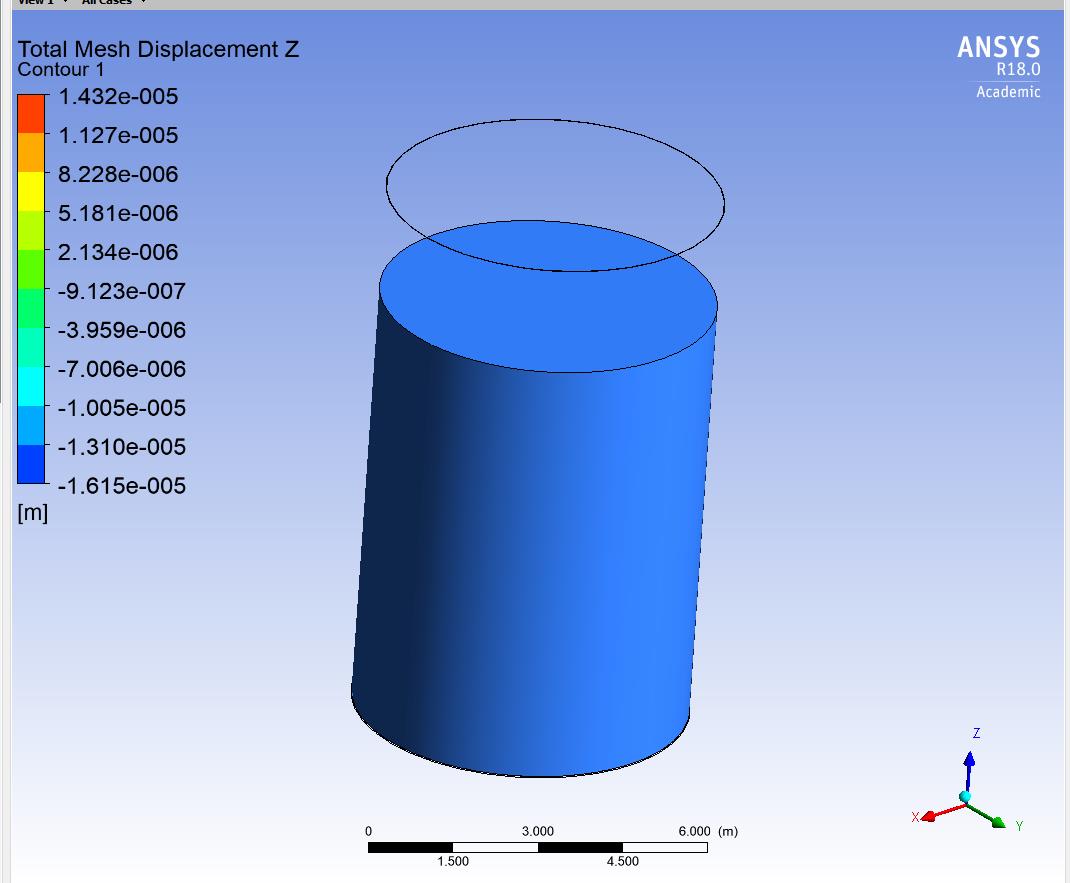
      Thank you again for the help so far, Peter. I've already calculated the problem a few times, but I never get a deformation of the water when I look at the results.


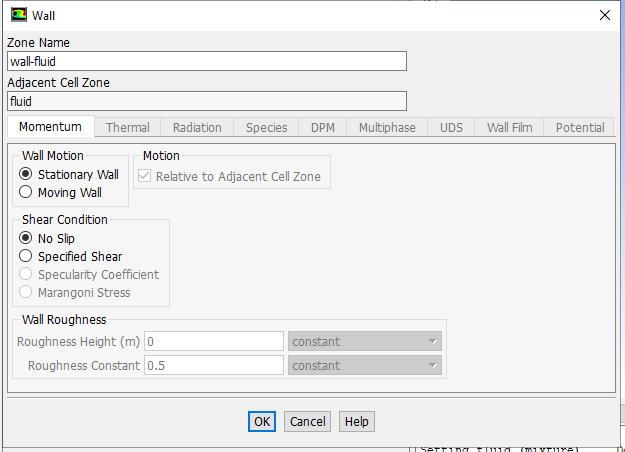
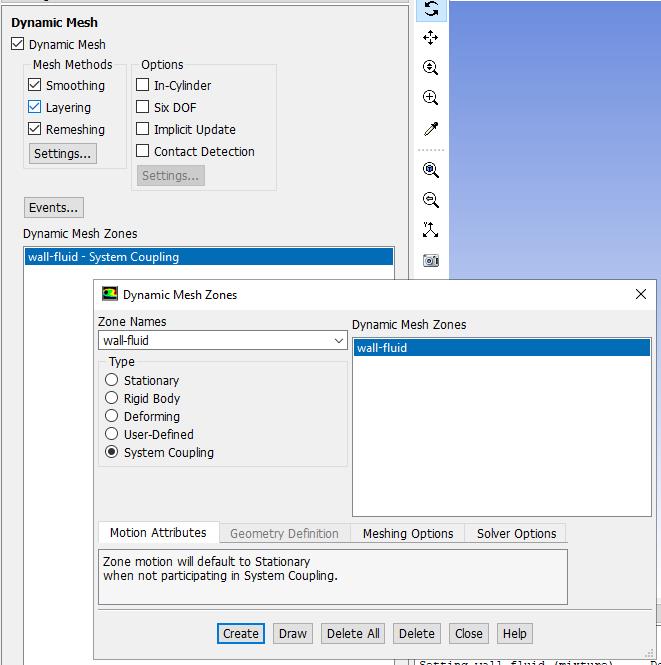
      An earlier calculation allows me to know that the "wall" of the water requires a dynamic mesh for the calculation. My settings for this can be seen in the image below. In addition, I think i remember that the boundary conditions of the water wall are set as a stationary wall.


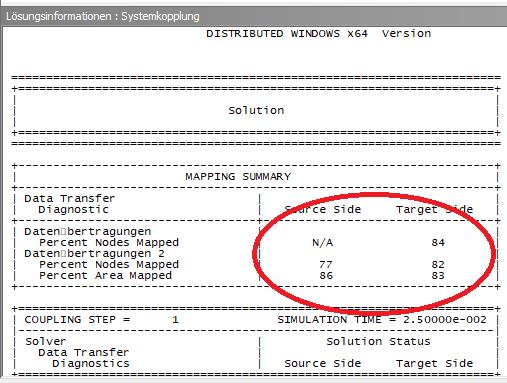
      In addition, something seems to be wrong with my meshing, as the percentages here are not 100.


      I would be very happy about possible improvements/changes.

    • peteroznewman
      Subscriber

      I don't think the free Student license can do 2-way FSI coupling. That is where the motion of walls creates a force on the fluid, and the pressure of the fluid deforms the walls in a tight, 2-way coupling.


      I know the free Student license can do 1-way FSI coupling. That means if you have a Fluent model, which I expect would be a VOF model of air and water, you can simulate the water sloshing in a rigid tank in a transient model with an acceleration load. Then you can take the wall pressure results from Fluent and apply them to the tank walls in a Structural model and look at the deformation that causes.  That is 1-way coupling as there is no feedback from the wall deformation to the fluid.


      In Fluent, you would have a mesh that covers the entire volume of the tank and call that water, but during Initialization, you Patch the top 1/3 of the tank with air, then you begin the transient simulation.


    • FlorianHenscheid1
      Subscriber

      We have the possibility to work with the full version of Ansys Workbench in our university. So that shouldnt be a problem. Would the air in the upper area of the tank also have to be taken into account with the 2-way fsi coupling method. 

    • FlorianHenscheid1
      Subscriber

      And then how do the fluid structure interface behave. Is there an interaction between air and tank, water and tank and even air and water?


    • peteroznewman
      Subscriber

      The Fluent model has 3 walls, the top, bottom and side of the tank.  The volume of the tank is filled with elements. Each element starts out as either water or air. During the solution, the acceleration load, which is the sum of gravity and the oscillating component in X, causes the water and air to move into and out of different elements according to the dynamics of the fluid.  That is called a VOF model. The walls experience the pressure of each element that has a face on the wall. That element will be water or air or some fraction of the two and will change over time.


      You take the wall pressure results for the duration of the Fluent simulation and apply it to the walls of the tank in a Transient Structural model. The walls will deform from the imported pressure load and you will see the stress and strain from that.

    • FlorianHenscheid1
      Subscriber

      Do I need a UDF to apply the acceleration at the bottom of the tank or is there another way to apply the acceleration? And if not what would this UDF look like?


    • peteroznewman
      Subscriber

      I don't think you need a UDF.


      Please reply with a screen snaphot of the Acceleration load in a Fluent Transient model.
      I'm just guessing, but I expect it has many rows and four columns for time, x, y and z acceleration.


      Someone who knows can reply with more information.

    • FlorianHenscheid1
      Subscriber


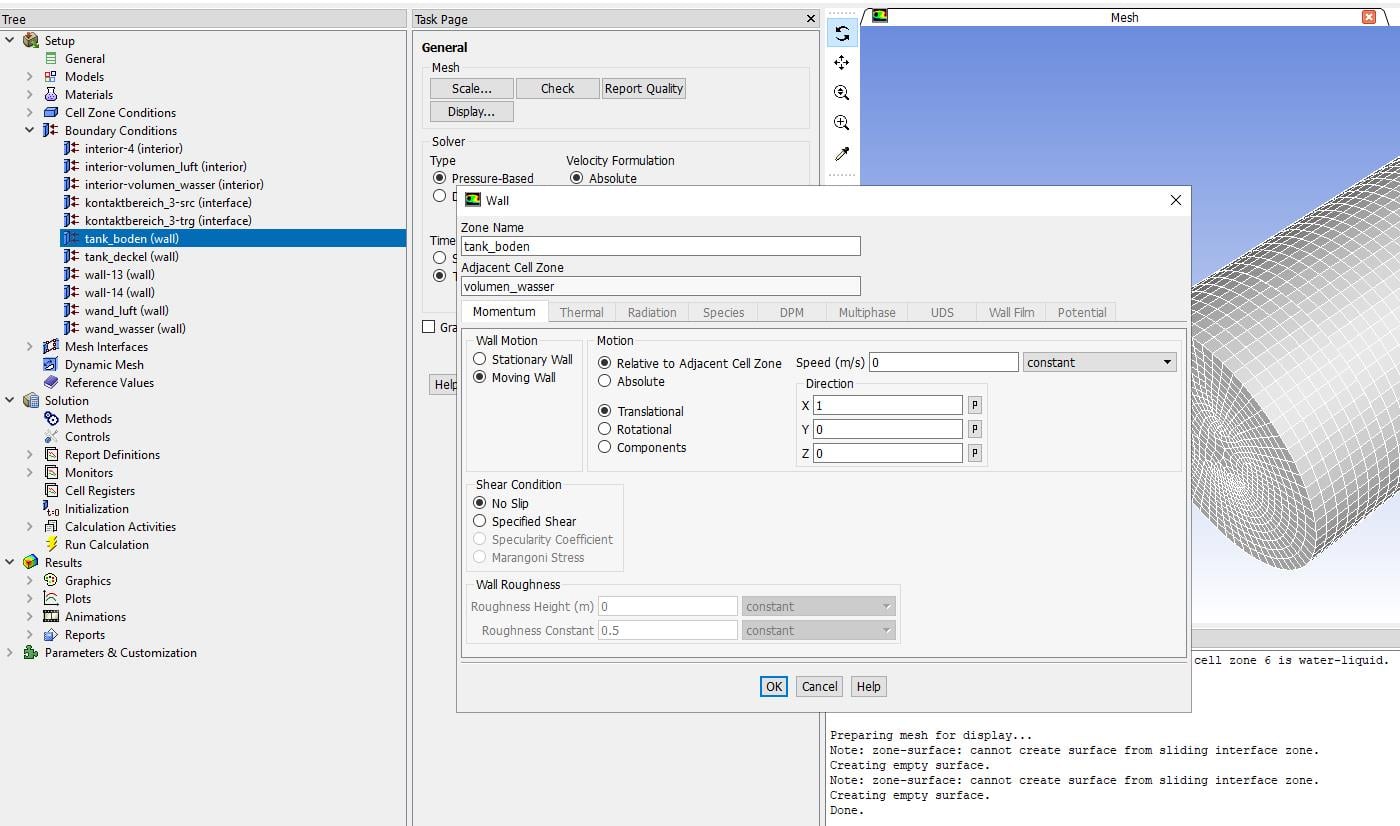
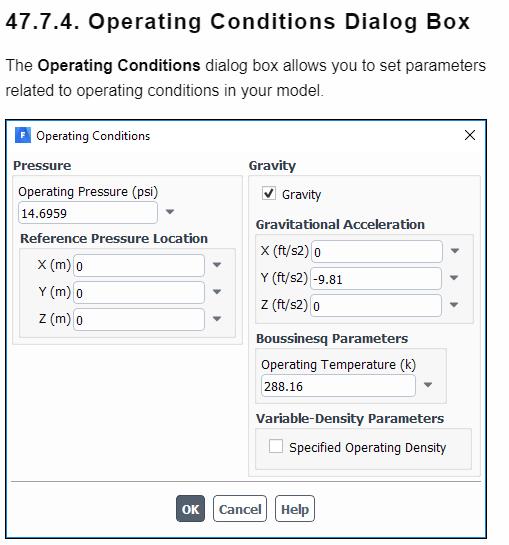
      these are the boundary conditions i could enter


      Ty

    • peteroznewman
      Subscriber

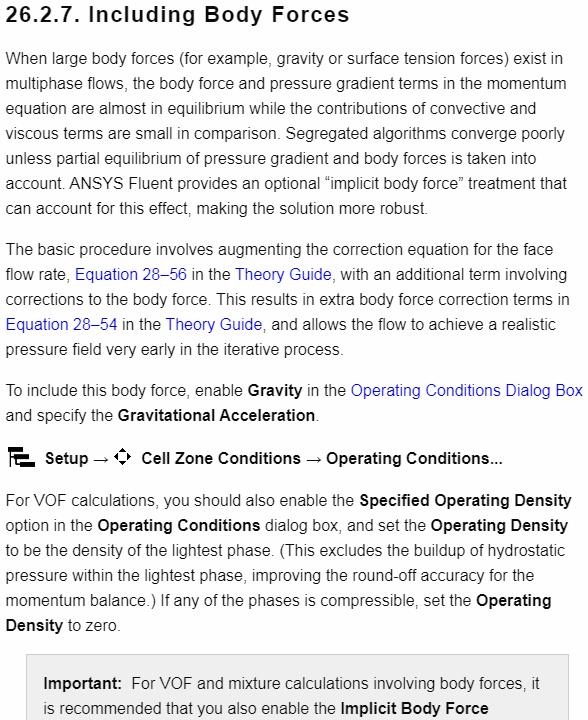
      I'm not sure, but I think there are no moving walls in this 1-way analysis.  All the walls are fixed.  The water and air move in and out of cells based on the acceleration body force that varies over time.  Look up Body Forces in the Fluent Help.


    • peteroznewman
      Subscriber

      I see there is Gravity that is easily enabled. You will want that on for sure.


      The question is can the acceleration be a function of time. I see there is a pull down next to the acceleration box. What is under that pull down?

Viewing 18 reply threads
  • The topic ‘Assesing a acceleration on a single area’ is closed to new replies.
[bingo_chatbox]