Ansys Assistant will be unavailable on the Learning Forum starting January 30. An upgraded version is coming soon. We apologize for any inconvenience and appreciate your patience. Stay tuned for updates.
General Mechanical

General Mechanical

Topics related to Mechanical Enterprise, Motion, Additive Print and more.

Applying pressure boundary condition in Coupled Field Transient acoustic region

    • a_l_o
      Subscriber

      Hello folks,

      In a Coupled Field Transient analysis (Mechanical R2022 R2), one can define the acoustic boundary condition -> pressure. In the regarding documentations it is said, that this boundary condition is allowed for solids in 3D, but only topologies like faces, edges and vertices. Now my question: If I want to model a process pressure in a pipeline, e.g., and then add any load to investigate on the transient answer of the system including sound pressure, how would I define the process pressure? Would I select the "inlet" surface of the process medium for instance and would that mean that the pressure in the whole acoustic region is the same (as I want it initially)?

      I tried one-way coupling with Fluent to import the pressure as load to my Coupled Field Transient analysis, but it seems easier to use Mechanicals own features. Also, through the coupling, I only can import surface pressures that affect structural regions (so no chance of applying the pressure on the acoustic region), therefore the inbuilt feature seems more adequate.

      Looking forward to your answers and suggestions!

    • ErKo
      Ansys Employee


      Yes In a Coupled Field Transient analysis (Mechanical R2022 R2), one can define the acoustic pressure (normally not used as excitation but still possible).

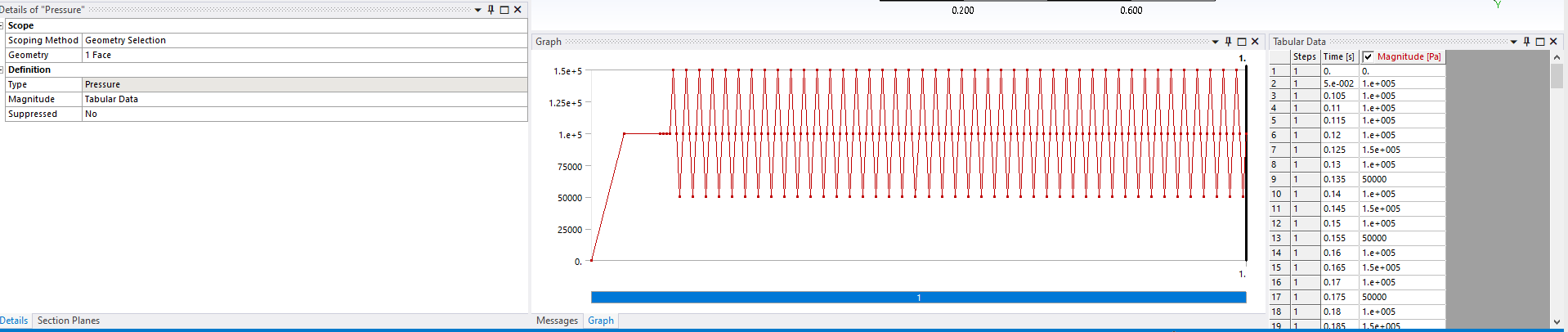
      Add the static pressure (process what you called) and then superimpose the pulse/transient on top - one can define all that in excel (so pressure vs time):

      p_static+p_dynamic(time, say sinusoidal) and paste it in the pressure boundary condition (e.g., as shown below – p_static=1E5 Pa, and p_dyn=sinusoidal / 50 Hz and Amp: 50000 Pa).

      All the best

      Erik


    • a_l_o
      Subscriber

      Hi Erik,

      Thank you very much for your answer! That looks really cool. I am still unsecure which geometry feature to choose to apply the pressure: If I select any vertice of the fluid-solid-interface for example, is this static pressure (process pressure) applied to the whole acoustic region (fluid region)? In terms of structural analysis I would say no, but in terms of pressure as an intense quantity (meaning that it is the same in any connected fluid region) I would say yes.

      All the best!

    • ErKo
      Ansys Employee


      Hi – the example here is static pressure (process what you called) and then superimpose the pulse/transient on top of it - so we have the static pressure on the structure in that way, and the propagating pulse along the fluid that is also interacting with the structure – it (acoustic pressure boundary condition) is typically applied at the inlet face of the fluid/acoustic region (say the inlet)


    • a_l_o
      Subscriber

      Thank you very much! Now I understand the matter a bit more. Have a nice day :)

Viewing 4 reply threads
  • The topic ‘Applying pressure boundary condition in Coupled Field Transient acoustic region’ is closed to new replies.
[bingo_chatbox]