

-
-
June 6, 2021 at 6:03 am
harsf
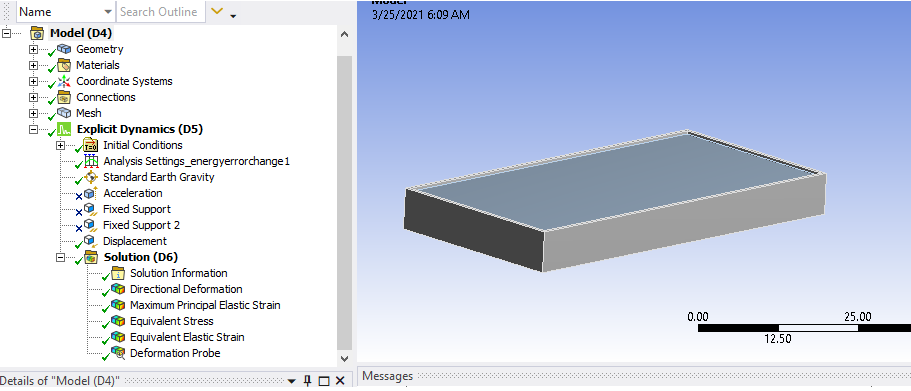
SubscriberIn Ansys dynamics explicit module, I have modeled a water tank for an earthquake analysis to observe sloshing behavior. I am interested in how Ansys solves the problem using conservation of mass, momentum, and Energy. I have used the eulerian body for water and the lagrangian domain for the water tank. My question Is it using the Finite Element Method (FEM) or Finite Volume Method (FVM) or Finite Difference Method (FDM)? to solve the PDE's. I am doing FSI with water and tank
June 6, 2021 at 11:57 amSubscriber@ram_gopisetti As in a previous discussion of mine it was mentioned, explicit dynamics uses FVM. But when I read the manual it mentions that it was done using Godunov scheme which uses FDM. Please can you clarify it? It is kind of urgent
June 7, 2021 at 11:37 amJuly 2, 2021 at 6:13 pmvikas.kaul
SubscriberI am not a legacy ANSYS user so take this with a grain of salt. With that disclaimer out of the way, and given the keywords I see in your question, odds are you are using the FEM to discretize spatial fields in an ALE (arbitrary Lagrangian Eulerian) frame of reference and a finite difference scheme to discretize time.
July 4, 2021 at 4:53 pmpeteroznewman
SubscriberRam Gopisetti didn't get your notifications because the @ symbol is not included in the link.
Viewing 4 reply threads- The topic ‘Ansys- Explicit dynamics – which method is used to solve? FEM or FVM or FDM?’ is closed to new replies.
Innovation Space Trending discussions
 Top Contributors
-
peteroznewman
 6450
6450 -
scabo
 1906
1906 -
Dennis Chen
 1457
1457 -
javat33489
 1308
1308 -
Shyam Prasad V Atri
1022
Top Rated Tags
© 2026 Copyright ANSYS, Inc. All rights reserved.
Ansys does not support the usage of unauthorized Ansys software. Please visit www.ansys.com to obtain an official distribution.
-


The Ansys Learning Forum is a public forum. You are prohibited from providing (i) information that is confidential to You, your employer, or any third party, (ii) Personal Data or individually identifiable health information, (iii) any information that is U.S. Government Classified, Controlled Unclassified Information, International Traffic in Arms Regulators (ITAR) or Export Administration Regulators (EAR) controlled or otherwise have been determined by the United States Government or by a foreign government to require protection against unauthorized disclosure for reasons of national security, or (iv) topics or information restricted by the People's Republic of China data protection and privacy laws.

 You are navigating away from the AIS Discovery experience