Ansys Assistant will be unavailable on the Learning Forum starting January 30. An upgraded version is coming soon. We apologize for any inconvenience and appreciate your patience. Stay tuned for updates.
LS Dyna

LS Dyna

Topics related to LS-DYNA, Autodyn, Explicit STR and more.

ALE axisymmetric simulation in LS-DYNA with volume fraction geometry?

    • gl6fp
      Subscriber

      When I am using the workbench, there is no option of ALE bodies under model. So i thought that using the LS Prepost might work. So I have imported the mesh from the workbench together with the keyword file. Then I made ALE2D and so on.
      The issue comes from material groups and used Volume fraction geometry to "patch" the bodies in the background domain. So firstly it needs some VOID parts, I have created them but it does not seem that Volume fraction geometry lets me input them. But for some reason presense of those eliminate the "cannot find void body" error. Then I am keep getting

       *** Error 21153 (STR+1153)
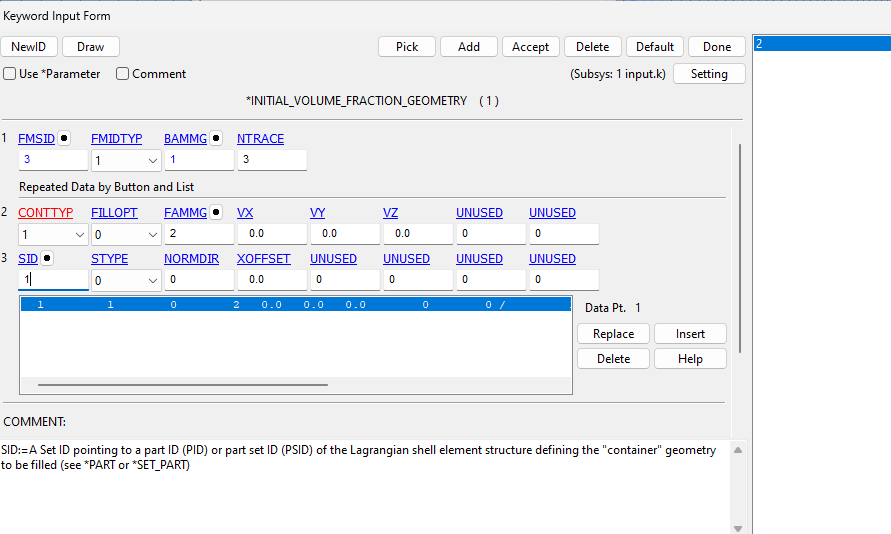
           Flag BAMMG = 2 specified in card *INITIAL_VOLUME_FRACTION_GEOMETRY
           is out of range. It is an ALE AMMG ID and its value should
           be greater than 1 and less than 1.

      I have tried switching the ID of the AMMG around, from 1 to 4, but it would only show up as 2, 22, or something. 
      Does anyone know what is going on? ID being greater than 1 and less than 1 means it cannot be 1, but it is not 1.

      (The following pic is me putting BAMMG on 1, same error message) 


      I am just confused how would you run a axisymmetric ALE simulation in ls dyna in general, 
      I was thinking 
      1) make mesh in workbench since its easier and do all the setup that is avaliable 
      2) import into LS dyna and they all come as shell bodies due to unavaliability of ALE, change them all to ALE2D
      3) use volume fraction geometry to patch them on the ALE background that we made before in workbench (already ALE2d)

      Idk why this doesnt work. 
      The issue of me not making mesh in ls dyna is because the shape I am tyring to run is irregular, and very hard to draw in ls dyna. 
      Do i need to do something with the axis of symmetry? Doesn't it already transfer write together with the workbench written k file? What about boundary? 

    • gl6fp
      Subscriber

      ok guys i figured out, you have to make seprate empty parts that will become material for ale, and patch your original fill parts with vaccum. 

    • Ashish Khemka
      Forum Moderator

      Thanks for sharing this!

      Regards,

      Ashish Khemka

    • arijit.garai
      Subscriber
      I am simulating a blast event in ALE2D involving a mild steel container filled with explosives, surrounded by air and soil domains.
      Model Setup:
      • ALE Parts: Air(1), Explosive(2), and Soil(3) (using SECTION_ALE2D).ALE Model
      • Lagrangian Part: Cylindrical container(4) (using SECTION_SHELL).
      • Symmetry: Half-symmetry model with the container at the centre.
      Issue:
      The simulation terminates with an error : Plane stress elements cannot be mixed with shell elements.

       If anyone can guide.

    • gl6fp
      Subscriber

      I think it means quite literally what it is saying. Are you sure you are patching your ALE parts correctly? How can your ALE be plane stress? 

    • arijit.garai
      Subscriber

      I am working on a 2D axisymmetric explosive blast simulation in LS-DYNA using ALE formulation, and I need guidance on correctly modeling a cylindrical mild steel container holding the explosive.

      My previous model (bare charge) ran successfully, but after introducing the steel container, I am getting errors depending on whether I use shell or solid elements for the container.

      I will describe both the working model and the current modified model below.

      Previously working model (bare explosive charge):

      • Model type: 2D axisymmetric, half symmetry
      • ALE parts: Air, Explosive, Soil
      • Section used: SECTION_ALE2D
      • ALEFORM = 11 (multi-material ALE formulation)
      • ELFORM = 14 (axisymmetric solid, area weighted formulation)

      Materials used:

      • Air: MAT_NULL with EOS_LINEAR_POLYNOMIAL
      • Explosive: MAT_HIGH_EXPLOSIVE_BURN with EOS_JWL
      • Soil: MAT_SOIL_AND_FOAM

      Explosive was initialized using INITIAL_VOLUME_FRACTION_GEOMETRY with CONTTYP = 6 (hypothetical explosive in spherical region).

      Initial detonation was defined using INITIAL_DETONATION with PID = 0, mentioned to be used for highly explosive.

      Hourglass control was applied.

      This model ran successfully without errors.

      Current modified model (explosive inside cylindrical mild steel container):

      Now instead of a hypothetical explosive region, I am modeling explosive inside a cylindrical mild steel container.

      Changes made:

      • Created cylindrical container at origin
      • Container wall thickness = 4 mm in x and y direction
      • Container material: MAT_JOHNSON_COOK with EOS_GRUNEISEN
      • Used CONSTRAINED_LAGRANGE_IN_SOLID for ALE-Lagrangian coupling
      • Used INITIAL_VOLUME_FRACTION_GEOMETRY with CONTTYP = 1
      • Hourglass QM = 0.05 applied for container

      Container modeling attempt 1: Shell elements

      • Used SECTION_SHELL
      • ELFORM = 15
      • Shell thickness = 0.005 m in z ditection.

      Result: Simulation stops with error:
      "Plane stress elements cannot be mixed with other shell elements"

      Container modeling attempt 2: Solid elements

      • Used SECTION_SOLID
      • ELFORM = 1

      Result: Simulation stops with negative volume error.

      My questions:

      • In ALE-2D axisymmetric explosive simulations, should the steel container be modeled using shell elements or solid elements?

      • If shell elements are correct:
      – Which ELFORM should be used?
      – What is the correct way to define thickness in axisymmetric model?

      • If solid elements are correct:
      – Which ELFORM should be used?
      – How can negative volume error be avoided?

      • Is it valid to use shell elements with ALE-2D explosive models?

      • What is the recommended approach to model cylindrical steel container interacting with ALE explosive in axisymmetric formulation?

      My objective is to correctly simulate explosive inside steel container without plane stress mixing error or negative volume error.


Viewing 5 reply threads
  • You must be logged in to reply to this topic.
[bingo_chatbox]