Ansys Assistant will be unavailable on the Learning Forum starting January 30. An upgraded version is coming soon. We apologize for any inconvenience and appreciate your patience. Stay tuned for updates.
Photonics

Photonics

Topics related to Lumerical and more.

Adding new material to lumerical via Python

    • geopsar
      Subscriber

      I'm trying to add a new material to Lumerical using Python but I'm not sure how to do this. The txt file that I have contains a 3D sampled material, so it has the wavelength and the Re and Im permittivities in x, y, z. This is what I tried to do but it doesn't work.

      newmaterial = fdtd.readdata("WS2 Bulk Dielectric Constant.txt")

      mymaterial = fdtd.addmaterial("3D Material data")

        fdtd.setmaterial(mymaterial,"name","WS2 (tungsten disulfide")

        fdtd.setmaterial("WS2 (tungsten disulfide)","Import data",newmaterial)

      Any help would be appreciated.

    • Taylor Robertson
      Ansys Employee


      Could you share the traceback from this? The error message will be helpful for debugging. I suspect that the sampled data matrix may not in the correct form.
      Probably this line.
      mymaterial = fdtd.addmaterial("3D Material data")


      It may be better pass a python dictionary = struct with the values defined in Python rather than reading into Lumerical -> Passing to Python -> and then Passing it back to Lumerical.

      sampledData = [f,eps]; # collect f and eps in one matrix

      # create a material
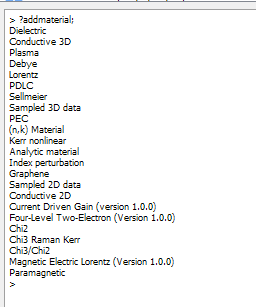
      setmaterial(addmaterial("Sampled 3D data"), "name", "mymaterial");

      setmaterial("mymaterial","sampled data",sampledData); # load the sampled data matrix

      You could try debugging in Lumerical script workspace. If nothing else works I would suggest using fdtd.eval(" ... ") on the lsf code that works.


    • geopsar
      Subscriber
      Thank you for your reply. I've tried to change my code according to your answer and it looks something like this now
      fdtd.addcircle fdtd.set("name","Nanoantenna")
      fdtd.set("x",0.0)
      fdtd.set("y",0.0)
      fdtd.set("z",0.0)
      fdtd.set("radius",R)
      fdtd.set("z span",100e-9)
      data = np.loadtxt('WS2 Bulk Dielectric Constant(1).txt')
      lam = data[:,0]
      repsx = data[:,1]
      iepsx = data[:,2]
      repsy = data[:,3]
      iepsy = data[:,4]
      repsz = data[:,5]
      iepsz = data[:,6]
      epsx = repsx + 1j*iepsx
      epsy = repsy + 1j*iepsy
      epsz = repsz + 1j*iepsz
      eps = epsx + epsy + epsz
      sampledData = [lam,eps]
      fdtd.setmaterial(fdtd.addmaterial("Sampled 3D data"),"name","WS2 (tungsten disulfide)")
      fdtd.setmaterial("WS2 (tungsten disulfide)","Sampled 3D data",sampledData)
      but I still get the following error in Python
      LumApiError: "argument list for setmaterial command is incorrect - setmaterial arguments were converted to ('str, 'str, cell array)"
      which corresponds to this warning on Lumerical
      Warning: prompt line 3: The material type 'sampled 3d data' is now called 'Sampled 3D data'.
      I'm not sure why I'm getting such an error since I am using 'Sampled 3D data.'
    • Kyle
      Ansys Employee

      As indicated by the LumApiError message, your sampledData Python list is being converted to a cell array. However, the Lumerical command requires a matrix, not a cell array. Numpy arrays are converted to Lumerical matrices, so the sampledData list needs to be converted to a Numpy array before it is used in the setmaterial method.
      The Python data types and their Lumerical equivalents are given on this page:
    • Saeid AsgarnezhadZorgabad
      Subscriber

      Sorry but I don't understand what you are saying Kyle.

      Let me show you my code. First I have made a matrix:

      M_data=np.array([f,eps])

      Then I set the name as:

      Mat_Name='Quantum dot'

      Then I have added these lines:

      temp=fdtd.addmaterial('Sampled data')      

      fdtd.setmaterial(temp,'name',Mat_Name)
      fdtd.setmaterial(Mat_Name,'max coefficients',2)
      fdtd.setmaterial(Mat_Name,'sampled data',M_data)

      and I get this error: "the number of columns for the data in 'sampled 3d data' should be either 2 or 4"

      Indeed the shape of M_data is (2,3000) and has 2 columns. So I am not sure what the error is. Can you be more specific and kindly correct my code instead of "explaining"?



    • mustafa
      Subscriber

      On a related note, would anyone know why changing the material color cannot be done from the python API? I'm getting an error for the following command:

      fdtd.setmaterial(matname, "color",[0.5, 0.5, 0.5, 1])

Viewing 5 reply threads
  • The topic ‘Adding new material to lumerical via Python’ is closed to new replies.
[bingo_chatbox]