-
-
May 15, 2019 at 2:41 pm
hhusker
SubscriberHi,
I am conducting an experiment using the impedance tube,and would like to simulate for transmission loss.I am quite new to ansys.I used harmonic response for the transmission loss. My problem is i have to simulate three conditions,where two of them have pre-stressed or moving components while I conduct transmission loss experiment. I was wondering how I can simulate this as combining both systems doesn't seem to work as I cant give the air gap inside as acoustic body. Any help would be much appreciated.
Hhusker
-
May 15, 2019 at 5:27 pm
peteroznewman
SubscriberPlease reply with a sketch or screen snapshot of the components in this system. Identify which are the pre-stressed or moving components. Identify the air gap. Which version of ANSYS are you using? One of the members here jj77, has some background in acoustics and might have a comment.
-
May 16, 2019 at 5:59 pm
hhusker
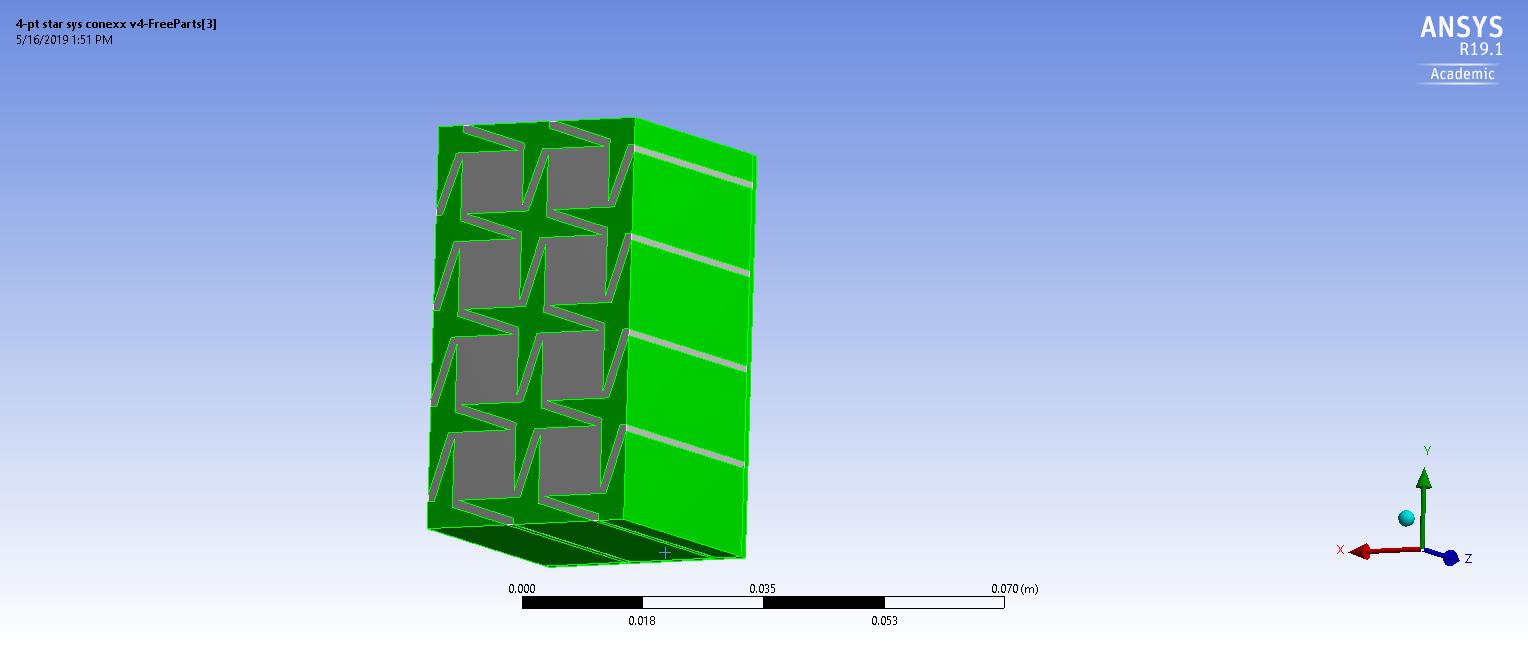
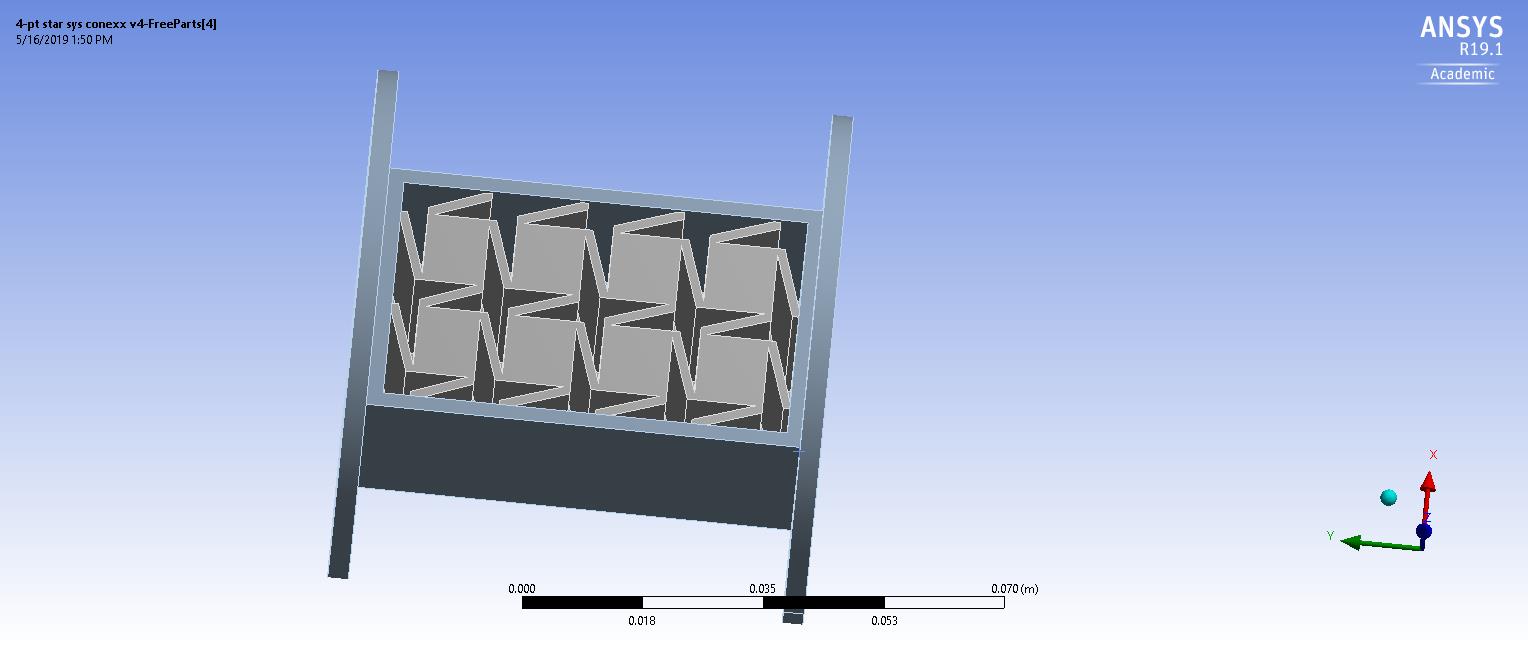
SubscriberI am using Ansys 19.1,I also have the extension. I initially planned to excite the structure by air pressure ,but will soon turn to other means. I wanted to know how I can prestress it and run analysis. I was planning to apply pressure force on the second image just for a general idea. Your Input is much appreciated.
-
May 17, 2019 at 9:36 pm
peteroznewman
SubscriberYou say you want to simulate having these solids and airspace (green) in an impedance tube.
Please annotate a screen image to show the face that receives the input plane wave and I assume the opposite face emits the sound that can be measured to calculate the transmission loss.
Do you have an impedance tube with a circular cross-section? What exactly is in the center of the tube? It's still not clear how you are arranging that rectangular block in the impedance tube.
-
May 18, 2019 at 1:35 am
hhusker
SubscriberYes the tube is circular in cross section,the sample in the screen shot 2 is tested in the tube. I had made two cylinders that corresponds to Interior and exterior ports. I already conducted the harmonic analysis for the sample. But i want to know how to conduct it by pre-stressing the the structure in the second screenshot. I am sorry if I am not being very articulate. Btw I do have doubt on the test i have conducted too.Â
-
May 18, 2019 at 10:32 pm
peteroznewman
SubscriberIf you put the structure shown above  that has two large disks and a small block of material between the two disks into an impedance tube, then the Transmission Loss through that structure will have a significant amount of energy that bypasses the complex body in the center and goes straight through the air from one disk to the other.
This method of holding a material sample in an impedance tube is not valid. The material sample should fill the entire cross-section of the impedance tube. If the sample is naturally square and not easily made to fit in a tube, then a square duct should be used for the impedance tube.
-
May 20, 2019 at 3:06 pm
hhusker
SubscriberThe design is in such a way that it the prototype covers the whole tube. The 'Disks' you referred to are actually flanges that was modeled from the tube itself.there are no air gaps between the tube and the model except the one i showed you. I usually use harmonic response for analysis of impedance tube experiment. I have a 4 microphone setup. I was wondering if there are some material that shows how to do simulations for this experiment.
-
May 21, 2019 at 3:06 am
peteroznewman
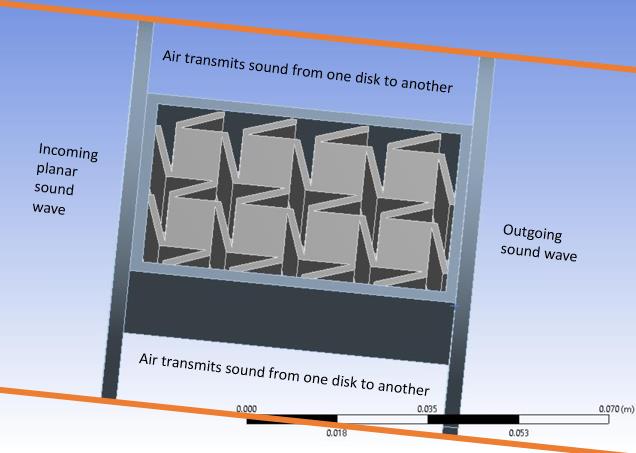
SubscriberIt seems that the complex material covers only a small portion of the cross-sectional area of the impedance tube. I sketched in the impedance tube walls as orange lines and show the air that is outside the complex material but is between the disks, allowing sound energy to go from disk to disk and bypass the complex material that only occupies the center.
-
May 21, 2019 at 5:25 am
hhusker
SubscriberThe complex material covers the whole tube of the impedance the disk is used to just fasted it. The apparatus has an diameter of 35mm and the structure in the middle is as big as that. Hence the sound is normally incident only on the structure. I have done the experimental part,just need clarifications and help in conducting the same in simulation.
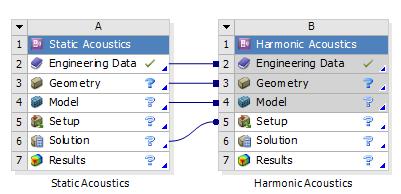
what is the difference in harmonic acoustic and harmonic response using the extension? which one should i use? since I used white noise as the incident source,is the surface velocity or mass source?
Â
Â
-
May 21, 2019 at 10:50 am
peteroznewman
SubscriberSorry, I still don't understand how the geometry you show relates to the impedance tube. You say that the disk is just used to fasten it. Don't put geometry in the model that is not in the cylindrical air column of the impedance tube.
What direction is the incident sound coming from that hits the sample? X, Y or Z? In my figure above, I assumed the impedance tube was along Y, but now I am guessing the Y axis is a cross tube to insert the sample and the impedance tube is along the blue Z axis.
If the impedance tube has a diameter of 35 mm, please show that diameter of material sample for the acoustic model with two 35 mm diameter solids that represents the air in the impedance tube before and after the sample.Â
The point I'm making is the geometry that goes into a simulation is different from the geometry used to make fixtures to hold samples to put in a physical experiment. This is just as important to understand as your other questions.

-
May 21, 2019 at 9:39 pm
hhusker
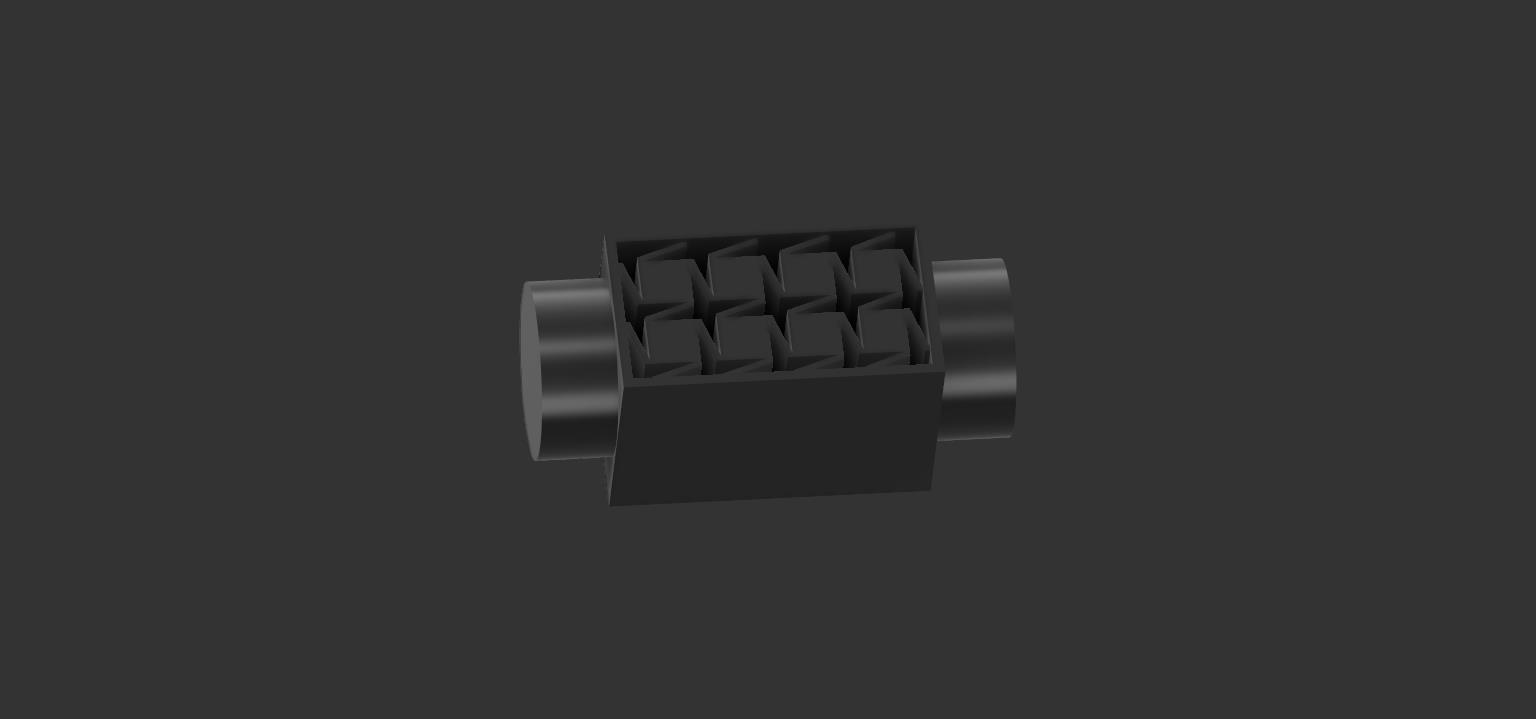
SubscriberOh thank you. I am sorry. You are right in your axis assumption,the sound is incident in the y axis. I haven't shown in the previous images,but I have made two 35 mm cylinders that is assigned as air in the model,which I had given as the inlet and outlet ports respectively. I shall remove the two flanges while I run the simulation. I have attached a figure like you asked without the holder and with the inlet and outlet. I have removed the lid so that you can better understand what I am trying to do.
I would like to know the applictaion of static acoustic module.
Thank you
-
May 21, 2019 at 10:15 pm
peteroznewman
SubscriberOkay, now it looks like you have geometry for an acoustic simulation. I saw above that you had a solid for the air inside the sample too.
Please read the posts about Acoustic Transmission Loss.
I am going on vacation for a few weeks starting tomorrow so I hope you will get some help while I am gone.
Good luck,
Peter -
May 21, 2019 at 11:05 pm
hhusker
SubscriberI have gone through most of this beforehand. My issue is I want to run a simulation for transmission loss,simultaneously while applying pressure to the design i showed initially. How can I go about that?
Hope you have a great vacation and Thank you. Â
-
May 22, 2019 at 1:35 am
-
June 5, 2019 at 4:27 pm
baijns
SubscriberHi peteroznewman,
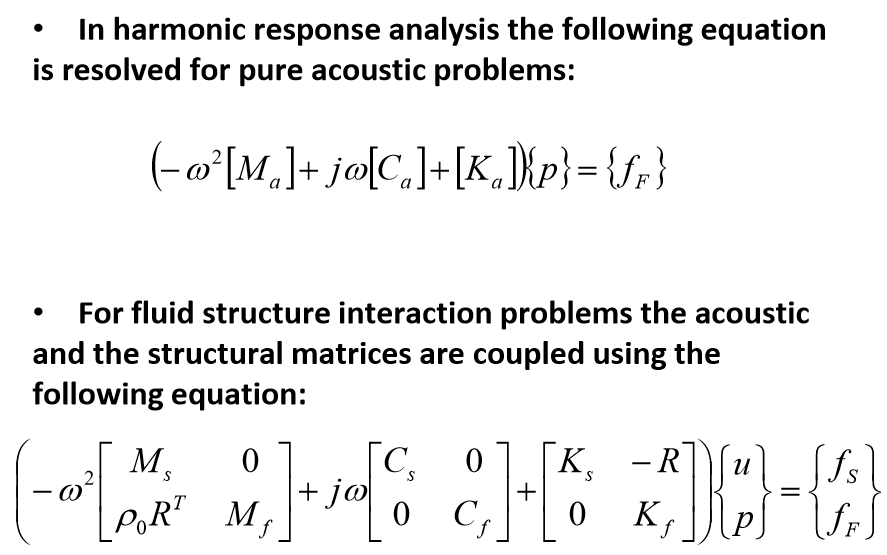
I am using Ansys 19.2 to simulate to sound radiation of vibrating rectangular plates. I have used modal analysis, followed by harmonic response analysis and finally harmonic acoustic analysis. My methodology and results are correct as I have imported the velocity b.c and solved it. The problem is how to validate the results with theory or experiment. What is the mathematical equation that ansys solves in harmonic acoustic analysis. Is it the rayleigh integral or someother equation. Please help.
Â
Thanks & Regards
Â
Baij
-
September 9, 2020 at 4:54 am
zulkarnainzakri
Subscribercan i use modal analysis followed by harmonic response and harmonic acoustic to obtain the sound generated from two moving contact surface (such as a wheel moving on a tile) ???n -
September 9, 2020 at 9:46 am
peteroznewman
Subscribern
nPlease look at this example.n/forum/discussion/4039/problem-in-harmonics-acousticn
-
- The topic ‘Acoustic Analysis’ is closed to new replies.
-
6369
-
1906
-
1457
-
1308
-
1022
© 2026 Copyright ANSYS, Inc. All rights reserved.