-
-
June 3, 2026 at 11:04 am
masaharu.watanabe.4z
SubscriberHello,
I am planning a 3D tensile shear analysis of a single lap joint (direct bonding of aluminum and resin) using PyMAPDL in Ansys Student 25.2. I have already successfully completed the 2D simulation, but I would like to know if this kind of 3D simulation is fundamentally possible within the free Student license in terms of functionality and accuracy.
[Analysis Conditions]
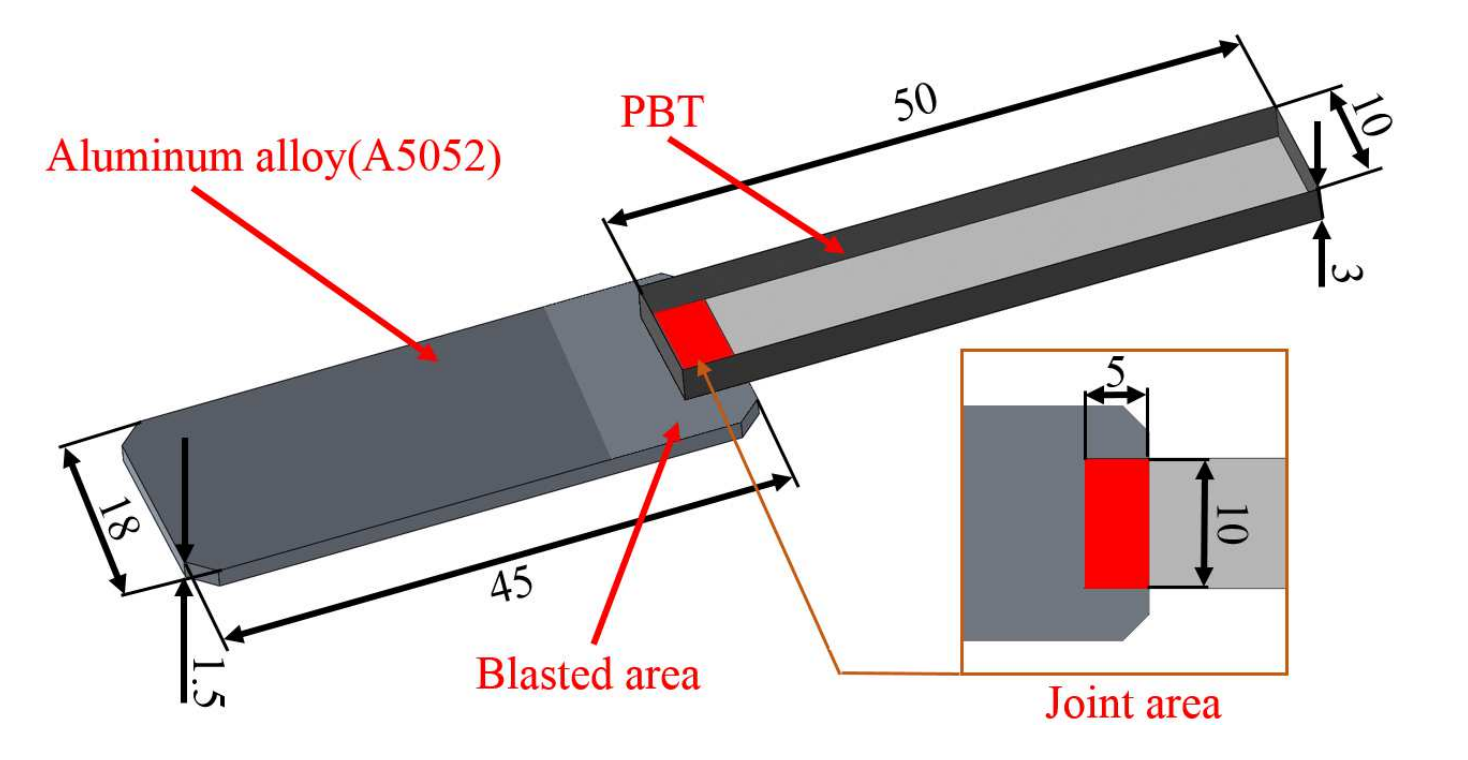
Dimensions: Aluminum (45x18x1.5mm), PBT (50x10x3mm), Joint area (5x10mm) *Please see the attached image.
Bonding Method: Shared Nodes (Mesh Connection) without using CZM (Cohesive Zone Model).
Evaluation Region: Analyzing up to the elastic region is acceptable.
[My Questions]
Is the mesh count (128k) the only restriction? Is 3D analysis fundamentally supported in the free version?
Are there any hidden locks or restrictions on specific analysis algorithms or 3D features in the free student license? As long as the mesh count stays within the 128k node/element limit, will the simulation run successfully just like the commercial version?
If I geometrically model micro-meter (μm) order surface roughness on the joint interface, can the free version solve it accurately?
Since there is a huge scale difference between the overall mm-size dimensions and the μm-size roughness, can the solver in the free version fundamentally handle this with high accuracy and precision?
Feasibility of using a completely smooth surface
If modeling the roughness is too difficult due to the mesh limit, is it realistic and feasible to run the 3D tensile shear analysis by simplifying the joint interface into a completely smooth surface with shared nodes within the Student version's capabilities?
[Summary / Conclusion]
In short, I would like to know if this simulation is fundamentally impossible with the free license, or if it is fully possible as long as it fits within the mesh limit. If it is possible, are there any specific pitfalls, limitations, or points of caution I should be aware of when using the Student version?
I would appreciate any insights on whether the free Student version can handle this simulation.
Thank you!
-
June 3, 2026 at 7:24 pm
peteroznewman
SubscriberHello,
Here are the answers to the questions you asked.
- The node/element count is the only significant limitation of the student license. 3D analysis is absolutely included.
- The Student license can model micro-meter features with accuracy up to the node/element count limit.
- A completely smooth surface won’t help predict the shear strength of the joint because there is no chemical bond, merging nodes is not valid for an insert molded part.
When you say “direct bonding of aluminum and resin” do you mean that there is a mold in the shape of the PBT part and the aluminum plate is inserted into the mold then molten PBT is injected into the mold and flows onto the plate? This is commonly called insert molding.
Insert molding relies on a mechanical grip at the interface rather than a chemical bond so I understand the need to roughen the surface with sand blasting the face to create microstructure for the plastic to flow into. What grit size or material (e.g., aluminum oxide, glass bead) was used for sandblasting?
The strength of the joint will be affected by thermal shrinkage and mold pressure. PBT shrinks as it cools in the mold. Because aluminum expands and contracts at a different rate, internal residual stresses will naturally “peel” or weaken the edges of the 5 mm overlap. Can the overlap length be increased beyond 5 mm? If the injection pressure wasn’t high enough to force the molten PBT completely into the microscopic cavities created by the sandblasting, your true contact area will be lower.
Will this part operate in high-temperature environments? The strength of PBT is a function of temperature. PBT is a semi-crystalline thermoplastic where its tensile strength is about 50–60 MPa at room temperature and higher in the cold. PBT has a glass transition temperature between 40 and 60 C where the tensile strength can drop by 30-50%. At high temperature (100 C) the tensile strength is severly reduced to 15–25 MPa.
-
June 4, 2026 at 5:48 am
masaharu.watanabe.4z
SubscriberHello,
Thank you for your response. It is a relief to know that the only significant limitation of the Ansys Student version is the 128k node/element count, and that the 3D analysis capabilities themselves are identical to the commercial version.
Also, I learned a lot about the physical phenomena involved in insert molding. Thank you very much for your valuable insights.
[Answers to Your Questions]
Molding Method: As you pointed out, it is indeed insert molding.
Grit Size: Alumina abrasive is used (Grain size: 47.5 μm to 181 μm, surface roughness of the joint interface: Ra: 1–3 μm, Rz: 5–15 μm).
Overlap Length: The experimental data is only available for 5 mm. However, if I take an approach to patch and extend the roughness geometry data, it is possible to increase the length beyond 5 mm on the model.
Operating Environment: Room temperature only (will not be used in low or high-temperature environments).
[Additional Concerns and Questions]
1. Mesh Count
Since the mesh count was already around 50,000 to 100,000 in the 2D analysis stage including the roughness, I estimate that the required mesh count will be in the range of millions to tens of millions when modeling the 3D geometry including the surface roughness. Naturally, it seems that the 128k limit of the Student version will be far from enough.
2. License
Does the commercial version have absolutely no limit on the mesh count? (Since my university does not have a contract with Ansys, the Academic version is not available to me.)
3. Modeling Approach
I now understand that there are many factors to consider, such as the peeling/weakening at the edges of the joint and the true contact area inside the interface. If I were to perform the analysis taking these into account (either within the 128k limit or assuming the use of the commercial version in the future), do you have any modeling ideas you could share? For example, would an approach like intentionally creating gaps at the interface to reduce the contact area be appropriate?
I would appreciate any further advice or insights. Thank you!

-
June 4, 2026 at 9:28 am
Rob
Forum ModeratorComment as Ansys (part of Synopsys) staff; I don't know enough to comment on the physics. You may well be able to run smaller models to learn the approach on Student; it's purpose is to allow you to learn remotely from the Campus whilst not replacing Campus hardware & licences. I'll leave Peter with the hard bit of explaining how!
The Research level Academic licence has no cell count limit and can take advantage of parallel licences to run significantly larger models: I'll leave Peter to comment on millions of cells in Mechanical as in CFD a few 100 million cells is fine! You're then hardware limited, ie is your computer big enough. No need to go to full Commercial level software. Note, we can't sell to a student, we must interact at the Department level as there are certain signatures required. Please ask your project supervisor/Prof to make contact via the "contact us" button on ansys.com That should then be passed onto the local team (I'm in the UK and cover fluids technical as opposed to commercial topics).
-
June 5, 2026 at 6:16 am
masaharu.watanabe.4z
SubscriberHello Rob,
Thank you for your reply. I wasn't fully aware of how the licensing works, so this was very helpful.
Following your advice, I will start by creating a small 3D model with Ansys Student to learn the approach. At the same time, I will talk to my project supervisor about this matter.
Also, as you pointed out, even without mesh limits, hardware limitations will certainly be the next issue.
[Question] Recommended hardware specs for large-scale analysis
I estimate that fully modeling the micro-meter surface roughness could increase the mesh count up to millions or tens of millions of elements. If I run this scale of analysis using a university Research license in the future, what hardware specifications (especially RAM capacity and CPU cores) would be recommended to solve it within a realistic timeframe? I would appreciate it if you could provide a rough guideline.
Thank you very much for your kind guidance. I am also looking forward to hearing from Peter.
-
June 5, 2026 at 8:05 am
Rob
Forum ModeratorYou're welcome.
I can't answer that as Mechanical has a different need to CFD, but it's something to discuss along with the licence. Hardware is covered to some extent here https://www.ansys.com/it-solutions/platform-support You'll also get some ideas when you run the test case and can see how much RAM is used.
As a thought, can you model in 2d or a narrow section if you're focussing on the contact effects?
-
- You must be logged in to reply to this topic.
-
6625
-
1906
-
1469
-
1311
-
1022
© 2026 Copyright ANSYS, Inc. All rights reserved.